

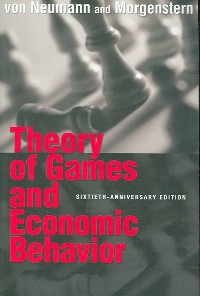
Theory of games and economic behavior / 60th anniversary ed. /
副标题:无
作 者:John von Neumann and Oskar Morgenstern.
分类号:
ISBN:9780691130613
微信扫一扫,移动浏览光盘
简介
Summary:
Publisher Summary 1
This is the classic work upon which modern-day game theory is based. What began more than sixty years ago as a modest proposal that a mathematician and an economist write a short paper together blossomed, in 1944, when Princeton University Press published Theory of Games and Economic Behavior. In it, John von Neumann and Oskar Morgenstern conceived a groundbreaking mathematical theory of economic and social organization, based on a theory of games of strategy. Not only would this revolutionize economics, but the entirely new field of scientific inquiry it yielded--game theory--has since been widely used to analyze a host of real-world phenomena from arms races to optimal policy choices of presidential candidates, from vaccination policy to major league baseball salary negotiations. And it is today established throughout both the social sciences and a wide range of other sciences.This sixtieth anniversary edition includes not only the original text but also an introduction by Harold Kuhn, an afterword by Ariel Rubinstein, and reviews and articles on the book that appeared at the time of its original publication in the New York Times, tthe American Economic Review, and a variety of other publications. Together, these writings provide readers a matchless opportunity to more fully appreciate a work whose influence will yet resound for generations to come.
目录
Table Of Contents:
Introduction vii
Harold W. Kuhn
Theory of Games and Economic Behavior xv
John von Neumann
Oskar Morgenstern
Afterword 633(4)
Ariel Rubinstein
REVIEWS 637(90)
The American Journal of Sociology 637(3)
Herbert A. Simon
Bulletin of the American Mathematical Society 640(6)
Arthur H. Copeland
The American Economic Review 646(18)
Leonid Hurwicz
Economica 664(3)
T. Barna
Psychometrika 667(8)
Walter A. Rosenblith
Heads I Win, and Tails, You Lose 675(3)
Paul Samuelson
Big D 678(2)
Paul Crume
Mathematics of Games and Economics 680(3)
E. Rowland
Theory of Games 683(3)
Claude Chevalley
Mathematical Theory of Poker Is Applied to Business Problems 686(6)
Will Lissner
A Theory of Strategy 692(20)
John McDonald
The Collaboration between Oskar Morgenstern and John von Neumann on the Theory of Games 712(15)
Oskar Morgenstern
Index 727(14)
Credits 741
Preface xxvii
Technical Note xxxi
Acknowledgment xxxii
Formulation of the Economic Problem
The Mathematical Method in Economics 1(7)
Introductory remarks 1(1)
Difficulties of the application of the mathematical method 2(4)
Necessary limitations of the objectives 6(1)
Concluding remarks 7(1)
Qualitative Discussion of the Problem of Rational Behavior 8(7)
The problem of rational behavior 8(1)
``Robinson Crusoe'' economy and social exchange economy 9(3)
The number of variables and the number of participants 12(1)
The case of many participants: Free competition 13(2)
The ``Lausanne'' theory 15(1)
The Notion of Utility 15(16)
Preferences and utilities 15(1)
Principles of measurement: Preliminaries 16(1)
Probability and numerical utilities 17(3)
Principles of measurement: Detailed discussion 20(4)
Conceptual structure of the axiomatic treatment of numerical utilities 24(2)
The axioms and their interpretation 26(2)
General remarks concerning the axioms 28(1)
The role of the concept of marginal utility 29(2)
Structure of the Theory: Solutions and Standards of Behavior 31(15)
The simplest concept of a solution for one participant 31(2)
Extension to all participants 33(1)
The solution as a set of imputations 34(3)
The intransitive notion of ``superiority'' or ``domination'' 37(2)
The precise definition of a solution 39(1)
Interpretation of our definition in terms of ``standards of behavior'' 40(3)
Games and social organizations 43(1)
Concluding remarks 43(3)
General Formal Description of Games of Strategy
Introduction 46(2)
Shift of emphasis from economics to games 46(1)
General principles of classification and of procedure 46(2)
The Simplified Concept of a Game 48(7)
Explanation of the termini technici 48(1)
The elements of the game 49(2)
Information and preliminary 51(1)
Preliminarity, transitivity, and signaling 51(4)
The Complete Concept of a Game 55(5)
Variability of the characteristics of each move 55(2)
The general description 57(3)
Sets and Partitions 60(7)
Desirability of a set-theoretical description of a game 60(1)
Sets, their properties, and their graphical representation 61(2)
Partitions, their properties, and their graphical representation 63(3)
Logistic interpretation of sets and partitions 66(1)
The Set-theoretical Description of a Game 67(6)
The partitions which describe a game 67(4)
Discussion of these partitions and their properties 71(2)
Axiomatic Formulation 73(6)
The axioms and their interpretations 73(3)
Logistic discussion of the axioms 76(1)
General remarks concerning the axioms 76(1)
Graphical representation 77(2)
Strategies and the Final Simplification of the Description of a Game 79(6)
The concept of a strategy and its formalization 79(2)
The final simplification of the description of a game 81(3)
The role of strategies in the simplified form of a game 84(1)
The meaning of the zero-sum restriction 84(1)
Zero-Sum Two-Person Games: Theory
Preliminary Survey 85(3)
General viewpoints 85(1)
The one-person game 85(2)
Chance and probability 87(1)
The next objective 87(1)
Functional Calculus 88(10)
Basic definitions 88(1)
The operations Max and Min 89(2)
Commutativity questions 91(2)
The mixed case. Saddle points 93(2)
Proofs of the main facts 95(3)
Strictly Determined Games 98(14)
Formulation of the problem 98(2)
The minorant and the majorant games 100(1)
Discussion of the auxiliary games 101(4)
Conclusions 105(1)
Analysis of strict determinateness 106(3)
The interchange of players. Symmetry 109(1)
Non strictly determined games 110(1)
Program of a detailed analysis of strict determinateness 111(1)
Games with Perfect Information 112(16)
Statement of purpose. Induction 112(2)
The exact condition (First step) 114(2)
The exact condition (Entire induction) 116(1)
Exact discussion of the inductive step 117(3)
Exact discussion of the inductive step (Continuation) 120(3)
The result in the case of perfect information 123(1)
Application to Chess 124(2)
The alternative, verbal discussion 126(2)
Linearity and Convexity 128(15)
Geometrical background 128(1)
Vector operations 129(5)
The theorem of the supporting hyperplanes 134(4)
The theorem of the alternative for matrices 138(5)
Mixed Strategies. The Solution for All Games 143(26)
Discussion of two elementary examples 143(2)
Generalization of this viewpoint 145(1)
Justification of the procedure as applied to an individual play 146(3)
The minorant and the majorant games. (For mixed strategies) 149(1)
General strict determinateness 150(3)
Proof of the main theorem 153(2)
Comparison of the treatment by pure and by mixed strategies 155(3)
Analysis of general strict determinateness 158(2)
Further characteristics of good strategies 160(2)
Mistakes and their consequences. Permanent optimality 162(3)
The interchange of players. Symmetry 165(4)
Zero-Sum Two-Person Games: Examples
Some Elementary Games 169(17)
The simplest games 169(1)
Detailed quantitative discussion of these games 170(3)
Qualitative characterizations 173(2)
Discussion of some specific games. (Generalized forms of Matching Pennies) 175(3)
Discussion of some slightly more complicated games 178(4)
Chance and imperfect information 182(3)
Interpretation of this result 185(1)
Poker and Bluffing 186(34)
Description of Poker 186(2)
Bluffing 188(1)
Description of Poker (Continued) 189(1)
Exact formulation of the rules 190(1)
Description of the strategy 191(4)
Statement of the problem 195(1)
Passage from the discrete to the continuous problem 196(3)
Mathematical determination of the solution 199(3)
Detailed analysis of the solution 202(2)
Interpretation of the solution 204(3)
More general forms of Poker 207(1)
Discrete hands 208(1)
m possible bids 209(2)
Alternate bidding 211(5)
Mathematical description of all solutions 216(2)
Interpretation of the solutions. Conclusions 218(2)
Zero-Sum Three-Person Games
Preliminary Survey 220(2)
General viewpoints 220(1)
Coalitions 221(1)
The Simple Majority Game of Three Persons 222(3)
Definition of the game 222(1)
Analysis of the game: Necessity of ``understandings'' 223(1)
Analysis of the game: Coalitions. The role of symmetry 224(1)
Further Examples 225(6)
Unsymmetric distributions. Necessity of compensations 225(2)
Coalitions of different strength. Discussion 227(2)
An inequality. Formulae 229(2)
The General Case 231(2)
Detailed discussion. Inessential and essential games 231(1)
Complete formulae 232(1)
Discussion of an Objection 233(5)
The case of perfect information and its significance 233(2)
Detailed discussion. Necessity of compensations between three or more players 235(3)
Formulation of the General Theory: Zero-Sum n-Person Games
The Characteristic Function 238(5)
Motivation and definition 238(2)
Discussion of the concept 240(1)
Fundamental properties 241(1)
Immediate mathematical consequences 242(1)
Construction of a Game with a Given Characteristic Function 243(2)
The construction 243(2)
Summary 245(1)
Strategic Equivalence. Inessential and Essential Games 245(10)
Strategic equivalence. The reduced form 245(3)
Inequalities. The quantity υ 248(1)
Inessentiality and essentiality 249(1)
Various criteria. Non additive utilities 250(2)
The inequalities in the essential case 252(1)
Vector operations on characteristic functions 253(2)
Groups, Symmetry and Fairness 255(5)
Permutations, their groups and their effect on a game 255(3)
Symmetry and fairness 258(2)
Reconsideration of the Zero-Sum Three-Person Game 260(3)
Qualitative discussion 260(2)
Quantitative discussion 262(1)
The Exact Form of the General Definitions 263(9)
The definitions 263(2)
Discussion and recapitulation 265(1)
The concept of saturation 266(5)
Three immediate objectives 271(1)
First Consequences 272(10)
Convexity, flatness, and some criteria for domination 272(5)
The system of all imputations. One element solutions 277(4)
The isomorphism which corresponds to strategic equivalence 281(1)
Determination of All Solutions of the Essential Zero-Sum Three-Person Game 282(6)
Formulation of the mathematical problem. The graphical method 282(3)
Determination of all solutions 285(3)
Conclusions 288(3)
The multiplicity of solutions. Discrimination and its meaning 288(2)
Statics and dynamics 290(1)
Zero-Sum Four-Person Games
Preliminary Survey 291(4)
General viewpoints 291(1)
Formalism of the essential zero sum four person games 291(3)
Permutations of the players 294(1)
Discussion of Some Special Points in the Cube Q 295(9)
The corner I. (and V., VI., VII.) 295(4)
The corner VIII. (and II., III., IV.,). The three person game and a ``Dummy'' 299(3)
Some remarks concerning the interior of Q 302(2)
Discussion of the Main Diagonals 304(9)
The part adjacent to the corner VIII.: Heuristic discussion 304(3)
The part adjacent to the corner VIII.: Exact discussion 307(5)
Other parts of the main diagonals 312(1)
The Center and Its Environs 313(8)
First orientation about the conditions around the center 313(2)
The two alternatives and the role of symmetry 315(1)
The first alternative at the center 316(1)
The second alternative at the center 317(1)
Comparison of the two central solutions 318(1)
Unsymmetrical central solutions 319(2)
A Family of Solutions for a Neighborhood of the Center 321(9)
Transformation of the solution belonging to the first alternative at the center 321(1)
Exact discussion 322(5)
Interpretation of the solutions 327(3)
Some Remarks Concerning n ≥ 5 Participants
The Number of Parameters in Various Classes of Games 330(2)
The situation for n = 3, 4 330(1)
The situation for all n ≥ 3 330(2)
The Symmetric Five Person Game 332(7)
Formalism of the symmetric five person game 332(1)
The two extreme cases 332(2)
Connection between the symmetric five person game and the 1, 2, 3- symmetric four person game 334(5)
Composition and Decomposition of Games
Composition and Decomposition 339(6)
Search for n-person games for which all solutions can be determined 339(1)
The first type. Composition and decomposition 340(1)
Exact definitions 341(2)
Analysis of decomposability 343(2)
Desirability of a modification 345(1)
Modification of the Theory 345(8)
No complete abandonment of the zero sum restriction 345(1)
Strategic equivalence. Constant sum games 346(2)
The characteristic function in the new theory 348(2)
Imputations, domination, solutions in the new theory 350(1)
Essentiality, inessentiality and decomposability in the new theory 351(2)
The Decomposition Partition 353(5)
Splitting sets. Constituents 353(1)
Properties of the system of all splitting sets 353(1)
Characterization of the system of all splitting sets. The decomposition partition 354(3)
Properties of the decomposition partition 357(1)
Decomposable Games. Further Extension of the Theory 358(10)
Solutions of a (decomposable) game and solutions of its constituents 358(1)
Composition and decomposition of imputations and of sets of imputations 359(2)
Composition and decomposition of solutions. The main possibilities and surmises 361(2)
Extension of the theory. Outside sources 363(1)
The excess 364(2)
Limitations of the excess. The non-isolated character of a game in the new setup 366(1)
Discussion of the new setup. E(e0), F(e0) 367(1)
Limitations of the Excess. Structure of the Extended Theory 368(13)
The lower limit of the excess 368(1)
The upper limit of the excess. Detached and fully detached imputations 369(3)
Discussion of the two limits, |Γ|1. |Γ|2. Their ratio 372(3)
Detached imputations and various solutions. The theorem connecting E(e0), F(e0) 375(1)
Proof of the theorem 376(4)
Summary and conclusions 380(1)
Determination of All Solutions of a Decomposable Game 381(22)
Elementary properties of decompositions 381(3)
Decomposition and its relation to the solutions: First results concerning F(e0) 384(2)
Continuation 386(2)
Continuation 388(2)
The complete result in F(e0) 390(3)
The complete result in E(e0) 393(1)
Graphical representation of a part of the result 394(2)
Interpretation: The normal zone. Heredity of various properties 396(1)
Dummies 397(1)
Imbedding of a game 398(3)
Significance of the normal zone 401(1)
First occurrence of the phenomenon of transfer: n = 6 402(1)
The Essential Three-Person Game in the New Theory 403(17)
Need for this discussion 403(1)
Preparatory considerations 403(3)
The six cases of the discussion. Cases (I)--(III) 406(1)
Case (IV): First part 407(2)
Case (IV): Second part 409(4)
Case (V) 413(2)
Case (VI) 415(1)
Interpretation of the result: The curves (one dimensional parts) in the solution 416(2)
Continuation: The areas (two dimensional parts) in the solution 418(2)
Simple Games
Winning and Losing Coalitions and Games Where They Occur 420(3)
The second type of 41.1. Decision by coalitions 420(1)
Winning and Losing Coalitions 421(2)
Characterization of the Simple Games 423(8)
General concepts of winning and losing coalitions 423(2)
The special role of one element sets 425(1)
Characterization of the systems W, L of actual games 426(2)
Exact definition of simplicity 428(1)
Some elementary properties of simplicity 428(1)
Simple games and their W, L. The Minimal winning coalitions: Wm 429(1)
The solutions of simple games 430(1)
The Majority Games and the Main Solution 431(14)
Examples of simple games: The majority games 431(2)
Homogeneity 433(2)
A more direct use of the concept of imputation in forming solutions 435(1)
Discussion of this direct approach 436(2)
Connections with the general theory. Exact formulation 438(2)
Reformulation of the result 440(2)
Interpretation of the result 442(1)
Connection with the Homogeneous Majority game 443(2)
Methods for the Enumeration of All Simple Games 445(12)
Preliminary Remarks 445(1)
The saturation method: Enumeration by means of W 446(2)
Reasons for passing from W to Wm. Difficulties of using Wm 448(2)
Changed Approach: Enumeration by means of Wm 450(2)
Simplicity and decomposition 452(2)
Inessentiality, Simplicity and Composition. Treatment of the excess 454(1)
A criterium of decomposability in terms of Wm 455(2)
The Simple Games for Small n 457(6)
Program. n = 1, 2 play no role. Disposal of n = 3 457(1)
Procedure for n ≥ 4: The two element sets and their role in classifying the Wm 458(1)
Decomposability of cases C*, Cn_2, Cn_1 459(2)
The simple games other than [1, . . . , 1, n
2]h (with dummies): The Cases Ck, k = 0, 1, . . . , n
3 461(1)
Disposal of n = 4, 5 462(1)
The New Possibilities of Simple Games for n ≥ 6 463(7)
The Regularities observed for n ≥ 6 463(1)
The six main counter examples (for n = 6, 7) 464(6)
Determination of All Solutions in Suitable Games 470(3)
Reasons to consider other solutions than the main solution in simple games 470(1)
Enumeration of those games for which all solutions are known 471(1)
Reasons to consider the simple game [1, . . . , 1, n
2]h 472(1)
The Simple Game [1, . . . , 1, n
2]h 473(31)
Preliminary Remarks 473(1)
Domination. The chief player. Cases (I) and (II) 473(2)
Disposal of Case (I) 475(3)
Case (II): Determination of V 478(3)
Case (II): Determination of V 481(3)
Case (II): a and S* 484(1)
Case (II') and (II``). Disposal of Case (II') 485(2)
Case (II''): a and V'. Domination 487(1)
Case (II``): Determination of V' 488(6)
Disposal of Case (II'') 494(3)
Reformulation of the complete result 497(2)
Interpretation of the result 499(5)
General Non-Zero-Sum Games
Extension of the Theory 504(23)
Formulation of the problem 504(1)
The fictitious player. The zero sum extension Γ 505(1)
Questions concerning the character of Γ 506(2)
Limitations of the use of Γ 508(2)
The two possible procedures 510(1)
The discriminatory solutions 511(1)
Alternative possibilities 512(2)
The new setup 514(2)
Reconsideration of the case when Γ is a zero sum game 516(4)
Analysis of the concept of domination 520(3)
Rigorous discussion 523(3)
The new definition of a solution 526(1)
The Characteristic Function and Related Topics 527(11)
The characteristic function: The extended and the restricted form 527(1)
Fundamental properties 528(2)
Determination of all characteristic functions 530(3)
Removable sets of players 533(2)
Strategic equivalence. Zero-sum and constant-sum games 535(3)
Interpretation of the Characteristic Function 538(4)
Analysis of the definition 538(1)
The desire to make a gain vs. that to inflict a loss 539(2)
Discussion 541(1)
General Considerations 542(6)
Discussion of the program 542(1)
The reduced forms. The inequalities 543(3)
Various topics 546(2)
The Solutions of All General Games with n ≤ 3 548(7)
The case n = 1 548(1)
The case n = 2 549(1)
The case n = 3 550(4)
Comparison with the zero sum games 554(1)
Economic Interpretation of the Results for n = 1, 2 555(9)
The case n = 1 555(1)
The case n = 2. The two person market 555(2)
Discussion of the two person market and its characteristic function 557(2)
Justification of the standpoint of 58 559(1)
Divisible goods. The ``marginal pairs'' 560(2)
The price. Discussion 562(2)
Economic Interpretation of the Results for n = 3: Special Case 564(9)
The case n = 3, special case. The three person market 564(2)
Preliminary discussion 566(1)
The solutions: First subcase 566(3)
The solutions: General form 569(1)
Algebraical form of the result 570(1)
Discussion 571(2)
Economic Interpretation of the Results for n = 3: General Case 573(10)
Divisible goods 573(2)
Analysis of the inequalities 575(2)
Preliminary discussion 577(1)
The solutions 577(3)
Algebraical form of the result 580(1)
Discussion 581(2)
The General Market 583(4)
Formulation of the problem 583(1)
Some special properties. Monopoly and monopsony 584(3)
Extension of the Concepts of Domination and Solution
The Extension. Special Cases 587(16)
Formulation of the problem 587(1)
General remarks 588(1)
Orderings, transitivity, acyclicity 589(2)
The solutions: For a symmetric relation. For a complete ordering 591(1)
The solutions: For a partial ordering 592(2)
Acyclicity and strict acyclicity 594(3)
The solutions: For an acyclic relation 597(3)
Uniqueness of solutions, acyclicity and strict acyclicity 600(2)
Application to games: Discreteness and continuity 602(1)
Generalization of the Concept of Utility 603(5)
The generalization. The two phases of the theoretical treatment 603(1)
Discussion of the first phase 604(2)
Discussion of the second phase 606(1)
Desirability of unifying the two phases 607(1)
Discussion of an Example 608(9)
Description of the example 608(3)
The solution and its interpretation 611(3)
Generalization: Different discrete utility scales 614(2)
Conclusions concerning bargaining 616(1)
Appendix: The Axiomatic Treatment of Utility 617
Introduction vii
Harold W. Kuhn
Theory of Games and Economic Behavior xv
John von Neumann
Oskar Morgenstern
Afterword 633(4)
Ariel Rubinstein
REVIEWS 637(90)
The American Journal of Sociology 637(3)
Herbert A. Simon
Bulletin of the American Mathematical Society 640(6)
Arthur H. Copeland
The American Economic Review 646(18)
Leonid Hurwicz
Economica 664(3)
T. Barna
Psychometrika 667(8)
Walter A. Rosenblith
Heads I Win, and Tails, You Lose 675(3)
Paul Samuelson
Big D 678(2)
Paul Crume
Mathematics of Games and Economics 680(3)
E. Rowland
Theory of Games 683(3)
Claude Chevalley
Mathematical Theory of Poker Is Applied to Business Problems 686(6)
Will Lissner
A Theory of Strategy 692(20)
John McDonald
The Collaboration between Oskar Morgenstern and John von Neumann on the Theory of Games 712(15)
Oskar Morgenstern
Index 727(14)
Credits 741
Preface xxvii
Technical Note xxxi
Acknowledgment xxxii
Formulation of the Economic Problem
The Mathematical Method in Economics 1(7)
Introductory remarks 1(1)
Difficulties of the application of the mathematical method 2(4)
Necessary limitations of the objectives 6(1)
Concluding remarks 7(1)
Qualitative Discussion of the Problem of Rational Behavior 8(7)
The problem of rational behavior 8(1)
``Robinson Crusoe'' economy and social exchange economy 9(3)
The number of variables and the number of participants 12(1)
The case of many participants: Free competition 13(2)
The ``Lausanne'' theory 15(1)
The Notion of Utility 15(16)
Preferences and utilities 15(1)
Principles of measurement: Preliminaries 16(1)
Probability and numerical utilities 17(3)
Principles of measurement: Detailed discussion 20(4)
Conceptual structure of the axiomatic treatment of numerical utilities 24(2)
The axioms and their interpretation 26(2)
General remarks concerning the axioms 28(1)
The role of the concept of marginal utility 29(2)
Structure of the Theory: Solutions and Standards of Behavior 31(15)
The simplest concept of a solution for one participant 31(2)
Extension to all participants 33(1)
The solution as a set of imputations 34(3)
The intransitive notion of ``superiority'' or ``domination'' 37(2)
The precise definition of a solution 39(1)
Interpretation of our definition in terms of ``standards of behavior'' 40(3)
Games and social organizations 43(1)
Concluding remarks 43(3)
General Formal Description of Games of Strategy
Introduction 46(2)
Shift of emphasis from economics to games 46(1)
General principles of classification and of procedure 46(2)
The Simplified Concept of a Game 48(7)
Explanation of the termini technici 48(1)
The elements of the game 49(2)
Information and preliminary 51(1)
Preliminarity, transitivity, and signaling 51(4)
The Complete Concept of a Game 55(5)
Variability of the characteristics of each move 55(2)
The general description 57(3)
Sets and Partitions 60(7)
Desirability of a set-theoretical description of a game 60(1)
Sets, their properties, and their graphical representation 61(2)
Partitions, their properties, and their graphical representation 63(3)
Logistic interpretation of sets and partitions 66(1)
The Set-theoretical Description of a Game 67(6)
The partitions which describe a game 67(4)
Discussion of these partitions and their properties 71(2)
Axiomatic Formulation 73(6)
The axioms and their interpretations 73(3)
Logistic discussion of the axioms 76(1)
General remarks concerning the axioms 76(1)
Graphical representation 77(2)
Strategies and the Final Simplification of the Description of a Game 79(6)
The concept of a strategy and its formalization 79(2)
The final simplification of the description of a game 81(3)
The role of strategies in the simplified form of a game 84(1)
The meaning of the zero-sum restriction 84(1)
Zero-Sum Two-Person Games: Theory
Preliminary Survey 85(3)
General viewpoints 85(1)
The one-person game 85(2)
Chance and probability 87(1)
The next objective 87(1)
Functional Calculus 88(10)
Basic definitions 88(1)
The operations Max and Min 89(2)
Commutativity questions 91(2)
The mixed case. Saddle points 93(2)
Proofs of the main facts 95(3)
Strictly Determined Games 98(14)
Formulation of the problem 98(2)
The minorant and the majorant games 100(1)
Discussion of the auxiliary games 101(4)
Conclusions 105(1)
Analysis of strict determinateness 106(3)
The interchange of players. Symmetry 109(1)
Non strictly determined games 110(1)
Program of a detailed analysis of strict determinateness 111(1)
Games with Perfect Information 112(16)
Statement of purpose. Induction 112(2)
The exact condition (First step) 114(2)
The exact condition (Entire induction) 116(1)
Exact discussion of the inductive step 117(3)
Exact discussion of the inductive step (Continuation) 120(3)
The result in the case of perfect information 123(1)
Application to Chess 124(2)
The alternative, verbal discussion 126(2)
Linearity and Convexity 128(15)
Geometrical background 128(1)
Vector operations 129(5)
The theorem of the supporting hyperplanes 134(4)
The theorem of the alternative for matrices 138(5)
Mixed Strategies. The Solution for All Games 143(26)
Discussion of two elementary examples 143(2)
Generalization of this viewpoint 145(1)
Justification of the procedure as applied to an individual play 146(3)
The minorant and the majorant games. (For mixed strategies) 149(1)
General strict determinateness 150(3)
Proof of the main theorem 153(2)
Comparison of the treatment by pure and by mixed strategies 155(3)
Analysis of general strict determinateness 158(2)
Further characteristics of good strategies 160(2)
Mistakes and their consequences. Permanent optimality 162(3)
The interchange of players. Symmetry 165(4)
Zero-Sum Two-Person Games: Examples
Some Elementary Games 169(17)
The simplest games 169(1)
Detailed quantitative discussion of these games 170(3)
Qualitative characterizations 173(2)
Discussion of some specific games. (Generalized forms of Matching Pennies) 175(3)
Discussion of some slightly more complicated games 178(4)
Chance and imperfect information 182(3)
Interpretation of this result 185(1)
Poker and Bluffing 186(34)
Description of Poker 186(2)
Bluffing 188(1)
Description of Poker (Continued) 189(1)
Exact formulation of the rules 190(1)
Description of the strategy 191(4)
Statement of the problem 195(1)
Passage from the discrete to the continuous problem 196(3)
Mathematical determination of the solution 199(3)
Detailed analysis of the solution 202(2)
Interpretation of the solution 204(3)
More general forms of Poker 207(1)
Discrete hands 208(1)
m possible bids 209(2)
Alternate bidding 211(5)
Mathematical description of all solutions 216(2)
Interpretation of the solutions. Conclusions 218(2)
Zero-Sum Three-Person Games
Preliminary Survey 220(2)
General viewpoints 220(1)
Coalitions 221(1)
The Simple Majority Game of Three Persons 222(3)
Definition of the game 222(1)
Analysis of the game: Necessity of ``understandings'' 223(1)
Analysis of the game: Coalitions. The role of symmetry 224(1)
Further Examples 225(6)
Unsymmetric distributions. Necessity of compensations 225(2)
Coalitions of different strength. Discussion 227(2)
An inequality. Formulae 229(2)
The General Case 231(2)
Detailed discussion. Inessential and essential games 231(1)
Complete formulae 232(1)
Discussion of an Objection 233(5)
The case of perfect information and its significance 233(2)
Detailed discussion. Necessity of compensations between three or more players 235(3)
Formulation of the General Theory: Zero-Sum n-Person Games
The Characteristic Function 238(5)
Motivation and definition 238(2)
Discussion of the concept 240(1)
Fundamental properties 241(1)
Immediate mathematical consequences 242(1)
Construction of a Game with a Given Characteristic Function 243(2)
The construction 243(2)
Summary 245(1)
Strategic Equivalence. Inessential and Essential Games 245(10)
Strategic equivalence. The reduced form 245(3)
Inequalities. The quantity υ 248(1)
Inessentiality and essentiality 249(1)
Various criteria. Non additive utilities 250(2)
The inequalities in the essential case 252(1)
Vector operations on characteristic functions 253(2)
Groups, Symmetry and Fairness 255(5)
Permutations, their groups and their effect on a game 255(3)
Symmetry and fairness 258(2)
Reconsideration of the Zero-Sum Three-Person Game 260(3)
Qualitative discussion 260(2)
Quantitative discussion 262(1)
The Exact Form of the General Definitions 263(9)
The definitions 263(2)
Discussion and recapitulation 265(1)
The concept of saturation 266(5)
Three immediate objectives 271(1)
First Consequences 272(10)
Convexity, flatness, and some criteria for domination 272(5)
The system of all imputations. One element solutions 277(4)
The isomorphism which corresponds to strategic equivalence 281(1)
Determination of All Solutions of the Essential Zero-Sum Three-Person Game 282(6)
Formulation of the mathematical problem. The graphical method 282(3)
Determination of all solutions 285(3)
Conclusions 288(3)
The multiplicity of solutions. Discrimination and its meaning 288(2)
Statics and dynamics 290(1)
Zero-Sum Four-Person Games
Preliminary Survey 291(4)
General viewpoints 291(1)
Formalism of the essential zero sum four person games 291(3)
Permutations of the players 294(1)
Discussion of Some Special Points in the Cube Q 295(9)
The corner I. (and V., VI., VII.) 295(4)
The corner VIII. (and II., III., IV.,). The three person game and a ``Dummy'' 299(3)
Some remarks concerning the interior of Q 302(2)
Discussion of the Main Diagonals 304(9)
The part adjacent to the corner VIII.: Heuristic discussion 304(3)
The part adjacent to the corner VIII.: Exact discussion 307(5)
Other parts of the main diagonals 312(1)
The Center and Its Environs 313(8)
First orientation about the conditions around the center 313(2)
The two alternatives and the role of symmetry 315(1)
The first alternative at the center 316(1)
The second alternative at the center 317(1)
Comparison of the two central solutions 318(1)
Unsymmetrical central solutions 319(2)
A Family of Solutions for a Neighborhood of the Center 321(9)
Transformation of the solution belonging to the first alternative at the center 321(1)
Exact discussion 322(5)
Interpretation of the solutions 327(3)
Some Remarks Concerning n ≥ 5 Participants
The Number of Parameters in Various Classes of Games 330(2)
The situation for n = 3, 4 330(1)
The situation for all n ≥ 3 330(2)
The Symmetric Five Person Game 332(7)
Formalism of the symmetric five person game 332(1)
The two extreme cases 332(2)
Connection between the symmetric five person game and the 1, 2, 3- symmetric four person game 334(5)
Composition and Decomposition of Games
Composition and Decomposition 339(6)
Search for n-person games for which all solutions can be determined 339(1)
The first type. Composition and decomposition 340(1)
Exact definitions 341(2)
Analysis of decomposability 343(2)
Desirability of a modification 345(1)
Modification of the Theory 345(8)
No complete abandonment of the zero sum restriction 345(1)
Strategic equivalence. Constant sum games 346(2)
The characteristic function in the new theory 348(2)
Imputations, domination, solutions in the new theory 350(1)
Essentiality, inessentiality and decomposability in the new theory 351(2)
The Decomposition Partition 353(5)
Splitting sets. Constituents 353(1)
Properties of the system of all splitting sets 353(1)
Characterization of the system of all splitting sets. The decomposition partition 354(3)
Properties of the decomposition partition 357(1)
Decomposable Games. Further Extension of the Theory 358(10)
Solutions of a (decomposable) game and solutions of its constituents 358(1)
Composition and decomposition of imputations and of sets of imputations 359(2)
Composition and decomposition of solutions. The main possibilities and surmises 361(2)
Extension of the theory. Outside sources 363(1)
The excess 364(2)
Limitations of the excess. The non-isolated character of a game in the new setup 366(1)
Discussion of the new setup. E(e0), F(e0) 367(1)
Limitations of the Excess. Structure of the Extended Theory 368(13)
The lower limit of the excess 368(1)
The upper limit of the excess. Detached and fully detached imputations 369(3)
Discussion of the two limits, |Γ|1. |Γ|2. Their ratio 372(3)
Detached imputations and various solutions. The theorem connecting E(e0), F(e0) 375(1)
Proof of the theorem 376(4)
Summary and conclusions 380(1)
Determination of All Solutions of a Decomposable Game 381(22)
Elementary properties of decompositions 381(3)
Decomposition and its relation to the solutions: First results concerning F(e0) 384(2)
Continuation 386(2)
Continuation 388(2)
The complete result in F(e0) 390(3)
The complete result in E(e0) 393(1)
Graphical representation of a part of the result 394(2)
Interpretation: The normal zone. Heredity of various properties 396(1)
Dummies 397(1)
Imbedding of a game 398(3)
Significance of the normal zone 401(1)
First occurrence of the phenomenon of transfer: n = 6 402(1)
The Essential Three-Person Game in the New Theory 403(17)
Need for this discussion 403(1)
Preparatory considerations 403(3)
The six cases of the discussion. Cases (I)--(III) 406(1)
Case (IV): First part 407(2)
Case (IV): Second part 409(4)
Case (V) 413(2)
Case (VI) 415(1)
Interpretation of the result: The curves (one dimensional parts) in the solution 416(2)
Continuation: The areas (two dimensional parts) in the solution 418(2)
Simple Games
Winning and Losing Coalitions and Games Where They Occur 420(3)
The second type of 41.1. Decision by coalitions 420(1)
Winning and Losing Coalitions 421(2)
Characterization of the Simple Games 423(8)
General concepts of winning and losing coalitions 423(2)
The special role of one element sets 425(1)
Characterization of the systems W, L of actual games 426(2)
Exact definition of simplicity 428(1)
Some elementary properties of simplicity 428(1)
Simple games and their W, L. The Minimal winning coalitions: Wm 429(1)
The solutions of simple games 430(1)
The Majority Games and the Main Solution 431(14)
Examples of simple games: The majority games 431(2)
Homogeneity 433(2)
A more direct use of the concept of imputation in forming solutions 435(1)
Discussion of this direct approach 436(2)
Connections with the general theory. Exact formulation 438(2)
Reformulation of the result 440(2)
Interpretation of the result 442(1)
Connection with the Homogeneous Majority game 443(2)
Methods for the Enumeration of All Simple Games 445(12)
Preliminary Remarks 445(1)
The saturation method: Enumeration by means of W 446(2)
Reasons for passing from W to Wm. Difficulties of using Wm 448(2)
Changed Approach: Enumeration by means of Wm 450(2)
Simplicity and decomposition 452(2)
Inessentiality, Simplicity and Composition. Treatment of the excess 454(1)
A criterium of decomposability in terms of Wm 455(2)
The Simple Games for Small n 457(6)
Program. n = 1, 2 play no role. Disposal of n = 3 457(1)
Procedure for n ≥ 4: The two element sets and their role in classifying the Wm 458(1)
Decomposability of cases C*, Cn_2, Cn_1 459(2)
The simple games other than [1, . . . , 1, n
2]h (with dummies): The Cases Ck, k = 0, 1, . . . , n
3 461(1)
Disposal of n = 4, 5 462(1)
The New Possibilities of Simple Games for n ≥ 6 463(7)
The Regularities observed for n ≥ 6 463(1)
The six main counter examples (for n = 6, 7) 464(6)
Determination of All Solutions in Suitable Games 470(3)
Reasons to consider other solutions than the main solution in simple games 470(1)
Enumeration of those games for which all solutions are known 471(1)
Reasons to consider the simple game [1, . . . , 1, n
2]h 472(1)
The Simple Game [1, . . . , 1, n
2]h 473(31)
Preliminary Remarks 473(1)
Domination. The chief player. Cases (I) and (II) 473(2)
Disposal of Case (I) 475(3)
Case (II): Determination of V 478(3)
Case (II): Determination of V 481(3)
Case (II): a and S* 484(1)
Case (II') and (II``). Disposal of Case (II') 485(2)
Case (II''): a and V'. Domination 487(1)
Case (II``): Determination of V' 488(6)
Disposal of Case (II'') 494(3)
Reformulation of the complete result 497(2)
Interpretation of the result 499(5)
General Non-Zero-Sum Games
Extension of the Theory 504(23)
Formulation of the problem 504(1)
The fictitious player. The zero sum extension Γ 505(1)
Questions concerning the character of Γ 506(2)
Limitations of the use of Γ 508(2)
The two possible procedures 510(1)
The discriminatory solutions 511(1)
Alternative possibilities 512(2)
The new setup 514(2)
Reconsideration of the case when Γ is a zero sum game 516(4)
Analysis of the concept of domination 520(3)
Rigorous discussion 523(3)
The new definition of a solution 526(1)
The Characteristic Function and Related Topics 527(11)
The characteristic function: The extended and the restricted form 527(1)
Fundamental properties 528(2)
Determination of all characteristic functions 530(3)
Removable sets of players 533(2)
Strategic equivalence. Zero-sum and constant-sum games 535(3)
Interpretation of the Characteristic Function 538(4)
Analysis of the definition 538(1)
The desire to make a gain vs. that to inflict a loss 539(2)
Discussion 541(1)
General Considerations 542(6)
Discussion of the program 542(1)
The reduced forms. The inequalities 543(3)
Various topics 546(2)
The Solutions of All General Games with n ≤ 3 548(7)
The case n = 1 548(1)
The case n = 2 549(1)
The case n = 3 550(4)
Comparison with the zero sum games 554(1)
Economic Interpretation of the Results for n = 1, 2 555(9)
The case n = 1 555(1)
The case n = 2. The two person market 555(2)
Discussion of the two person market and its characteristic function 557(2)
Justification of the standpoint of 58 559(1)
Divisible goods. The ``marginal pairs'' 560(2)
The price. Discussion 562(2)
Economic Interpretation of the Results for n = 3: Special Case 564(9)
The case n = 3, special case. The three person market 564(2)
Preliminary discussion 566(1)
The solutions: First subcase 566(3)
The solutions: General form 569(1)
Algebraical form of the result 570(1)
Discussion 571(2)
Economic Interpretation of the Results for n = 3: General Case 573(10)
Divisible goods 573(2)
Analysis of the inequalities 575(2)
Preliminary discussion 577(1)
The solutions 577(3)
Algebraical form of the result 580(1)
Discussion 581(2)
The General Market 583(4)
Formulation of the problem 583(1)
Some special properties. Monopoly and monopsony 584(3)
Extension of the Concepts of Domination and Solution
The Extension. Special Cases 587(16)
Formulation of the problem 587(1)
General remarks 588(1)
Orderings, transitivity, acyclicity 589(2)
The solutions: For a symmetric relation. For a complete ordering 591(1)
The solutions: For a partial ordering 592(2)
Acyclicity and strict acyclicity 594(3)
The solutions: For an acyclic relation 597(3)
Uniqueness of solutions, acyclicity and strict acyclicity 600(2)
Application to games: Discreteness and continuity 602(1)
Generalization of the Concept of Utility 603(5)
The generalization. The two phases of the theoretical treatment 603(1)
Discussion of the first phase 604(2)
Discussion of the second phase 606(1)
Desirability of unifying the two phases 607(1)
Discussion of an Example 608(9)
Description of the example 608(3)
The solution and its interpretation 611(3)
Generalization: Different discrete utility scales 614(2)
Conclusions concerning bargaining 616(1)
Appendix: The Axiomatic Treatment of Utility 617
Theory of games and economic behavior / 60th anniversary ed. /
- 名称
- 类型
- 大小
光盘服务联系方式: 020-38250260 客服QQ:4006604884
云图客服:
用户发送的提问,这种方式就需要有位在线客服来回答用户的问题,这种 就属于对话式的,问题是这种提问是否需要用户登录才能提问
Video Player
×
Audio Player
×
pdf Player
×
