

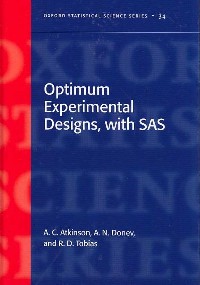
Optimum experimental designs, with SAS /
副标题:无
作 者:A. C. Atkinson, A. N. Donev, R. D. Tobias.
分类号:
ISBN:9780199296590
微信扫一扫,移动浏览光盘
简介
Experiments in the field and in the laboratory cannot avoid random error,and statistical methods are essential for their efficient design and analysis.This book focuses on the use of SAS, a powerful software package that provides acomplete set of statistical tools including analysis of variance, regression,categorical data analysis, and multivariate analysis. Many examples of SAS code,results, plots and tables are provided, along with a fully supported website.The text contains numerous figures, and end of chapter notes on further reading.Exercises consolidating the material covered are given in the final chapter.Authored by leading experts, this book is ideal for statisticians in academia,research and the medical, pharmaceutical and chemical industries.
目录
Contents 12
PART I: BACKGROUND 18
1 Introduction 20
1.1 Some Examples 20
1.2 Scope and Limitations 28
1.3 Background Reading 31
2 Some Key Ideas 34
2.1 Scaled Variables 34
2.2 Design Regions 36
2.3 Random Error 38
2.4 Unbiasedness, Validity, and Efficiency 40
3 Experimental Strategies 42
3.1 Objectives of the Experiment 42
3.2 Stages in Experimental Research 45
3.3 The Optimization of Yield 48
3.4 Further Reading 50
4 The Choice of a Model 51
4.1 Linear Models for One Factor 51
4.2 Non-linear Models 55
4.3 Interaction 56
4.4 Response Surface Models 59
5 Models and Least Squares 62
5.1 Simple Regression 62
5.2 Matrices and Experimental Design 65
5.3 Least Squares 69
5.4 Further Reading 74
6 Criteria for a Good Experiment 75
6.1 Aims of a Good Experiment 75
6.2 Confidence Regions and the Variance of Prediction 76
6.3 Contour Plots of Variances for Two-Factor Designs 82
6.4 Variance\u2013Dispersion Graphs 84
6.5 Some Criteria for Optimum Experimental Designs 86
7 Standard Designs 89
7.1 Introduction 89
7.2 2m Factorial Designs 89
7.3 Blocking 2m] Factorial Designs 92
7.4 2m Fractional Factorial Designs 93
7.5 Plackett\u2014Burman Designs 96
7.6 Composite Designs 97
7.7 Standard Designs in SAS 100
7.8 Further Reading 104
8 The Analysis of Experiments 105
8.1 Introduction 105
8.2 Example 1.1 Revisited: The Desorption of Carbon Monoxide 106
8.3 Example 1.2 Revisited: The Viscosity of Elastomer Blends 111
8.4 Selecting Effects in Saturated Fractional Factorial Designs 116
8.5 Robust Design 121
8.6 Analysing Data with SAS 128
PART II: THEORY AND APPLICATIONS 134
9 Optimum Design Theory 136
9.1 Continuous and Exact Designs 136
9.2 The General Equivalence Theorem 139
9.3 Exact Designs and the General Equivalence Theorem 142
9.4 Algorithms for Continuous Designs and the General Equivalence Theorem 144
9.5 Function Optimization and Continuous Design 145
9.6 Finding Continuous Optimum Designs Using SAS/IML Software 148
10 Criteria of Optimality 152
10.1 A-, D-, and E-optimality 152
10.2 DA-optimality (Generalized D-optimality) 154
10.3 DS-optimality 155
10.4 c-optimality 159
10.5 Linear Optimality: C- and L-optimality 159
10.6 V-optimality: Average Variance 160
10.7 G-optimality 160
10.8 Compound Design Criteria 161
10.9 Compound DA-optimality 162
10.10 D-optimum Designs for Multivariate Responses 162
10.11 Further Reading and Other Criteria 164
11 D-optimum Designs 168
11.1 Properties of D-optimum Designs 168
11.2 The Sequential Construction of Optimum Designs 170
11.3 An Example of Design Efficiency: The Desorption of Carbon Monoxide. Example 1.1 Continued 177
11.4 Polynomial Regression in One Variable 178
11.5 Second-order Models in Several Variables 180
11.6 Further Reading 184
12 Algorithms for the Construction of Exact D-optimum Designs 186
12.1 Introduction 186
12.2 The Exact Design Problem 187
12.3 Basic Formulae for Exchange Algorithms 189
12.4 Sequential Algorithms 192
12.5 Non-sequential Algorithms 193
12.6 The KL and BLKL Exchange Algorithms 194
12.7 Example 12.2: Performance of an Internal Combustion Engine 196
12.8 Other Algorithms and Further Reading 198
13 Optimum Experimental Design with SAS 201
13.1 Introduction 201
13.2 Finding Exact Optimum Designs Using the OPTEX Procedure 201
13.3 Efficiencies and Coding in OPTEX 204
13.4 Finding Optimum Designs Over Continuous Regions Using SAS/IML Software 206
13.5 Finding Exact Optimum Designs Using the ADX Interface 208
14 Experiments with Both Qualitative and Quantitative Factors 210
14.1 Introduction 210
14.2 Continuous Designs 212
14.3 Exact Designs 214
14.4 Designs with Qualitative Factors in SAS 218
14.5 Further Reading 221
15 Blocking Response Surface Designs 222
15.1 Introduction 222
15.2 Models and Design Optimality 222
15.3 Orthogonal Blocking 227
15.4 Related Problems and Literature 230
15.5 Optimum Block Designs in SAS 232
16 Mixture Experiments 238
16.1 Introduction 238
16.2 Models and Designs for Mixture Experiments 239
16.3 Constrained Mixture Experiments 242
16.4 Mixture Experiments with Other Factors 248
16.5 Blocking Mixture Experiments 254
16.6 The Amount of a Mixture 257
16.7 Optimum Mixture Designs in SAS 260
16.8 Further Reading 264
17 Non-linear Models 265
17.1 Some Examples 265
17.2 Parameter Sensitivities and D-optimum Designs 268
17.3 Strategies for Local Optimality 274
17.4 Sampling Windows 276
17.5 Locally c-optimum Designs 278
17.6 The Analysis of Non-linear Experiments 283
17.7 A Sequential Experimental Design 284
17.8 Design for Diffierential Equation Models 287
17.9 Multivariate Designs 292
17.10 Optimum Designs for Non-linear Models in SAS 294
17.11 Further Reading 303
18 Bayesian Optimum Designs 306
18.1 Introduction 306
18.2 A General Equivalence Theorem Incorporating Prior Information 309
18.3 Bayesian D-optimum Designs 311
18.4 Bayesian c-optimum Designs 319
18.5 Sampled Parameter Values 321
18.6 Discussion 327
19 Design Augmentation 329
19.1 Failure of an Experiment 329
19.2 Design Augmentation and Equivalence Theory 331
19.3 Examples of Design Augmentation 333
19.4 Exact Optimum Design Augmentation 343
19.5 Design Augmentation in SAS 343
19.6 Further Reading 345
20 Model Checking and Designs for Discriminating Between Models 346
20.1 Introduction 346
20.2 Parsimonious Model Checking 346
20.3 Examples of Designs for Model Checking 350
20.4 Example 20.3. A Non-linear Model for Crop Yield and Plant Density 355
20.5 Exact Model Checking Designs in SAS 361
20.6 Discriminating Between Two Models 364
20.7 Sequential Designs for Discriminating Between Two Models 370
20.8 Developments of T-optimality 373
20.9 Nested Linear Models and DS-optimum Designs 376
20.10 Exact T-optimum Designs in SAS 380
20.11 The Analysis of T-optimum Designs 382
20.12 Further Reading 383
21 Compound Design Criteria 384
21.1 Introduction 384
21.2 Design Efficiencies 385
21.3 Compound Design Criteria 385
21.4 Polynomials in One Factor 387
21.5 Model Building and Parameter Estimation 389
21.6 Non-linear Models 395
21.7 Discrimination Between Models 398
21.8 DT-Optimum Designs 402
21.9 CD-Optimum Designs 406
21.10 Optimizing Compound Design Criteria in SAS 408
21.11 Further Reading 410
22 Generalized Linear Models 412
22.1 Introduction 412
22.2 Weighted Least Squares 413
22.3 Generalized Linear Models 414
22.4 Models and Designs for Binomial Data 415
22.5 Optimum Design for Gamma Models 427
22.6 Designs for Generalized Linear Models in SAS 431
22.7 Further Reading 433
23 Response Transformation and Structured Variances 435
23.1 Introduction 435
23.2 Transformation of the Response 436
23.3 Design for a Response Transformation 438
23.4 Response Transformations in Non-linear models 443
23.5 Robust and Compound Designs 448
23.6 Structured Mean\u2013Variance Relationships 450
24 Time-dependent Models with Correlated Observations 456
24.1 Introduction 456
24.2 The Statistical Model 457
24.3 Numerical Example 458
24.4 Multiple Independent Series 459
24.5 Discussion and Further Reading 464
25 Further Topics 468
25.1 Introduction 468
25.2 Crossover Designs 469
25.3 Biased-coin Designs for Clinical Trials 472
25.4 Adaptive Designs for Clinical Trials 477
25.5 Population Designs 481
25.6 Designs Over Time 486
25.7 Neural Networks 487
25.8 In Brief 488
26 Exercises 490
Bibliography 496
Author Index 520
A 520
B 520
C 520
D 520
E 521
F 521
G 521
H 521
J 521
K 521
L 521
M 521
N 522
O 522
P 522
R 522
S 522
T 523
U 523
V 523
W 523
Y 523
Z 523
Subject Index 524
A 524
B 524
C 524
D 525
E 525
F 525
G 525
H 526
I 526
J 526
L 526
M 526
N 526
O 527
P 527
Q 527
R 527
S 528
T 528
U 528
V 528
W 528
X 528
Z 528
PART I: BACKGROUND 18
1 Introduction 20
1.1 Some Examples 20
1.2 Scope and Limitations 28
1.3 Background Reading 31
2 Some Key Ideas 34
2.1 Scaled Variables 34
2.2 Design Regions 36
2.3 Random Error 38
2.4 Unbiasedness, Validity, and Efficiency 40
3 Experimental Strategies 42
3.1 Objectives of the Experiment 42
3.2 Stages in Experimental Research 45
3.3 The Optimization of Yield 48
3.4 Further Reading 50
4 The Choice of a Model 51
4.1 Linear Models for One Factor 51
4.2 Non-linear Models 55
4.3 Interaction 56
4.4 Response Surface Models 59
5 Models and Least Squares 62
5.1 Simple Regression 62
5.2 Matrices and Experimental Design 65
5.3 Least Squares 69
5.4 Further Reading 74
6 Criteria for a Good Experiment 75
6.1 Aims of a Good Experiment 75
6.2 Confidence Regions and the Variance of Prediction 76
6.3 Contour Plots of Variances for Two-Factor Designs 82
6.4 Variance\u2013Dispersion Graphs 84
6.5 Some Criteria for Optimum Experimental Designs 86
7 Standard Designs 89
7.1 Introduction 89
7.2 2m Factorial Designs 89
7.3 Blocking 2m] Factorial Designs 92
7.4 2m Fractional Factorial Designs 93
7.5 Plackett\u2014Burman Designs 96
7.6 Composite Designs 97
7.7 Standard Designs in SAS 100
7.8 Further Reading 104
8 The Analysis of Experiments 105
8.1 Introduction 105
8.2 Example 1.1 Revisited: The Desorption of Carbon Monoxide 106
8.3 Example 1.2 Revisited: The Viscosity of Elastomer Blends 111
8.4 Selecting Effects in Saturated Fractional Factorial Designs 116
8.5 Robust Design 121
8.6 Analysing Data with SAS 128
PART II: THEORY AND APPLICATIONS 134
9 Optimum Design Theory 136
9.1 Continuous and Exact Designs 136
9.2 The General Equivalence Theorem 139
9.3 Exact Designs and the General Equivalence Theorem 142
9.4 Algorithms for Continuous Designs and the General Equivalence Theorem 144
9.5 Function Optimization and Continuous Design 145
9.6 Finding Continuous Optimum Designs Using SAS/IML Software 148
10 Criteria of Optimality 152
10.1 A-, D-, and E-optimality 152
10.2 DA-optimality (Generalized D-optimality) 154
10.3 DS-optimality 155
10.4 c-optimality 159
10.5 Linear Optimality: C- and L-optimality 159
10.6 V-optimality: Average Variance 160
10.7 G-optimality 160
10.8 Compound Design Criteria 161
10.9 Compound DA-optimality 162
10.10 D-optimum Designs for Multivariate Responses 162
10.11 Further Reading and Other Criteria 164
11 D-optimum Designs 168
11.1 Properties of D-optimum Designs 168
11.2 The Sequential Construction of Optimum Designs 170
11.3 An Example of Design Efficiency: The Desorption of Carbon Monoxide. Example 1.1 Continued 177
11.4 Polynomial Regression in One Variable 178
11.5 Second-order Models in Several Variables 180
11.6 Further Reading 184
12 Algorithms for the Construction of Exact D-optimum Designs 186
12.1 Introduction 186
12.2 The Exact Design Problem 187
12.3 Basic Formulae for Exchange Algorithms 189
12.4 Sequential Algorithms 192
12.5 Non-sequential Algorithms 193
12.6 The KL and BLKL Exchange Algorithms 194
12.7 Example 12.2: Performance of an Internal Combustion Engine 196
12.8 Other Algorithms and Further Reading 198
13 Optimum Experimental Design with SAS 201
13.1 Introduction 201
13.2 Finding Exact Optimum Designs Using the OPTEX Procedure 201
13.3 Efficiencies and Coding in OPTEX 204
13.4 Finding Optimum Designs Over Continuous Regions Using SAS/IML Software 206
13.5 Finding Exact Optimum Designs Using the ADX Interface 208
14 Experiments with Both Qualitative and Quantitative Factors 210
14.1 Introduction 210
14.2 Continuous Designs 212
14.3 Exact Designs 214
14.4 Designs with Qualitative Factors in SAS 218
14.5 Further Reading 221
15 Blocking Response Surface Designs 222
15.1 Introduction 222
15.2 Models and Design Optimality 222
15.3 Orthogonal Blocking 227
15.4 Related Problems and Literature 230
15.5 Optimum Block Designs in SAS 232
16 Mixture Experiments 238
16.1 Introduction 238
16.2 Models and Designs for Mixture Experiments 239
16.3 Constrained Mixture Experiments 242
16.4 Mixture Experiments with Other Factors 248
16.5 Blocking Mixture Experiments 254
16.6 The Amount of a Mixture 257
16.7 Optimum Mixture Designs in SAS 260
16.8 Further Reading 264
17 Non-linear Models 265
17.1 Some Examples 265
17.2 Parameter Sensitivities and D-optimum Designs 268
17.3 Strategies for Local Optimality 274
17.4 Sampling Windows 276
17.5 Locally c-optimum Designs 278
17.6 The Analysis of Non-linear Experiments 283
17.7 A Sequential Experimental Design 284
17.8 Design for Diffierential Equation Models 287
17.9 Multivariate Designs 292
17.10 Optimum Designs for Non-linear Models in SAS 294
17.11 Further Reading 303
18 Bayesian Optimum Designs 306
18.1 Introduction 306
18.2 A General Equivalence Theorem Incorporating Prior Information 309
18.3 Bayesian D-optimum Designs 311
18.4 Bayesian c-optimum Designs 319
18.5 Sampled Parameter Values 321
18.6 Discussion 327
19 Design Augmentation 329
19.1 Failure of an Experiment 329
19.2 Design Augmentation and Equivalence Theory 331
19.3 Examples of Design Augmentation 333
19.4 Exact Optimum Design Augmentation 343
19.5 Design Augmentation in SAS 343
19.6 Further Reading 345
20 Model Checking and Designs for Discriminating Between Models 346
20.1 Introduction 346
20.2 Parsimonious Model Checking 346
20.3 Examples of Designs for Model Checking 350
20.4 Example 20.3. A Non-linear Model for Crop Yield and Plant Density 355
20.5 Exact Model Checking Designs in SAS 361
20.6 Discriminating Between Two Models 364
20.7 Sequential Designs for Discriminating Between Two Models 370
20.8 Developments of T-optimality 373
20.9 Nested Linear Models and DS-optimum Designs 376
20.10 Exact T-optimum Designs in SAS 380
20.11 The Analysis of T-optimum Designs 382
20.12 Further Reading 383
21 Compound Design Criteria 384
21.1 Introduction 384
21.2 Design Efficiencies 385
21.3 Compound Design Criteria 385
21.4 Polynomials in One Factor 387
21.5 Model Building and Parameter Estimation 389
21.6 Non-linear Models 395
21.7 Discrimination Between Models 398
21.8 DT-Optimum Designs 402
21.9 CD-Optimum Designs 406
21.10 Optimizing Compound Design Criteria in SAS 408
21.11 Further Reading 410
22 Generalized Linear Models 412
22.1 Introduction 412
22.2 Weighted Least Squares 413
22.3 Generalized Linear Models 414
22.4 Models and Designs for Binomial Data 415
22.5 Optimum Design for Gamma Models 427
22.6 Designs for Generalized Linear Models in SAS 431
22.7 Further Reading 433
23 Response Transformation and Structured Variances 435
23.1 Introduction 435
23.2 Transformation of the Response 436
23.3 Design for a Response Transformation 438
23.4 Response Transformations in Non-linear models 443
23.5 Robust and Compound Designs 448
23.6 Structured Mean\u2013Variance Relationships 450
24 Time-dependent Models with Correlated Observations 456
24.1 Introduction 456
24.2 The Statistical Model 457
24.3 Numerical Example 458
24.4 Multiple Independent Series 459
24.5 Discussion and Further Reading 464
25 Further Topics 468
25.1 Introduction 468
25.2 Crossover Designs 469
25.3 Biased-coin Designs for Clinical Trials 472
25.4 Adaptive Designs for Clinical Trials 477
25.5 Population Designs 481
25.6 Designs Over Time 486
25.7 Neural Networks 487
25.8 In Brief 488
26 Exercises 490
Bibliography 496
Author Index 520
A 520
B 520
C 520
D 520
E 521
F 521
G 521
H 521
J 521
K 521
L 521
M 521
N 522
O 522
P 522
R 522
S 522
T 523
U 523
V 523
W 523
Y 523
Z 523
Subject Index 524
A 524
B 524
C 524
D 525
E 525
F 525
G 525
H 526
I 526
J 526
L 526
M 526
N 526
O 527
P 527
Q 527
R 527
S 528
T 528
U 528
V 528
W 528
X 528
Z 528
Optimum experimental designs, with SAS /
- 名称
- 类型
- 大小
光盘服务联系方式: 020-38250260 客服QQ:4006604884
云图客服:
用户发送的提问,这种方式就需要有位在线客服来回答用户的问题,这种 就属于对话式的,问题是这种提问是否需要用户登录才能提问
Video Player
×
Audio Player
×
pdf Player
×
