

简介
Summary:
Publisher Summary 1
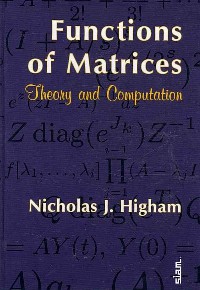
In a research monograph that can be used as a core or supplemental text in a graduate course, Higham (applied mathematics, U. of Manchester, England) offers what he characterizes as a reasonably complete treatment of the theory of matrix functions, along with numerical methods for computing them, and an overview of applications. He focuses on three equivalent definitions of f(A), based respectively on the Jordan canonical form, polynomial interpolation, and the Cauchy integral formula. Much of the material can be understood with only a basic grounding in numerical analysis and linear algebra, he says, but he is really writing for specialists in numerical analysis and applied linear algebra. Annotation 漏2008 Book News, Inc., Portland, OR (booknews.com)
Publisher Summary 2
鈥淭his superb book is timely and is written with great attention paid to detail, particularly in its referencing of the literature. The book has a wonderful blend of theory and code (MATLAB庐) so will be useful both to nonexperts and to experts in the field.鈥?鈥?Alan Laub, Professor, University of California, Los Angeles The only book devoted exclusively to matrix functions, this research monograph gives a thorough treatment of the theory of matrix functions and numerical methods for computing them. The author's elegant presentation focuses on the equivalent definitions of f(A) via the Jordan canonical form, polynomial interpolation, and the Cauchy integral formula, and features an emphasis on results of practical interest and an extensive collection of problems and solutions. Functions of Matrices: Theory and Computation is more than just a monograph on matrix functions; its wide-ranging content鈥攊ncluding an overview of applications, historical references, and miscellaneous results, tricks, and techniques with an f(A) connection鈥攎akes it useful as a general reference in numerical linear algebra.Other key features of the book include development of the theory of conditioning and properties of the Fr茅chet derivative; an emphasis on the Schur decomposition, the block Parlett recurrence, and judicious use of Pad茅 approximants; the inclusion of new, unpublished research results and improved algorithms; a chapter devoted to the f(A)b problem; and a MATLAB庐 toolbox providing implementations of the key algorithms.Audience: This book is for specialists in numerical analysis and applied linear algebra as well as anyone wishing to learn about the theory of matrix functions and state of the art methods for computing them. It can be used for a graduate-level course on functions of matrices and is a suitable reference for an advanced course on applied or numerical linear algebra. It is also particularly well suited for self-study. Contents: List of Figures; List of Tables; Preface; Chapter 1: Theory of Matrix Functions; Chapter 2: Applications; Chapter 3: Conditioning; Chapter 4: Techniques for General Functions; Chapter 5: Matrix Sign Function; Chapter 6: Matrix Square Root; Chapter 7: Matrix pth Root; Chapter 8: The Polar Decomposition; Chapter 9: Schur-Parlett Algorithm; Chapter 10: Matrix Exponential; Chapter 11: Matrix Logarithm; Chapter 12: Matrix Cosine and Sine; Chapter 13: Function of Matrix Times Vector: f(A)b; Chapter 14: Miscellany; Appendix A: Notation; Appendix B: Background: Definitions and Useful Facts; Appendix C: Operation Counts; Appendix D: Matrix Function Toolbox; Appendix E: Solutions to Problems; Bibliography; Index.
目录
Table Of Contents:
List of Figures xiii
List of Tables xv
Preface xvii
Theory of Matrix Functions 1(34)
Introduction 1(1)
Definitions of f(A) 2(8)
Jordan Canonical Form 2(2)
Polynomial Interpolation 4(3)
Cauchy Integral Theorem 7(1)
Equivalence of Definitions 8(1)
Example: Function of Identity Plus Rank-1 Matrix 8(2)
Example: Function of Discrete Fourier Transform Matrix 10(1)
Properties 10(4)
Nonprimary Matrix Functions 14(2)
Existence of (Real) Matrix Square Roots and Logarithms 16(1)
Classification of Matrix Square Roots and Logarithms 17(3)
Principal Square Root and Logarithm 20(1)
f(AB) and f(BA) 21(2)
Miscellany 23(3)
A Brief History of Matrix Functions 26(1)
Notes and References 27(2)
Problems 29(6)
Applications 35(20)
Differential Equations 35(2)
Exponential Integrators 36(1)
Nuclear Magnetic Resonance 37(1)
Markov Models 37(2)
Control Theory 39(2)
The Nonsymmetric Eigenvalue Problem 41(1)
Orthogonalization and the Orthogonal Procrustes Problem 42(1)
Theoretical Particle Physics 43(1)
Other Matrix Functions 44(1)
Nonlinear Matrix Equations 44(2)
Geometric Mean 46(1)
Pseudospectra 47(1)
Algebras 47(1)
Sensitivity Analysis 48(1)
Other Applications 48(3)
Boundary Value Problems 48(1)
Semidefinite Programming 48(1)
Matrix Sector Function 48(1)
Matrix Disk Function 49(1)
The Average Eye in Optics 50(1)
Computer Graphics 50(1)
Bregman Divergences 50(1)
Structured Matrix Interpolation 50(1)
The Lambert W Function and Delay Differential Equations 51(1)
Notes and References 51(1)
Problems 52(3)
Conditioning 55(16)
Condition Numbers 55(2)
Properties of the Frechet Derivative 57(6)
Bounding the Condition Number 63(1)
Computing or Estimating the Condition Number 64(5)
Notes and References 69(1)
Problems 70(1)
Techniques for General Functions 71(36)
Matrix Powers 71(1)
Polynomial Evaluation 72(4)
Taylor Series 76(2)
Rational Approximation 78(3)
Best L∞ Approximation 79(1)
Pade Approximation 79(1)
Evaluating Rational Functions 80(1)
Diagonalization 81(3)
Schur Decomposition and Triangular Matrices 84(5)
Block Diagonalization 89(1)
Interpolating Polynomial and Characteristic Polynomial 89(2)
Matrix Iterations 91(8)
Order of Convergence 91(1)
Termination Criteria 92(1)
Convergence 93(2)
Numerical Stability 95(4)
Preprocessing 99(3)
Bounds for ¶f(A)¶ 102(2)
Notes and References 104(1)
Problems 105(2)
Matrix Sign Function 107(26)
Sensitivity and Conditioning 109(3)
Schur Method 112(1)
Newton's Method 113(2)
The Pade Family of Iterations 115(4)
Scaling the Newton Iteration 119(2)
Terminating the Iterations 121(2)
Numerical Stability of Sign Iterations 123(2)
Numerical Experiments and Algorithm 125(3)
Best L∞ Approximation 128(1)
Notes and References 129(2)
Problems 131(2)
Matrix Square Root 133(40)
Sensitivity and Conditioning 133(2)
Schur Method 135(4)
Newton's Method and Its Variants 139(5)
Stability and Limiting Accuracy 144(3)
Newton Iteration 144(1)
DB Iterations 145(1)
CR Iteration 146(1)
IN Iteration 146(1)
Summary 147(1)
Scaling the Newton Iteration 147(1)
Numerical Experiments 148(4)
Iterations via the Matrix Sign Function 152(2)
Special Matrices 154(8)
Binomial Iteration 154(3)
Modified Newton Iterations 157(2)
M-Matrices and H-Matrices 159(2)
Hermitian Positive Definite Matrices 161(1)
Computing Small-Normed Square Roots 162(2)
Comparison of Methods 164(2)
Involutory Matrices 166(1)
Notes and References 166(2)
Problems 168(5)
Matrix pth Root 173(20)
Theory 173(2)
Schur Method 175(2)
Newton's Method 177(4)
Inverse Newton Method 181(3)
Schur-Newton Algorithm 184(2)
Matrix Sign Method 186(1)
Notes and References 187(2)
Problems 189(4)
The Polar Decomposition 193(28)
Approximation Properties 197(2)
Sensitivity and Conditioning 199(3)
Newton's Method 202(1)
Obtaining Iterations via the Matrix Sign Function 202(1)
The Pade Family of Methods 203(2)
Scaling the Newton Iteration 205(2)
Terminating the Iterations 207(2)
Numerical Stability and Choice of H 209(1)
Algorithm 210(3)
Notes and References 213(3)
Problems 216(5)
Schur-Parlett Algorithm 221(12)
Evaluating Functions of the Atomic Blocks 221(4)
Evaluating the Upper Triangular Part of f(T) 225(1)
Reordering and Blocking the Schur Form 226(2)
Schur-Parlett Algorithm for f(A) 228(2)
Preprocessing 230(1)
Notes and References 231(1)
Problems 231(2)
Matrix Exponential 233(36)
Basic Properties 233(5)
Conditioning 238(3)
Scaling and Squaring Method 241(9)
Schur Algorithms 250(2)
Newton Divided Difference Interpolation 250(1)
Schur-Frechet Algorithm 251(1)
Schur-Parlett Algorithm 251(1)
Numerical Experiment 252(1)
Evaluating the Frechet Derivative and Its Norm 253(6)
Quadrature 254(2)
The Kronecker Formulae 256(2)
Computing and Estimating the Norm 258(1)
Miscellany 259(3)
Hermitian Matrices and Best L∞ Approximation 259(1)
Essentially Nonnegative Matrices 260(1)
Preprocessing 261(1)
The ψ Functions 261(1)
Notes and References 262(3)
Problems 265(4)
Matrix Logarithm 269(18)
Basic Properties 269(3)
Conditioning 272(1)
Series Expansions 273(1)
Pade Approximation 274(1)
Inverse Scaling and Squaring Method 275(4)
Schur Decomposition: Triangular Matrices 276(2)
Full Matrices 278(1)
Schur Algorithms 279(1)
Schur-Frechet Algorithm 279(1)
Schur-Parlett Algorithm 279(1)
Numerical Experiment 280(1)
Evaluating the Frechet Derivative 281(2)
Notes and References 283(1)
Problems 284(3)
Matrix Cosine and Sine 287(14)
Basic Properties 287(2)
Conditioning 289(1)
Pade Approximation of Cosine 290(1)
Double Angle Algorithm for Cosine 290(5)
Numerical Experiment 295(1)
Double Angle Algorithm for Sine and Cosine 296(3)
Preprocessing 299(1)
Notes and References 299(1)
Problems 300(1)
Function of Matrix Times Vector: f(A)b 301(12)
Representation via Polynomial Interpolation 301(1)
Krylov Subspace Methods 302(4)
The Arnoldi Process 302(2)
Arnoldi Approximation of f(A)b 304(2)
Lanczos Biorthogonalization 306(1)
Quadrature 306(2)
On the Real Line 306(1)
Contour Integration 307(1)
Differential Equations 308(1)
Other Methods 309(1)
Notes and References 309(1)
Problems 310(3)
Miscellany 313(6)
Structured Matrices 313(4)
Algebras and Groups 313(2)
Monotone Functions 315(1)
Other Structures 315(1)
Data Sparse Representations 316(1)
Computing Structured f(A) for Structured A 316(1)
Exponential Decay of Functions of Banded Matrices 317(1)
Approximating Entries of Matrix Functions 318(1)
Notation 319(2)
Background: Definitions and Useful Facts 321(14)
Basic Notation 321(1)
Eigenvalues and Jordan Canonical Form 321(2)
Invariant Subspaces 323(1)
Special Classes of Matrices 323(1)
Matrix Factorizations and Decompositions 324(1)
Pseudoinverse and Orthogonality 325(1)
Pseudoinverse 325(1)
Projector and Orthogonal Projector 326(1)
Partial Isometry 326(1)
Norms 326(2)
Matrix Sequences and Series 328(1)
Perturbation Expansions for Matrix Inverse 328(1)
Sherman-Morrison-Woodbury Formula 329(1)
Nonnegative Matrices 329(1)
Positive (Semi)definite Ordering 330(1)
Kronecker Product and Sum 331(1)
Sylvester Equation 331(1)
Floating Point Arithmetic 331(1)
Divided Differences 332(2)
Problems 334(1)
Operation Counts 335(4)
Matrix Function Toolbox 339(4)
Solutions to Problems 343(36)
Bibliography 379(36)
Index 415
List of Figures xiii
List of Tables xv
Preface xvii
Theory of Matrix Functions 1(34)
Introduction 1(1)
Definitions of f(A) 2(8)
Jordan Canonical Form 2(2)
Polynomial Interpolation 4(3)
Cauchy Integral Theorem 7(1)
Equivalence of Definitions 8(1)
Example: Function of Identity Plus Rank-1 Matrix 8(2)
Example: Function of Discrete Fourier Transform Matrix 10(1)
Properties 10(4)
Nonprimary Matrix Functions 14(2)
Existence of (Real) Matrix Square Roots and Logarithms 16(1)
Classification of Matrix Square Roots and Logarithms 17(3)
Principal Square Root and Logarithm 20(1)
f(AB) and f(BA) 21(2)
Miscellany 23(3)
A Brief History of Matrix Functions 26(1)
Notes and References 27(2)
Problems 29(6)
Applications 35(20)
Differential Equations 35(2)
Exponential Integrators 36(1)
Nuclear Magnetic Resonance 37(1)
Markov Models 37(2)
Control Theory 39(2)
The Nonsymmetric Eigenvalue Problem 41(1)
Orthogonalization and the Orthogonal Procrustes Problem 42(1)
Theoretical Particle Physics 43(1)
Other Matrix Functions 44(1)
Nonlinear Matrix Equations 44(2)
Geometric Mean 46(1)
Pseudospectra 47(1)
Algebras 47(1)
Sensitivity Analysis 48(1)
Other Applications 48(3)
Boundary Value Problems 48(1)
Semidefinite Programming 48(1)
Matrix Sector Function 48(1)
Matrix Disk Function 49(1)
The Average Eye in Optics 50(1)
Computer Graphics 50(1)
Bregman Divergences 50(1)
Structured Matrix Interpolation 50(1)
The Lambert W Function and Delay Differential Equations 51(1)
Notes and References 51(1)
Problems 52(3)
Conditioning 55(16)
Condition Numbers 55(2)
Properties of the Frechet Derivative 57(6)
Bounding the Condition Number 63(1)
Computing or Estimating the Condition Number 64(5)
Notes and References 69(1)
Problems 70(1)
Techniques for General Functions 71(36)
Matrix Powers 71(1)
Polynomial Evaluation 72(4)
Taylor Series 76(2)
Rational Approximation 78(3)
Best L∞ Approximation 79(1)
Pade Approximation 79(1)
Evaluating Rational Functions 80(1)
Diagonalization 81(3)
Schur Decomposition and Triangular Matrices 84(5)
Block Diagonalization 89(1)
Interpolating Polynomial and Characteristic Polynomial 89(2)
Matrix Iterations 91(8)
Order of Convergence 91(1)
Termination Criteria 92(1)
Convergence 93(2)
Numerical Stability 95(4)
Preprocessing 99(3)
Bounds for ¶f(A)¶ 102(2)
Notes and References 104(1)
Problems 105(2)
Matrix Sign Function 107(26)
Sensitivity and Conditioning 109(3)
Schur Method 112(1)
Newton's Method 113(2)
The Pade Family of Iterations 115(4)
Scaling the Newton Iteration 119(2)
Terminating the Iterations 121(2)
Numerical Stability of Sign Iterations 123(2)
Numerical Experiments and Algorithm 125(3)
Best L∞ Approximation 128(1)
Notes and References 129(2)
Problems 131(2)
Matrix Square Root 133(40)
Sensitivity and Conditioning 133(2)
Schur Method 135(4)
Newton's Method and Its Variants 139(5)
Stability and Limiting Accuracy 144(3)
Newton Iteration 144(1)
DB Iterations 145(1)
CR Iteration 146(1)
IN Iteration 146(1)
Summary 147(1)
Scaling the Newton Iteration 147(1)
Numerical Experiments 148(4)
Iterations via the Matrix Sign Function 152(2)
Special Matrices 154(8)
Binomial Iteration 154(3)
Modified Newton Iterations 157(2)
M-Matrices and H-Matrices 159(2)
Hermitian Positive Definite Matrices 161(1)
Computing Small-Normed Square Roots 162(2)
Comparison of Methods 164(2)
Involutory Matrices 166(1)
Notes and References 166(2)
Problems 168(5)
Matrix pth Root 173(20)
Theory 173(2)
Schur Method 175(2)
Newton's Method 177(4)
Inverse Newton Method 181(3)
Schur-Newton Algorithm 184(2)
Matrix Sign Method 186(1)
Notes and References 187(2)
Problems 189(4)
The Polar Decomposition 193(28)
Approximation Properties 197(2)
Sensitivity and Conditioning 199(3)
Newton's Method 202(1)
Obtaining Iterations via the Matrix Sign Function 202(1)
The Pade Family of Methods 203(2)
Scaling the Newton Iteration 205(2)
Terminating the Iterations 207(2)
Numerical Stability and Choice of H 209(1)
Algorithm 210(3)
Notes and References 213(3)
Problems 216(5)
Schur-Parlett Algorithm 221(12)
Evaluating Functions of the Atomic Blocks 221(4)
Evaluating the Upper Triangular Part of f(T) 225(1)
Reordering and Blocking the Schur Form 226(2)
Schur-Parlett Algorithm for f(A) 228(2)
Preprocessing 230(1)
Notes and References 231(1)
Problems 231(2)
Matrix Exponential 233(36)
Basic Properties 233(5)
Conditioning 238(3)
Scaling and Squaring Method 241(9)
Schur Algorithms 250(2)
Newton Divided Difference Interpolation 250(1)
Schur-Frechet Algorithm 251(1)
Schur-Parlett Algorithm 251(1)
Numerical Experiment 252(1)
Evaluating the Frechet Derivative and Its Norm 253(6)
Quadrature 254(2)
The Kronecker Formulae 256(2)
Computing and Estimating the Norm 258(1)
Miscellany 259(3)
Hermitian Matrices and Best L∞ Approximation 259(1)
Essentially Nonnegative Matrices 260(1)
Preprocessing 261(1)
The ψ Functions 261(1)
Notes and References 262(3)
Problems 265(4)
Matrix Logarithm 269(18)
Basic Properties 269(3)
Conditioning 272(1)
Series Expansions 273(1)
Pade Approximation 274(1)
Inverse Scaling and Squaring Method 275(4)
Schur Decomposition: Triangular Matrices 276(2)
Full Matrices 278(1)
Schur Algorithms 279(1)
Schur-Frechet Algorithm 279(1)
Schur-Parlett Algorithm 279(1)
Numerical Experiment 280(1)
Evaluating the Frechet Derivative 281(2)
Notes and References 283(1)
Problems 284(3)
Matrix Cosine and Sine 287(14)
Basic Properties 287(2)
Conditioning 289(1)
Pade Approximation of Cosine 290(1)
Double Angle Algorithm for Cosine 290(5)
Numerical Experiment 295(1)
Double Angle Algorithm for Sine and Cosine 296(3)
Preprocessing 299(1)
Notes and References 299(1)
Problems 300(1)
Function of Matrix Times Vector: f(A)b 301(12)
Representation via Polynomial Interpolation 301(1)
Krylov Subspace Methods 302(4)
The Arnoldi Process 302(2)
Arnoldi Approximation of f(A)b 304(2)
Lanczos Biorthogonalization 306(1)
Quadrature 306(2)
On the Real Line 306(1)
Contour Integration 307(1)
Differential Equations 308(1)
Other Methods 309(1)
Notes and References 309(1)
Problems 310(3)
Miscellany 313(6)
Structured Matrices 313(4)
Algebras and Groups 313(2)
Monotone Functions 315(1)
Other Structures 315(1)
Data Sparse Representations 316(1)
Computing Structured f(A) for Structured A 316(1)
Exponential Decay of Functions of Banded Matrices 317(1)
Approximating Entries of Matrix Functions 318(1)
Notation 319(2)
Background: Definitions and Useful Facts 321(14)
Basic Notation 321(1)
Eigenvalues and Jordan Canonical Form 321(2)
Invariant Subspaces 323(1)
Special Classes of Matrices 323(1)
Matrix Factorizations and Decompositions 324(1)
Pseudoinverse and Orthogonality 325(1)
Pseudoinverse 325(1)
Projector and Orthogonal Projector 326(1)
Partial Isometry 326(1)
Norms 326(2)
Matrix Sequences and Series 328(1)
Perturbation Expansions for Matrix Inverse 328(1)
Sherman-Morrison-Woodbury Formula 329(1)
Nonnegative Matrices 329(1)
Positive (Semi)definite Ordering 330(1)
Kronecker Product and Sum 331(1)
Sylvester Equation 331(1)
Floating Point Arithmetic 331(1)
Divided Differences 332(2)
Problems 334(1)
Operation Counts 335(4)
Matrix Function Toolbox 339(4)
Solutions to Problems 343(36)
Bibliography 379(36)
Index 415
- 名称
- 类型
- 大小
光盘服务联系方式: 020-38250260 客服QQ:4006604884
云图客服:
用户发送的提问,这种方式就需要有位在线客服来回答用户的问题,这种 就属于对话式的,问题是这种提问是否需要用户登录才能提问
Video Player
×
Audio Player
×
pdf Player
×
