

简介
Summary:
Publisher Summary 1
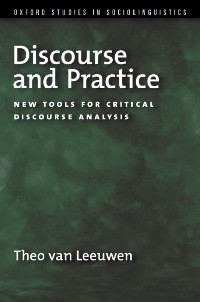
Adding a new introduction and two previously unpublished papers, Discourse and Practice: New Tools for Critical Discourse Analysisbrings together van Leeuwen's methodological work on discourse analysis of the last 15 years. Discourse, van Leeuwen argues, is a resource for representation, a knowledge about some aspect of reality which can be drawn upon when that aspect of reality has to be represented, a framework for making sense of things. And they are plural. There can be different discourses, different ways of making sense of the same aspect of reality that serve different interests and will therefore be used in different social contexts.
However abstract some discourses are, discourses ultimately always represent doings, van Leeuwen argues. Doing is the foundation of knowing, and social practices are the foundation of discourses. Studying children's books, newspaper reports, brochures and other texts, as well as photographs and children's toys, van Leeuwen investigates what can happen when practices are transformed into discourses and provides analytical tools for reconstructing discourses from texts.
Throughout the book, van Leeuwen makes connections between sociological and linguistic or semiotic concepts and methods to ensure the social and critical relevance of his analytical categories. van Leeuwen's work has already been widely used by critical discourse analysts across the world. This volume will be a welcome guide for anyone looking for a form of discourse analysis that is both explicit and methodical, and critically incisive.
目录
Contents
Preface
Chapter 1: Discourse as the recontextualization of social practice
1. The supersedure of meaning by function
2. Discourse as the recontextualization of social practice
3. Social practices
Chapter 2: Representing social actors
1. A sociosemantic inventory
2. "Our Race Odyssey"
3. Exclusion
4. Role Allocation
5. Genericisation and specification
6. Assimilation
7. Association and dissociation
8. Indetermination and differentiation
9. Nomination and categorization
10. Functionalisation and identification
11. Personalisation and impersonalisation
12. Overdetermination
13. Conclusion
Chapter 3: Representing social action
1. Introduction
2. Reactions
3. Material and semiotic action
4. Objectivation and descriptivization
5. De-agenitalization
6. Generalization and abstraction
7. Overdetermination
8. Conclusion
Chapter 4: Time in discourse
1. Introduction
2. The socio-semantics of location and extent
2.1. Time summons
2.2. Synchronisation
2.3. Punctuality
2.4. Exact and inexact timing
2.5. Unique and recurring timing
3. Experiencing Duration
4. Managing Time
5. Two examples
Chapter 5: Space in discourse
1. Introduction
2. Locating action
3. Arranging and interpreting space
4. Description and legitimation
5. Subjective and objective space
6. Word and image
Chapter 6: The discursive construction of legitimation
1. Introduction
2. Authorization
3. Moral evaluation
4. Rationalization
5. Mythopoesis
6. Multimodal legitimation
7. Legitimation and context
Chapter 7: The discursive construction of purpose
1. Introduction
2. Purpose and Legitimation
3. The grammar of purpose
Chapter 8: The visual representation of social actors
1. Word and image
2. The image and the viewer
3. Depicting people
Chapter 9: Representing social actors with toys
1. Introduction
2. Roles, identities, meanings
3. Preschool Playmobil
4. Playing with Playmobil
- 名称
- 类型
- 大小
光盘服务联系方式: 020-38250260 客服QQ:4006604884
云图客服:
用户发送的提问,这种方式就需要有位在线客服来回答用户的问题,这种 就属于对话式的,问题是这种提问是否需要用户登录才能提问
Video Player
×
Audio Player
×
pdf Player
×
