

简介
Summary:
Publisher Summary 1
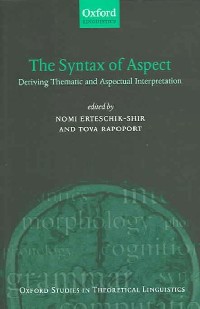
This collection of new work focuses on issues at the lexicon-syntax interface. It presents innovative analyses of theoretical issues of aspectual interpretation in a variety of languages. The authors address questions such as to what extent can variation in verbal meaning, and thematic information can be determined in the syntax, and how the interpretation of various syntactic constructions is derived, once lexical information is minimized. A subset of the articles develops theories that take as their starting point the lexical-syntactic framework of the late Ken Hale and Jay Keyser, prominent among which is their own chapter.
目录
Contents 8
General Preface 10
Preface 11
Notes on Contributors 12
Overview of the Volume 16
1 Introduction 22
Part I: From Lexical Roots to Syntax 30
2 Aspect and the Syntax of Argument Structure 32
3 How Do Verbs Get Their Names? Denominal Verbs, Manner Incorporation, and the Ontology of Verb Roots in English 63
4 Path Predicates 86
Part II: Event Structure and Feature Projections 108
5 Tense, Person, and Transitivity 110
6 Complex Aspectual Structure in Hindi/Urdu 138
7 The Aspect of Agency 175
8 Agents and Causes in Malagasy and Tagalog 195
9 Event Structure and Morphosyntax in Navajo 211
Part III: Lexical Restrictions on Syntax 234
10 Constructions, Lexical Semantics, and the Correspondence Principle: Accounting for Generalizations and Subregularities in the Realization of Arguments 236
11 Unspecified Arguments in Episodic and Habitual Sentences 258
12 Resultatives under the \u2018Event\u2013Argument Homomorphism\u2019 Model of Telicity 276
13 Change-of-State Verbs: Implications for Theories of Argument Projection 295
References 308
Author Index 324
A 324
B 324
C 324
D 324
E 324
F 324
G 324
H 325
I 325
J 325
K 325
L 325
M 325
N 325
O 325
P 325
R 326
S 326
T 326
V 326
W 326
Y 326
Z 326
Index of Terms 327
A 327
B 327
C 327
D 327
E 328
F 328
H 328
I 328
L 328
M 328
N 329
O 329
P 329
Q 329
R 329
S 329
T 330
U 330
V 330
Z 330
General Preface 10
Preface 11
Notes on Contributors 12
Overview of the Volume 16
1 Introduction 22
Part I: From Lexical Roots to Syntax 30
2 Aspect and the Syntax of Argument Structure 32
3 How Do Verbs Get Their Names? Denominal Verbs, Manner Incorporation, and the Ontology of Verb Roots in English 63
4 Path Predicates 86
Part II: Event Structure and Feature Projections 108
5 Tense, Person, and Transitivity 110
6 Complex Aspectual Structure in Hindi/Urdu 138
7 The Aspect of Agency 175
8 Agents and Causes in Malagasy and Tagalog 195
9 Event Structure and Morphosyntax in Navajo 211
Part III: Lexical Restrictions on Syntax 234
10 Constructions, Lexical Semantics, and the Correspondence Principle: Accounting for Generalizations and Subregularities in the Realization of Arguments 236
11 Unspecified Arguments in Episodic and Habitual Sentences 258
12 Resultatives under the \u2018Event\u2013Argument Homomorphism\u2019 Model of Telicity 276
13 Change-of-State Verbs: Implications for Theories of Argument Projection 295
References 308
Author Index 324
A 324
B 324
C 324
D 324
E 324
F 324
G 324
H 325
I 325
J 325
K 325
L 325
M 325
N 325
O 325
P 325
R 326
S 326
T 326
V 326
W 326
Y 326
Z 326
Index of Terms 327
A 327
B 327
C 327
D 327
E 328
F 328
H 328
I 328
L 328
M 328
N 329
O 329
P 329
Q 329
R 329
S 329
T 330
U 330
V 330
Z 330
- 名称
- 类型
- 大小
光盘服务联系方式: 020-38250260 客服QQ:4006604884
云图客服:
用户发送的提问,这种方式就需要有位在线客服来回答用户的问题,这种 就属于对话式的,问题是这种提问是否需要用户登录才能提问
Video Player
×
Audio Player
×
pdf Player
×
