

简介
Summary:
Publisher Summary 1
Examining the writings, speeches, and congressional testimony of economist Walt Whitman Rostow, Pearce (English, St. Anselm College) explores the ability of Rostow to push his economic theories of foreign aid into the mainstream policy choices of the Eisenhower, Kennedy, and Johnson administrations. Rostow's alternative to Marx's theory of historical materialism, modeled on five stages of growth that inevitably leads to capitalist democracy, was quickly accepted by many policy elites. Pearce explores how Rostow's ideas were integrated into Kennedy's Latin American initiative, the Alliance for Progress, and other foreign aid programs. The major focus on the book is an examination of what rhetorical tools were used by Rostow to convince policy makers of the soundness of his ideas. The idea that Rostow's rhetoric already fit into the ideological suppositions of elite policy makers (as Milton Friedman's would in the next couple of decades) seems not to have occurred to Pearce. Annotation c. Book News, Inc., Portland, OR (booknews.com)
Publisher Summary 2
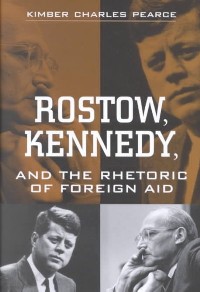
Rostow, Kennedy, and the Rhetoric of Foreign Aid is the first comprehensive, critical analysis of the influence of economic historian Walt Whitman Rostow's theory of the "stages of economic growth" on U.S. foreign aid policy during the 1950s and 1960s. Kimber Charles Pearce analyzes Rostow's rhetorical approaches to producing and promoting his modernization theory to U.S. policymakers during the Cold War, as a template for development aid programs designed to contain Soviet expansionism around the world. Drawing upon Rostow's writings, public speeches, congressional testimony, personal interviews, and recently declassified documents, Pearce examines the economist's protracted campaign to convince policy makers to apply his theory of economic growth to the development aid initiatives of Presidents Dwight D. Eisenhower, John F. Kennedy, and Lyndon B. Johnson. The analysis culminates in a case study of Rostow's influence on the planning, advocacy, and implementation of President Kennedy's Alliance for Progress to develop Latin America.
聽聽聽聽 Pearce demonstrates how Rostow's dual role as a leading architect of U.S. development aid programs and U.S. military escalation in South Vietnam made him a key figure, both in the history of developmental economic theory and in U.S. diplomacy during the Cold War. He argues that Rostow's role in economic diplomacy epitomized the social scientific turn toward argumentation and advocacy that occurred in the United States after World War II. Using methods of rhetorical analysis, Pearce offers new insights into how Rostovian theory was translated into political language by members of the Eisenhower, Kennedy, and Johnson administrations, and how Rostow's themes of nation-building, fiscal interdependency, and macro-management of the global economy have become commonplaces of post-Cold War policy discourse. By illuminating relations of social scientific research, foreign policy advocacy, and political power in the context of U.S. economic diplomacy during the Cold War, Rostow, Kennedy, and the Rhetoric of Foreign Aid makes a significant contribution to the study of the rhetoric of economics and American diplomatic history.
Publisher Summary 3
Rostow, Kennedy, and the Rhetoric of Foreign Aid is the first comprehensive, critical analysis of the influence of economic historian Walt Whitman Rostow's theory of the "stages of economic growth" on U.S. foreign aid policy during the 1950s and 1960s.
目录
Chapter 1. From the Academy to the White House: Rostow,
Foreign Aid, and Social Scientific Advocacy
1916-50: The Early Years
1951-59: The CENIS Years
1960-68: Rostow and the Rise and Fall of the
Alliance for Progress
Chapter 2. Theory, Countertheory, and Rostow's Pursuit of
Academic Novelty: The Process of Economic Growth
The Process of Economic Growth in the Intellectual and
Political Contexts of Cold War Modernization
Rostow contra Marx
Human Motivation in Rostovian Theory
Narrating the Propensities for Economic Growth:
The Paradigm Case of the British Industrial Revolution
Chapter 3. Ideas in Action: A Proposal:
Key to an Effective Foreign Policy
The Princeton Inn Conference of 1954: Rhetorical Invention in
Foreign Aid Policy ,,
From the Princeton Inn Proposal to the Millikan-Rostow Thesis:
Keeping Up the Fight
Modeling Democracy: The "Diffusion of Power" and
Development Aid Policy
"Peaceful Revolution" and the Stages of Economic Growth
Chapter 4. Narrative Reason in Rostow's Stages of Economic Growth:
A Non-Communist Manifesto
Responses to The Stages of Economic Growth
The Frame Narrative of The Stages of Economic Growth
Embedded Narratives in The Stages of Economic Growth:
The Dynamics of Cold War Modernization
The Embedded Narrative of Human Motivation
The Embedded Narrative of the "Buddenbrooks" Analogy
Chapter 5. Advocating the Alliance for Progress: Rostow,
Kennedy, and the Rhetoric of Peaceful Revolution
Mobilizing the Alliance for Progress, 1961
Kennedy's Rhetorical Campaign for the Alliance:
Sequence of Speeches, 1961
Inaugural Address, 20 January 1961
Annual Message to the Congress on the State of the Union,
30 January 1961
Address at a White House Reception for
Members of the Congress and for the Diplomatic
Corps of the Latin American Republics, 13 March 1961
Special Message to the Congress on Foreign Aid, 22 March 1961
Chapter 6. From Punta Del Este and Back: The Alliance Fades 1
The First Punta Del Este Meeting, 1961
Return to Punta Del Este: The Alliance during the Johnson Years
Conclusion
Conclusion 1
Endnotes
Bibliography
Index
- 名称
- 类型
- 大小
光盘服务联系方式: 020-38250260 客服QQ:4006604884
云图客服:
用户发送的提问,这种方式就需要有位在线客服来回答用户的问题,这种 就属于对话式的,问题是这种提问是否需要用户登录才能提问
Video Player
×
Audio Player
×
pdf Player
×
