

简介
目录
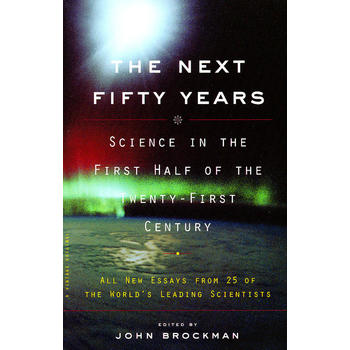
Introduction: by John Brockman
Part I: The Future, in Theory
Lee Smolin: The Future of the Nature of the Universe
"We will probably know more about the detailed history and
properties of the universe than we know now about the historyof
the surface of our planet."
Martin Rees: Cosmological Challenges: Are We Alone, andWhere?
"We can't predict what role life will eventually carve out foritself: It could become extinct, or it could achieve such dominancethat it would influence the entire cosmos."
Ian Stewart: The Mathematics of 2050
"There will be `virtual unreality' systems, allowing mathematiciansto `visit' abstract conceptual structures such as non-euclideangeometries or ranges of giant primes and manipulate them atwill."
Brian Goodwin: In the Shadow of Culture
"Why is animism so threatening to the Western scientific worldview?Is there any sign that the dialectic of science is beginning tobring this view into the light again?"
Marc D. Hauser: Swappable Minds
"Imagine that we could download the neuronal signals from anyanimal, creating a kind of hard-drive library of their thoughtswhile they were interacting with the world."
Alison Gopnik: What Children Will Teach Scientists
"The greatest achievement of a unified theory of learning may be todemonstrate that the most brilliant scientists and the mostordinary kids are engaged in the same enterprise."
Paul Bloom: Toward a Theory of Moral Development
"It may be that the nature of moral thought or consciousness issimply beyond our understanding, not because they have a special,mystical status but because we aren't smart enough to understandsuch things. We might be like dogs trying to understandcalculus."
Geoffrey Miller: The Science of Subtlety
"Our more recently evolved, distinctively human capacities--forcreativity, kindness, humor, imagination--remain understudied inbrain-imaging labs."
Mihaly Csikszentmihalyi: The Future of Happiness
"In the past, we were like passengers on the slow coach ofevolution. Now evolution is more like a rocket hurtling throughspace, and we are no longer passengers but its pilots."
Robert M. Sapolsky: Will We Still Be Sad Fifty Years fromNow?
"Our technology isn't likely to help reduce our stress, despite (ormaybe even because of) our expectation that it will."
Steven Strogatz: Fermi's "Little Discovery" and the Future of Chaosand Complexity Theory
"Nonlinearity giveth chaos, and nonlinearity taketh it away."
Stuart Kauffman: What Is Life?
"The biosphere may actually be doing something that cannot bestated at all beforehand. If so, the way Newton, Einstein, Bohr,and Boltzmann taught us to do science is limited."
Part II: The Future, in Practice
Richard Dawkins: Son of Moore's Law
"Genetics today is pure information technology. This, precisely, iswhy an antifreeze gene can be copied from an arctic fish and pastedinto a tomato."
Paul Davies: Was There a Second Genesis?
"The existence of complex life on Earth probably depends on certainrather special features of our solar system."
John H. Holland: What Is to Come and How to Predict It
"When complex adaptive systems are involved, prediction is fraughtwith hazard."
Rodney Brooks: The Merger of Flesh and Machines
"The generalization we are facing is that we humans aremachines--and as such, subject to the same technologicalmanipulations we routinely apply to machines."
Peter Atkins: The Future of Matter
"By mid-century the bits and pieces of fully synthetic life will bein position....In the longer term there will be no need to stickwith carbon, and the speculative dream of at least partialincorporation of silicon and germanium into living things and thegeneration of an entirely new kind of life will come true."
Roger C. Schank: Are We Going to Get Smarter?
"We will begin to understand in the next fifty years thatexperience and one's ability to extend its range is the ultimatemeasure of intelligence and the ultimate expression offreedom."
Jaron Lanier: The Complexity Ceiling
"Accompanying the parade of quixotic overstatements of theoreticalcomputer power has been a humiliating and unending sequence ofdisappointments in the performance of real informationsystems."
David Gelernter: Tapping into the Beam
"The continuous, ubiquitous Cybersphere will replace today'schaotic, stuttering Internet."
Joseph LeDoux: Mind, Brain, and Self
"New technologies are enabling us to study normal human brainfunction, and they promise a new level of understanding of therelation of the human brain to the human mind."
Judith Rich Harris: What Makes Us the Way We Are: The View from2050
"Developmentalists of the twentieth century...thought theyunderstood the sources of individual differences in behavior andpersonality, but...they were mostly wrong."
Samuel Barondes: Drugs, DNA, and the Analyst's Couch
"Fifty years from now, everyone who visits a psychiatrist willbring with them a new source of information--a password providingaccess to their personal DNA file on the National Health Servicecomputer."
Nancy Etcoff: Brains, Wearables, and Brief Encounters
"At a time of giddy optimism in the neurosciences, it is a time ofdiscontent in psychiatry and wary optimism in clinical psychology.If current trends continue, there will be few psychiatrists inpractice fifty years from now."
Paul W. Ewald: Mastering Disease
"Chronic diseases may be a consequence of infectious agents thatcryptically cause tissue damage, which eventually manifests itselfin such serious diseases as heart attack, cancer, orAlzheimer's."
- 名称
- 类型
- 大小
光盘服务联系方式: 020-38250260 客服QQ:4006604884
云图客服:
用户发送的提问,这种方式就需要有位在线客服来回答用户的问题,这种 就属于对话式的,问题是这种提问是否需要用户登录才能提问
