

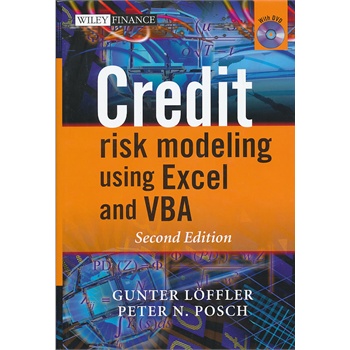
Credit Risk Modeling Using Excel And Vba 2E +Cd 9780470660928
副标题:无
作 者:Peter N. Posch 著
分类号:
ISBN:9780470660928
微信扫一扫,移动浏览光盘
简介
目录
Preface to the 2nd edition. Preface to the 1st edition. SomeHints for Troubleshooting. 1 Estimating Credit Scores with Logit.Linking scores, default probabilities and observed defaultbehavior. Estimating logit coefficients in Excel. Computingstatistics after model estimation. Interpreting regressionstatistics. Prediction and scenario analysis. Treating outliers ininput variables. Choosing the functional relationship between thescore and explanatory variables. Concluding remarks. Appendix.Logit and probit. Marginal effects. Notes and literature. 2 TheStructural Approach to Default Prediction and Valuation. Defaultand valuation in a structural model. Implementing the Merton modelwith a one-year horizon. The iterative approach. A solution usingequity values and equity volatilities. Implementing the Mertonmodel with a T -year horizon. Credit spreads. CreditGrades.Appendix. Notes and literature. Assumptions. Literature. 3Transition Matrices. Cohort approach. Multi-period transitions.Hazard rate approach. Obtaining a generator matrix from a giventransition matrix. Confidence intervals with the binomialdistribution. Bootstrapped confidence intervals for the hazardapproach. Notes and literature. Appendix. Matrix functions. 4Prediction of Default and Transition Rates. Candidate variables forprediction. Predicting investment-grade default rates with linearregression. Predicting investment-grade default rates with Poissonregression. Backtesting the prediction models. Predictingtransition matrices. Adjusting transition matrices. Representingtransition matrices with a single parameter. Shifting thetransition matrix. Backtesting the transition forecasts. Scope ofapplication. Notes and literature. Appendix. 5 Prediction of LossGiven Default. Candidate variables for prediction.Instrument-related variables. Firm-specific variables.Macroeconomic variables. Industry variables. Creating a data set.Regression analysis of LGD. Backtesting predictions. Notes andliterature. Appendix. 6 Modeling and Estimating DefaultCorrelations with the Asset Value Approach. Default correlation,joint default probabilities and the asset value approach.Calibrating the asset value approach to default experience: themethod of moments. Estimating asset correlation with maximumlikelihood. Exploring the reliability of estimators with a MonteCarlo study. Concluding remarks. Notes and literature. 7 MeasuringCredit Portfolio Risk with the Asset Value Approach. A default-modemodel implemented in the spreadsheet. VBA implementation of adefault-mode model. Importance sampling. Quasi Monte Carlo.Assessing Simulation Error. Exploiting portfolio structure in theVBA program. Dealing with parameter uncertainty. Extensions. Firstextension: Multi-factor model. Second extension: t -distributedasset values. Third extension: Random LGDs. Fourth extension: Otherrisk measures. Fifth extension: Multi-state modeling. Notes andliterature. 8 Validation of Rating Systems. Cumulative accuracyprofile and accuracy ratios. Receiver operating characteristic(ROC). Bootstrapping confidence intervals for the accuracy ratio.Interpreting caps and ROCs. Brier score. Testing the calibration ofrating-specific default probabilities. Validation strategies.Testing for missing information. Notes and literature. 9 Validationof Credit Portfolio Models. Testing distributions with theBerkowitz test. Example implementation of the Berkowitz testRepresenting the loss distribution. Simulating the criticalchi-square value. Testing modeling details: Berkowitz onsubportfolios. Assessing power. Scope and limits of the test. Notesand literature. 10 Credit Default Swaps and Risk-Neutral DefaultProbabilities. Describing the term structure of default: PDscumulative, marginal and seen from today. From bond prices torisk-neutral default probabilities. Concepts and formulae.Implementation. Pricing a CDS. Refining the PD estimation. Marketvalues for a CDS. Example. Estimating upfront CDS and the 'BigBang' protocol. Pricing of a pro-rata basket. Forward CDS spreads.Example. Pricing of swaptions. Notes and literature. Appendix.Deriving the hazard rate for a CDS. 11 Risk Analysis and Pricing ofStructured Credit: CDOs and First-to-Default Swaps. Estimating CDOrisk with Monte Carlo simulation. The large homogeneous portfolio(LHP) approximation. Systemic risk of CDO tranches. Default timesfor first-to-default swaps. CDO pricing in the LHP framework.Simulation-based CDO pricing. Notes and literature. Appendix.Closed-form solution for the LHP model. Cholesky decomposition.Estimating PD structure from a CDS. 12 Basel II and InternalRatings. Calculating capital requirements in the InternalRatings-Based (IRB) approach. Assessing a given grading structure.Towards an optimal grading structure. Notes and literature.Appendix A1 Visual Basics for Applications (VBA). Appendix A2Solver. Appendix A3 Maximum Likelihood Estimation and Newton'sMethod. Appendix A4 Testing and Goodness of Fit. Appendix A5User-defined Functions. Index.
光盘服务联系方式: 020-38250260 客服QQ:4006604884
云图客服:
用户发送的提问,这种方式就需要有位在线客服来回答用户的问题,这种 就属于对话式的,问题是这种提问是否需要用户登录才能提问
