

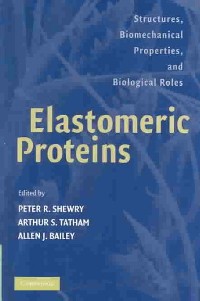
Elastomeric proteins : structures, biomechanical properties, and biological roles /
副标题:无
作 者:edited by Peter R. Shewry, Arthur S. Tatham, Allen J. Bailey.
分类号:
ISBN:9780521815949
微信扫一扫,移动浏览光盘
简介
Summary:
Publisher Summary 1
Comparison of structures and mechanisms of elastic proteins in relation to their biological roles.
Publisher Summary 2
Elastic proteins occur in a wide range of biological systems where they have evolved to fulfill precise biological roles. The best known include proteins in vertebrate muscles and connective tissues, such as titin, elastin, fibrillin and spider silks. Interest in elastomeric proteins is currently high for several reasons. Firstly, they have biological and medical significance, particularly in human disease. Secondly, the unusual properties of proteins such as spider silks provide opportunities to develop novel materials. Thirdly, the development of scanning probe microscopy makes it possible to study structures and biomechanical properties of these proteins at the single molecule level.
目录
Cover 1
Half-title 3
Title 5
Copyright 6
Contents 7
Preface 9
Contributors 13
Elastomeric Proteins 17
ONE Functions of Elastomeric Proteins in Animals 19
INTRODUCTION 19
POWER AMPLIFIERS 19
ENERGY STORES FOR RUNNING 22
ENERGY STORES IN FLIGHT AND SWIMMING 24
RETURN SPRINGS 28
SMOOTHING FLOW 29
CUSHIONING IMPACTS 29
FORCE CONTROL 30
CONCLUSIONS 30
REFERENCES 30
TWO Elastic Proteins: Biological Roles and Mechanical Properties 33
INTRODUCTION 33
MATERIAL PROPERTIES 34
THE FUNCTIONAL DESIGN OF RUBBER-LIKE PROTEINS 38
THE FUNCTIONAL DESIGN OF COLLAGEN 44
THE FUNCTIONAL DESIGN OF MUSSEL BYSSAL FIBRES 47
THE FUNCTIONAL DESIGN OF SPIDER SILKS 50
CONCLUSIONS 54
ACKNOWLEDGEMENTS 55
REFERENCES 55
THREE Elastin as a Self-Assembling Biomaterial 57
INTRODUCTION 57
TROPOELASTIN 58
IN VIVO ASSEMBLY AND CROSS-LINKING 59
SELF-AGGREGATION OF ELASTIN 62
SELF-ASSEMBLY OF RECOMBINANT HUMAN ELASTIN POLYPEPTIDES 63
AGGREGATION AS AN ORDERING PROCESS 64
ACKNOWLEDGMENTS 68
REFERENCES 68
FOUR Ideal Protein Elasticity: The Elastin Models 72
INTRODUCTION 72
Definition of Ideal or Perfect Elasticity 72
Delineation of Internal Energy and Entropy Components of Elastomeric Force 73
Basic Statistical Mechanical Expression for Entropy 74
The Boltzmann Relation 74
Fundamental Expression for the Change in Entropy on Extension 75
Historical Notes of Proposed Mechanisms for Protein Entropic Elasticity 75
Classical (Random Chain Network) Theory of Rubber Elasticity 75
Decrease in Solvent Entropy on Extension 76
Damping of Internal Chain Dynamics on Extension 76
Inverse Temperature Transition Behaviour of Elastin and Its Models 76
Increase in Order with an Increase in Temperature 76
Composition of Poly(GVGVP) in Water as a Function of Temperature 77
A Structured State at Intermediate Temperatures for Elastin-Based Systems 78
MATERIALS 79
Preparation of Elastin Models 79
Synthesis of Model Systems 79
Preparation of Natural Materials 80
Purification Using Phase Transitional Behaviour 80
Cross-Linking of Elastin Models 80
General Cross-Linking Procedure 80
Efforts to Cross-Link Alpha-Elastin 81
Efforts to Cross-Link Heat-Denatured Poly(GVGVP) 81
SPECIALIZED METHODOLOGIES AND ANALYSIS OF RESULTS 81
Atomic Force Microscopy (AFM) in the Force-Extension Mode 81
Preparation of the Sample for AFM 81
The AFM Instrument 81
Obtaining the Single-Chain Force-Extension Curve 82
Analysis of the Results 83
Comparison of AFM Single-Chain and Macroscopic Elastic Moduli 84
The Acoustic Absorption Experiment 87
Sample Preparation and Experimental Set-up 87
Comparison of the Acoustic Absorptions of (GVGIP) and Natural Rubber 89
Dielectric Relaxation Studies on Elastin-Related Systems 89
Dielectric Relaxation and Acoustic Absorption Data for (GVGIP) Over the Frequency Range, 0.1 to 100 kHz 89
Related Dielectric Relaxation (Mechanical Resonance) Near 5 MHz for Poly(GVGIP) 91
Comparison of Poly(GVGVP) and Alpha-Elastin 93
Comparison of Cross-Linked Poly(GVGVP) to Fibrous Elastin 93
DISCUSSION 93
Relevance of Proposed Mechanisms for Protein Entropic (Ideal) Elasticity 93
The Flory Random Chain Network Theory of Entropic Elasticity? 95
Solvent Entropy Changes as a Source of Entropic Elastic Force? 99
Entropic Elasticity Due to Damping of Internal Chain Dynamic on Extension 100
Dependence of Entropy and Structural Free Energy on Oscillator Frequency 108
ACKNOWLEDGMENTS 109
REFERENCES 109
FIVE Fibrillin: From Microfibril Assembly to Biomechanical Function 112
INTRODUCTION 112
MOLECULAR ASSEMBLY 116
FIBRILLIN MOLECULE ALIGNMENT IN MICROFIBRILS 119
NEW MODEL OF FIBRILLIN ALIGNMENT IN EXTENSIBLE MICROFIBRILS 119
Untensioned Microfibrils 121
Extended Microfibrils 123
Molecular Alignment and Reversible Extensibility 124
Number of Fibrillin Molecules in Cross-Section 126
Microfibril Bundle Extensibility and Organisation 127
SUMMARY AND FUTURE PERSPECTIVES 128
ACKNOWLEDGMENTS 129
REFERENCES 129
SIX Spinning an Elastic Ribbon of Spider Silk 133
INTRODUCTION 133
EXAMINATION OF SILKS AND SPIDERS 134
Structure of the Retreat and Silk Ribbons 134
Gross Morphology of Major Ampullate Gland and Duct 138
Morphology of the Major Ampullate Spigot 140
Ultrastructure of the Major Ampullate Gland 143
CONCLUSIONS 146
ACKNOWLEDGEMENTS 151
REFERENCES 151
SEVEN Sequences, Structures, and Properties of Spider Silks 154
INTRODUCTION 154
BIOLOGICAL ASPECTS OF SPIDER SILK PRODUCTION 154
MECHANICAL PROPERTIES 155
PROTEIN SEQUENCES 156
BIOPHYSICAL STUDIES 162
STRUCTURE\u2013FUNCTION RELATIONSHIPS 163
CONCLUSIONS 167
REFERENCES 168
EIGHT The Nature of Some Spiders\u2019 Silks 170
INTRODUCTION 170
THE NATURAL ROLE OF SPIDER SILK 171
THE ORB WEB AND ITS TWO MAJOR SILKS 174
THREADS OF THE GARDEN SPIDER\u2019S ORB 176
WATER PLASTICISATION 181
SPINNING 184
THE ROLE OF MANUFACTURE FOR MECHANICS 185
CONCLUSIONS 186
ACKNOWLEDGMENTS 187
REFERENCES 187
NINE Collagen: Hierarchical Structure and Viscoelastic Properties of Tendon 193
INTRODUCTION 193
DEFORMATION MECHANISMS OF COLLAGEN FIBRILS 193
DEFORMATION MECHANISMS OF WHOLE TENDONS 196
In Situ Tensile Testing and X-ray Diffraction with Synchrotron Radiation 196
Results from In Situ Experiments 198
VISCOELASTIC MODEL FOR TENDON ELONGATION 200
REFERENCES 205
TEN Collagens with Elastin-and Silk-like Domains 207
INTRODUCTION 207
SHOCK-ABSORBING TETHERS 207
INCREMENTAL MODULUS 210
PROTEINS IN BYSSAL THREADS 213
Composition 213
Byssal Proteins 214
Collagen Domains and Sequence Transitions 217
IDENTIFICATION OF PROTEIN GRADIENTS 218
ASSEMBLY AND CROSS-LINKING 220
Cross-bridging Interactions 220
Axial Sequence 222
Register and Density 223
MECHANICAL MODELS 224
CONCLUSIONS 225
ACKNOWLEDGMENTS 226
REFERENCES 226
ELEVEN Conformational Compliance of Spectrins in Membrane Deformation, Morphogenesis, and Signalling 231
INTRODUCTION 231
TARGETING SPECTRIN TO THE MEMBRANE 233
N-terminal Actin-Binding Domain 233
Central Spectrin Repeat Region 233
Ankyrin 233
Ankyrin-Independent Membrane Association 235
Spectrin C-terminus 235
ROLES OF THE SPECTRIN-BASED MEMBRANE SKELETON 236
THE SPECTRIN REPEAT 240
SPECTRIN\u2019S CONFORMATIONAL COMPLIANCE IN ISOLATION 241
SPECTRIN EXTENSIBILITY AT THE RED CELL MEMBRANE 244
THERMAL FLUCTUATIONS AND THEIR DEFORMATION ENHANCEMENT 245
OTHER SPECTRIN NETWORKS 248
The Terminal Web 248
The Apical Contractile Ring 250
The Outer Hair Cell Lateral Membrane 250
Platelet Plasma Membrane 251
PERSPECTIVE 252
REFERENCES 254
TWELVE Giant Protein Titin: Structural and Functional Aspects 260
INTRODUCTION 260
A-Band Titin and the Structure of Thick Filament 262
I-Band Titin and Mechanism of Muscle Elasticity 263
Titin Extensibility In Vitro 264
Comparison of In Vitro and In Situ Titin Extensibilty 267
Titin in Muscle Regulation 270
ACKNOWLEDGEMENTS 271
REFERENCES 271
THIRTEEN Structure and Function of Resilin 277
INTRODUCTION 277
PHYSICAL PROPERTIES OF RESILIN 278
RESILIN CROSS-LINKS 279
DEFINING RESILIN 280
OCCURRENCE OF RESILIN 281
A RESILIN GENE 284
THE MOLECULAR BASIS FOR RESILIN ELASTICITY 287
BIOSYNTHESIS OF RESILIN 288
RESILIN COMPARED WITH OTHER CUTICULAR PROTEINS 289
SOME PROBLEMS FOR THE FUTURE 290
REFERENCES 292
FOURTEEN Gluten, the Elastomeric Protein of Wheat Seeds 297
INTRODUCTION 297
THE ORIGIN OF THE WHEAT GLUTEN NETWORK 297
WHEAT GLUTEN PROTEINS 301
THE HMW GLUTENIN SUBUNITS 303
SEQUENCES OF THE REPETITIVE DOMAINS 305
STRUCTURE OF THE HMW SUBUNIT REPETITIVE DOMAIN 308
SEQUENCES AND STRUCTURES OF THE NON-REPETITIVE DOMAINS 309
HMW SUBUNIT STRUCTURE AND GLUTEN ELASTICITY 310
MANIPULATION OF HMW SUBUNIT COMPOSITION IN TRANSGENIC WHEAT 312
ACKNOWLEDGEMENTS 315
REFERENCES 315
FIFTEEN Biological Liquid Crystal Elastomers 320
INTRODUCTION 320
EVIDENCE THAT FIBRILLAR COLLAGENS ARE LLCEs 322
Liquid Crystalline Structure 322
Liquid Crystalline Assembly 325
Elastomeric Properties 325
EVIDENCE THAT ORB WEB SPIDER DRAGLINE SILKS ARE LLCEs 326
Liquid Crystalline Structure 326
Liquid Crystalline Assembly 328
Elastomeric Properties 330
DISCUSSION 330
Assembly of Spider Silk 331
Tensile Properties 332
Production of Biomimetic Materials 332
Exotic Properties 332
ACKNOWLEDGEMENTS 333
REFERENCES 333
SIXTEEN Restraining Cross-Links in Elastomeric Proteins 339
INTRODUCTION 339
COVALENT CROSS-LINKS 339
Peroxidase-Induced Di-tyrosine Cross-links 339
Resilin 339
Abductin 341
Lysyl Aldehyde-Derived Cross-links 341
Elastin 341
Collagen 343
Lamprey Cartilage 346
Transglutaminase-Derived Cross-links 346
Fibrillin 346
Disulphide Cross-links 348
Gluten 348
Catechol Oxidase\u2013Quinones 349
Byssus Threads 349
NON-COVALENT CROSS-LINKS 351
Co-ordinate Metal\u2013Ion Complexes 351
Byssus Threads 351
Hydrophobic Bond Cross-links 352
Silks 352
Hydrogen Bond Cross-links 353
Gluten 353
Silk 353
CONCLUDING REMARKS 353
REFERENCES 354
SEVENTEEN Comparative Structures and Properties of Elastic Proteins 356
INTRODUCTION 356
SEQUENCES OF ELASTOMERIC PROTEINS 356
STRUCTURAL FEATURES OF ELASTOMERIC PROTEINS 361
ELASTIC MECHANISM AND FUNCTION 363
CONCLUSIONS 366
REFERENCES 366
EIGHTEEN Mechanical Applications of Elastomeric Proteins\u2013A Biomimetic Approach 370
INTRODUCTION 370
PROTEINS IN CERAMICS 371
FIBROUS COMPOSITES 374
MECHANICAL PROPERTIES 378
USE OF PROTEINS IN MACROSTRUCTURES 380
REFERENCES 381
NINETEEN Biomimetics of Elastomeric Proteins in Medicine 384
INTRODUCTION 384
ELASTIN 384
SILKS 388
COLLAGEN 389
BRANCHED TRIPLE HELICAL PEPTIDES 390
CONCLUDING REMARKS 393
REFERENCES 393
Index 397
Half-title 3
Title 5
Copyright 6
Contents 7
Preface 9
Contributors 13
Elastomeric Proteins 17
ONE Functions of Elastomeric Proteins in Animals 19
INTRODUCTION 19
POWER AMPLIFIERS 19
ENERGY STORES FOR RUNNING 22
ENERGY STORES IN FLIGHT AND SWIMMING 24
RETURN SPRINGS 28
SMOOTHING FLOW 29
CUSHIONING IMPACTS 29
FORCE CONTROL 30
CONCLUSIONS 30
REFERENCES 30
TWO Elastic Proteins: Biological Roles and Mechanical Properties 33
INTRODUCTION 33
MATERIAL PROPERTIES 34
THE FUNCTIONAL DESIGN OF RUBBER-LIKE PROTEINS 38
THE FUNCTIONAL DESIGN OF COLLAGEN 44
THE FUNCTIONAL DESIGN OF MUSSEL BYSSAL FIBRES 47
THE FUNCTIONAL DESIGN OF SPIDER SILKS 50
CONCLUSIONS 54
ACKNOWLEDGEMENTS 55
REFERENCES 55
THREE Elastin as a Self-Assembling Biomaterial 57
INTRODUCTION 57
TROPOELASTIN 58
IN VIVO ASSEMBLY AND CROSS-LINKING 59
SELF-AGGREGATION OF ELASTIN 62
SELF-ASSEMBLY OF RECOMBINANT HUMAN ELASTIN POLYPEPTIDES 63
AGGREGATION AS AN ORDERING PROCESS 64
ACKNOWLEDGMENTS 68
REFERENCES 68
FOUR Ideal Protein Elasticity: The Elastin Models 72
INTRODUCTION 72
Definition of Ideal or Perfect Elasticity 72
Delineation of Internal Energy and Entropy Components of Elastomeric Force 73
Basic Statistical Mechanical Expression for Entropy 74
The Boltzmann Relation 74
Fundamental Expression for the Change in Entropy on Extension 75
Historical Notes of Proposed Mechanisms for Protein Entropic Elasticity 75
Classical (Random Chain Network) Theory of Rubber Elasticity 75
Decrease in Solvent Entropy on Extension 76
Damping of Internal Chain Dynamics on Extension 76
Inverse Temperature Transition Behaviour of Elastin and Its Models 76
Increase in Order with an Increase in Temperature 76
Composition of Poly(GVGVP) in Water as a Function of Temperature 77
A Structured State at Intermediate Temperatures for Elastin-Based Systems 78
MATERIALS 79
Preparation of Elastin Models 79
Synthesis of Model Systems 79
Preparation of Natural Materials 80
Purification Using Phase Transitional Behaviour 80
Cross-Linking of Elastin Models 80
General Cross-Linking Procedure 80
Efforts to Cross-Link Alpha-Elastin 81
Efforts to Cross-Link Heat-Denatured Poly(GVGVP) 81
SPECIALIZED METHODOLOGIES AND ANALYSIS OF RESULTS 81
Atomic Force Microscopy (AFM) in the Force-Extension Mode 81
Preparation of the Sample for AFM 81
The AFM Instrument 81
Obtaining the Single-Chain Force-Extension Curve 82
Analysis of the Results 83
Comparison of AFM Single-Chain and Macroscopic Elastic Moduli 84
The Acoustic Absorption Experiment 87
Sample Preparation and Experimental Set-up 87
Comparison of the Acoustic Absorptions of (GVGIP) and Natural Rubber 89
Dielectric Relaxation Studies on Elastin-Related Systems 89
Dielectric Relaxation and Acoustic Absorption Data for (GVGIP) Over the Frequency Range, 0.1 to 100 kHz 89
Related Dielectric Relaxation (Mechanical Resonance) Near 5 MHz for Poly(GVGIP) 91
Comparison of Poly(GVGVP) and Alpha-Elastin 93
Comparison of Cross-Linked Poly(GVGVP) to Fibrous Elastin 93
DISCUSSION 93
Relevance of Proposed Mechanisms for Protein Entropic (Ideal) Elasticity 93
The Flory Random Chain Network Theory of Entropic Elasticity? 95
Solvent Entropy Changes as a Source of Entropic Elastic Force? 99
Entropic Elasticity Due to Damping of Internal Chain Dynamic on Extension 100
Dependence of Entropy and Structural Free Energy on Oscillator Frequency 108
ACKNOWLEDGMENTS 109
REFERENCES 109
FIVE Fibrillin: From Microfibril Assembly to Biomechanical Function 112
INTRODUCTION 112
MOLECULAR ASSEMBLY 116
FIBRILLIN MOLECULE ALIGNMENT IN MICROFIBRILS 119
NEW MODEL OF FIBRILLIN ALIGNMENT IN EXTENSIBLE MICROFIBRILS 119
Untensioned Microfibrils 121
Extended Microfibrils 123
Molecular Alignment and Reversible Extensibility 124
Number of Fibrillin Molecules in Cross-Section 126
Microfibril Bundle Extensibility and Organisation 127
SUMMARY AND FUTURE PERSPECTIVES 128
ACKNOWLEDGMENTS 129
REFERENCES 129
SIX Spinning an Elastic Ribbon of Spider Silk 133
INTRODUCTION 133
EXAMINATION OF SILKS AND SPIDERS 134
Structure of the Retreat and Silk Ribbons 134
Gross Morphology of Major Ampullate Gland and Duct 138
Morphology of the Major Ampullate Spigot 140
Ultrastructure of the Major Ampullate Gland 143
CONCLUSIONS 146
ACKNOWLEDGEMENTS 151
REFERENCES 151
SEVEN Sequences, Structures, and Properties of Spider Silks 154
INTRODUCTION 154
BIOLOGICAL ASPECTS OF SPIDER SILK PRODUCTION 154
MECHANICAL PROPERTIES 155
PROTEIN SEQUENCES 156
BIOPHYSICAL STUDIES 162
STRUCTURE\u2013FUNCTION RELATIONSHIPS 163
CONCLUSIONS 167
REFERENCES 168
EIGHT The Nature of Some Spiders\u2019 Silks 170
INTRODUCTION 170
THE NATURAL ROLE OF SPIDER SILK 171
THE ORB WEB AND ITS TWO MAJOR SILKS 174
THREADS OF THE GARDEN SPIDER\u2019S ORB 176
WATER PLASTICISATION 181
SPINNING 184
THE ROLE OF MANUFACTURE FOR MECHANICS 185
CONCLUSIONS 186
ACKNOWLEDGMENTS 187
REFERENCES 187
NINE Collagen: Hierarchical Structure and Viscoelastic Properties of Tendon 193
INTRODUCTION 193
DEFORMATION MECHANISMS OF COLLAGEN FIBRILS 193
DEFORMATION MECHANISMS OF WHOLE TENDONS 196
In Situ Tensile Testing and X-ray Diffraction with Synchrotron Radiation 196
Results from In Situ Experiments 198
VISCOELASTIC MODEL FOR TENDON ELONGATION 200
REFERENCES 205
TEN Collagens with Elastin-and Silk-like Domains 207
INTRODUCTION 207
SHOCK-ABSORBING TETHERS 207
INCREMENTAL MODULUS 210
PROTEINS IN BYSSAL THREADS 213
Composition 213
Byssal Proteins 214
Collagen Domains and Sequence Transitions 217
IDENTIFICATION OF PROTEIN GRADIENTS 218
ASSEMBLY AND CROSS-LINKING 220
Cross-bridging Interactions 220
Axial Sequence 222
Register and Density 223
MECHANICAL MODELS 224
CONCLUSIONS 225
ACKNOWLEDGMENTS 226
REFERENCES 226
ELEVEN Conformational Compliance of Spectrins in Membrane Deformation, Morphogenesis, and Signalling 231
INTRODUCTION 231
TARGETING SPECTRIN TO THE MEMBRANE 233
N-terminal Actin-Binding Domain 233
Central Spectrin Repeat Region 233
Ankyrin 233
Ankyrin-Independent Membrane Association 235
Spectrin C-terminus 235
ROLES OF THE SPECTRIN-BASED MEMBRANE SKELETON 236
THE SPECTRIN REPEAT 240
SPECTRIN\u2019S CONFORMATIONAL COMPLIANCE IN ISOLATION 241
SPECTRIN EXTENSIBILITY AT THE RED CELL MEMBRANE 244
THERMAL FLUCTUATIONS AND THEIR DEFORMATION ENHANCEMENT 245
OTHER SPECTRIN NETWORKS 248
The Terminal Web 248
The Apical Contractile Ring 250
The Outer Hair Cell Lateral Membrane 250
Platelet Plasma Membrane 251
PERSPECTIVE 252
REFERENCES 254
TWELVE Giant Protein Titin: Structural and Functional Aspects 260
INTRODUCTION 260
A-Band Titin and the Structure of Thick Filament 262
I-Band Titin and Mechanism of Muscle Elasticity 263
Titin Extensibility In Vitro 264
Comparison of In Vitro and In Situ Titin Extensibilty 267
Titin in Muscle Regulation 270
ACKNOWLEDGEMENTS 271
REFERENCES 271
THIRTEEN Structure and Function of Resilin 277
INTRODUCTION 277
PHYSICAL PROPERTIES OF RESILIN 278
RESILIN CROSS-LINKS 279
DEFINING RESILIN 280
OCCURRENCE OF RESILIN 281
A RESILIN GENE 284
THE MOLECULAR BASIS FOR RESILIN ELASTICITY 287
BIOSYNTHESIS OF RESILIN 288
RESILIN COMPARED WITH OTHER CUTICULAR PROTEINS 289
SOME PROBLEMS FOR THE FUTURE 290
REFERENCES 292
FOURTEEN Gluten, the Elastomeric Protein of Wheat Seeds 297
INTRODUCTION 297
THE ORIGIN OF THE WHEAT GLUTEN NETWORK 297
WHEAT GLUTEN PROTEINS 301
THE HMW GLUTENIN SUBUNITS 303
SEQUENCES OF THE REPETITIVE DOMAINS 305
STRUCTURE OF THE HMW SUBUNIT REPETITIVE DOMAIN 308
SEQUENCES AND STRUCTURES OF THE NON-REPETITIVE DOMAINS 309
HMW SUBUNIT STRUCTURE AND GLUTEN ELASTICITY 310
MANIPULATION OF HMW SUBUNIT COMPOSITION IN TRANSGENIC WHEAT 312
ACKNOWLEDGEMENTS 315
REFERENCES 315
FIFTEEN Biological Liquid Crystal Elastomers 320
INTRODUCTION 320
EVIDENCE THAT FIBRILLAR COLLAGENS ARE LLCEs 322
Liquid Crystalline Structure 322
Liquid Crystalline Assembly 325
Elastomeric Properties 325
EVIDENCE THAT ORB WEB SPIDER DRAGLINE SILKS ARE LLCEs 326
Liquid Crystalline Structure 326
Liquid Crystalline Assembly 328
Elastomeric Properties 330
DISCUSSION 330
Assembly of Spider Silk 331
Tensile Properties 332
Production of Biomimetic Materials 332
Exotic Properties 332
ACKNOWLEDGEMENTS 333
REFERENCES 333
SIXTEEN Restraining Cross-Links in Elastomeric Proteins 339
INTRODUCTION 339
COVALENT CROSS-LINKS 339
Peroxidase-Induced Di-tyrosine Cross-links 339
Resilin 339
Abductin 341
Lysyl Aldehyde-Derived Cross-links 341
Elastin 341
Collagen 343
Lamprey Cartilage 346
Transglutaminase-Derived Cross-links 346
Fibrillin 346
Disulphide Cross-links 348
Gluten 348
Catechol Oxidase\u2013Quinones 349
Byssus Threads 349
NON-COVALENT CROSS-LINKS 351
Co-ordinate Metal\u2013Ion Complexes 351
Byssus Threads 351
Hydrophobic Bond Cross-links 352
Silks 352
Hydrogen Bond Cross-links 353
Gluten 353
Silk 353
CONCLUDING REMARKS 353
REFERENCES 354
SEVENTEEN Comparative Structures and Properties of Elastic Proteins 356
INTRODUCTION 356
SEQUENCES OF ELASTOMERIC PROTEINS 356
STRUCTURAL FEATURES OF ELASTOMERIC PROTEINS 361
ELASTIC MECHANISM AND FUNCTION 363
CONCLUSIONS 366
REFERENCES 366
EIGHTEEN Mechanical Applications of Elastomeric Proteins\u2013A Biomimetic Approach 370
INTRODUCTION 370
PROTEINS IN CERAMICS 371
FIBROUS COMPOSITES 374
MECHANICAL PROPERTIES 378
USE OF PROTEINS IN MACROSTRUCTURES 380
REFERENCES 381
NINETEEN Biomimetics of Elastomeric Proteins in Medicine 384
INTRODUCTION 384
ELASTIN 384
SILKS 388
COLLAGEN 389
BRANCHED TRIPLE HELICAL PEPTIDES 390
CONCLUDING REMARKS 393
REFERENCES 393
Index 397
Elastomeric proteins : structures, biomechanical properties, and biological roles /
- 名称
- 类型
- 大小
光盘服务联系方式: 020-38250260 客服QQ:4006604884
云图客服:
用户发送的提问,这种方式就需要有位在线客服来回答用户的问题,这种 就属于对话式的,问题是这种提问是否需要用户登录才能提问
Video Player
×
Audio Player
×
pdf Player
×
