

简介
Summary:
Publisher Summary 1
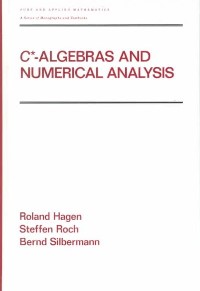
To those who might think that using C*-algebras to study properties of approximation methods as unusual and even exotic, Hagen (mathematics, Freies Gymnasium Penig), Steffen Roch (Technical U. of Darmstadt), and Bernd Silbermann (mathematics, Technical U. Chemnitz) invite them to pay the money and read the book to discover the power of such techniques both for investigating very concrete discretization procedures and for establishing the theoretical foundation of numerical analysis. They speak both to students wanting to see applications of functional analysis and to learn numeral analysis, and to mathematicians and engineers interested in the theoretical aspects of numerical analysis. Annotation c. Book News, Inc., Portland, OR (booknews.com)
目录
Preface p. 3
0 Introduction p. 11
0.1 Numerical analysis p. 11
0.2 Operator chemistry p. 14
0.3 The algebraic language of numerical analysis p. 15
0.4 Microscoping p. 18
0.5 A few remarks on economy p. 21
0.6 Brief description of the contents p. 22
1 The algebraic language of numerical analysis p. 25
1.1 Approximation methods p. 25
1.1.1 Basic definitions p. 26
1.1.2 Projection methods p. 28
1.1.3 Finite section method p. 31
1.2 Banach algebras and stability p. 34
1.2.1 Algebras, ideals and homomorphisms p. 35
1.2.2 Algebraization of stability p. 36
1.2.3 Small perturbations p. 39
1.2.4 Compact perturbations p. 39
1.3 Finite sections of Toeplitz operators with continuous generating function p. 45
1.3.1 Laurent, Toeplitz and Hankel operators p. 45
1.3.2 Invertibility and Fredholmness of Toeplitz operators p. 48
1.3.3 The finite section method p. 49
1.4 C*-algebras of approximation sequences p. 52
1.4.1 C*-algebras, their ideals and homomorphisms p. 53
1.4.2 The Toeplitz C*-algebra and the C*-algebra of the finite section method for Toeplitz operators p. 56
1.4.3 Stability of sequences in the C*-algebra of the finite section method for Toeplitz operators p. 60
1.4.4 Symbol of the finite section method for Toeplitz operators p. 61
1.5 Asymptotic behaviour of condition numbers p. 62
1.5.1 The condition of an operator p. 63
1.5.2 Convergence of norms p. 64
1.5.3 Condition numbers of finite sections of Toeplitz operators p. 65
1.6 Fractality of approximation methods p. 66
1.6.1 Fractal homomorphisms, fractal algebras, fractal sequences p. 67
1.6.2 Fractal algebras, and convergence of norms p. 71
Notes and references p. 73
2 Regularization of approximation methods p. 75
2.1 Stably regularizable sequences p. 76
2.1.1 Moore-Penrose inverses and regularizations of matrices p. 76
2.1.2 Moore-Penrose inverses and regularization of operators p. 80
2.1.3 Stably regularizable approximation sequences p. 85
2.2 Algebraic characterization of stably regularizable sequences p. 89
2.2.1 Moore-Penrose invertibility in C*-algebras p. 89
2.2.2 Stable regularizability, and Moore-Penrose invertibility in F/G p. 92
2.2.3 Finite sections of Toeplitz operators and their stable regularizability p. 97
2.2.4 Convergence of generalized condition numbers p. 100
2.2.5 Difficulties with Moore-Penrose stability p. 103
Notes and references p. 104
3 Approximation of spectra p. 105
3.1 Set sequences p. 105
3.1.1 Limiting sets of set functions p. 106
3.1.2 Coincidence of the partial and uniform limiting set p. 108
3.2 Spectra and their limiting sets p. 110
3.2.1 Limiting sets of spectra of norm convergent sequences p. 112
3.2.2 Limiting sets of spectra: the general case p. 114
3.2.3 The case of fractal sequences p. 117
3.2.4 Limiting sets of singular values p. 119
3.3 Pseudospectra and their limiting sets p. 119
3.3.1 [varepsilon]-invertibility p. 119
3.3.2 Limiting sets of pseudospectra p. 125
3.3.3 The case of fractal sequences p. 127
3.3.4 Pseudospectra of operator polynomials p. 128
3.4 Numerical ranges and their limiting sets p. 134
3.4.1 Spatial and algebraic numerical ranges p. 134
3.4.2 Limiting sets of numerical ranges p. 136
3.4.3 The case of fractal sequences p. 140
Notes and references p. 143
4 Stability analysis for concrete approximation methods p. 145
4.1 Local principles p. 146
4.1.1 Commutative C*-algebras p. 146
4.1.2 The local principle by Allan and Douglas p. 149
4.1.3 Fredholmness of Toeplitz operators with piecewise continuous generating function p. 151
4.2 Finite sections of Toeplitz operators generated by a piecewise continuous function p. 158
4.2.1 The lifting theorem p. 158
4.2.2 Application of the local principle p. 163
4.2.3 Galerkin methods with spline ansatz for singular integral equations p. 167
4.3 Finite sections of Toeplitz operators generated by a quasi-continuous function p. 169
4.3.1 Quasicontinuous functions p. 169
4.3.2 Stability of the finite section method p. 173
4.3.3 Some other classes of oscillating functions p. 175
4.4 Polynomial collocation methods for singular integral operators with piecewise continuous coefficients p. 177
4.4.1 Singular integral operators p. 178
4.4.2 Stability of the polynomial collocation method p. 183
4.4.3 Collocation versus Galerkin methods p. 187
4.5 Paired circulants and spline approximation methods p. 188
4.5.1 Circulants and paired circulants p. 190
4.5.2 The stability theorem p. 191
4.6 Finite sections of band-dominated operators p. 197
4.6.1 Multidimensional band dominated operators p. 197
4.6.2 Fredholmness of band dominated operators p. 198
4.6.3 Finite sections of band dominated operators p. 200
Notes and references p. 204
5 Representation theory p. 207
5.1 Representations p. 208
5.1.1 The spectrum of a C*-algebra p. 208
5.1.2 Primitive ideals p. 210
5.1.3 The spectrum of an ideal and of a quotient p. 212
5.1.4 Representations of some concrete algebras p. 213
5.2 Postliminal algebras p. 222
5.2.1 Liminal and postliminal algebras p. 223
5.2.2 Dual algebras p. 226
5.2.3 Finite sections of Wiener-Hopf operators with almost periodic generating function p. 230
5.3 Lifting theorems and representation theory p. 238
5.3.1 Lifting one ideal p. 238
5.3.2 The lifting theorem p. 239
5.3.3 Sufficient families of homomorphisms p. 243
5.3.4 Structure of fractal lifting homomorphisms p. 249
Notes and references p. 254
6 Fredholm sequences p. 255
6.1 Fredholm sequences in standard algebras p. 256
6.1.1 The standard model p. 256
6.1.2 Fredholm sequences p. 258
6.1.3 Fredholm sequences and stable regularizability p. 259
6.1.4 Fredholm sequences and Moore-Penrose stability p. 260
6.2 Fredholm sequences and the asymptotic behavior of singular values p. 264
6.2.1 The main result p. 265
6.2.2 A distinguished element and its range dimension p. 266
6.2.3 Upper estimate of dim Im [Pi subscript n] p. 269
6.2.4 Lower estimate of dim Im [Pi subscript n] p. 270
6.2.5 Some examples p. 276
6.3 A general Fredholm theory p. 282
6.3.1 Centrally compact and Fredholm sequences p. 282
6.3.2 Fredholmness modulo compact elements p. 288
6.3.3 Fredholm sequences in standard algebras p. 297
6.4 Weakly Fredholm sequences p. 305
6.4.1 Sequences with finite splitting property p. 305
6.4.2 Properties of weakly Fredholm sequences p. 305
6.4.3 Strong limits of weakly Fredholm sequences p. 307
6.4.4 Weakly Fredholm sequences of matrices p. 313
6.5 Some applications p. 314
6.5.1 Numerical determination of the kernel dimension p. 314
6.5.2 Around the finite section method for Toeplitz operators p. 315
6.5.3 Discretization of shift operators p. 317
Notes and references p. 322
7 Self-adjoint approximation sequences p. 323
7.1 The spectrum of a self-adjoint approximation sequence p. 323
7.1.1 Essential and transient points p. 323
7.1.2 Fractality of self-adjoint sequences p. 327
7.1.3 Arveson dichotomy: band operators p. 333
7.1.4 Arveson dichotomy: standard algebras p. 338
7.2 Szego-type theorems p. 339
7.2.1 Folner and Szego algebras p. 340
7.2.2 Szego's theorem revisited p. 346
7.2.3 A further generalization of Szego's theorem p. 348
7.2.4 Algebras with unique tracial state p. 352
Notes and references p. 354
Bibliography p. 357
Index p. 373
0 Introduction p. 11
0.1 Numerical analysis p. 11
0.2 Operator chemistry p. 14
0.3 The algebraic language of numerical analysis p. 15
0.4 Microscoping p. 18
0.5 A few remarks on economy p. 21
0.6 Brief description of the contents p. 22
1 The algebraic language of numerical analysis p. 25
1.1 Approximation methods p. 25
1.1.1 Basic definitions p. 26
1.1.2 Projection methods p. 28
1.1.3 Finite section method p. 31
1.2 Banach algebras and stability p. 34
1.2.1 Algebras, ideals and homomorphisms p. 35
1.2.2 Algebraization of stability p. 36
1.2.3 Small perturbations p. 39
1.2.4 Compact perturbations p. 39
1.3 Finite sections of Toeplitz operators with continuous generating function p. 45
1.3.1 Laurent, Toeplitz and Hankel operators p. 45
1.3.2 Invertibility and Fredholmness of Toeplitz operators p. 48
1.3.3 The finite section method p. 49
1.4 C*-algebras of approximation sequences p. 52
1.4.1 C*-algebras, their ideals and homomorphisms p. 53
1.4.2 The Toeplitz C*-algebra and the C*-algebra of the finite section method for Toeplitz operators p. 56
1.4.3 Stability of sequences in the C*-algebra of the finite section method for Toeplitz operators p. 60
1.4.4 Symbol of the finite section method for Toeplitz operators p. 61
1.5 Asymptotic behaviour of condition numbers p. 62
1.5.1 The condition of an operator p. 63
1.5.2 Convergence of norms p. 64
1.5.3 Condition numbers of finite sections of Toeplitz operators p. 65
1.6 Fractality of approximation methods p. 66
1.6.1 Fractal homomorphisms, fractal algebras, fractal sequences p. 67
1.6.2 Fractal algebras, and convergence of norms p. 71
Notes and references p. 73
2 Regularization of approximation methods p. 75
2.1 Stably regularizable sequences p. 76
2.1.1 Moore-Penrose inverses and regularizations of matrices p. 76
2.1.2 Moore-Penrose inverses and regularization of operators p. 80
2.1.3 Stably regularizable approximation sequences p. 85
2.2 Algebraic characterization of stably regularizable sequences p. 89
2.2.1 Moore-Penrose invertibility in C*-algebras p. 89
2.2.2 Stable regularizability, and Moore-Penrose invertibility in F/G p. 92
2.2.3 Finite sections of Toeplitz operators and their stable regularizability p. 97
2.2.4 Convergence of generalized condition numbers p. 100
2.2.5 Difficulties with Moore-Penrose stability p. 103
Notes and references p. 104
3 Approximation of spectra p. 105
3.1 Set sequences p. 105
3.1.1 Limiting sets of set functions p. 106
3.1.2 Coincidence of the partial and uniform limiting set p. 108
3.2 Spectra and their limiting sets p. 110
3.2.1 Limiting sets of spectra of norm convergent sequences p. 112
3.2.2 Limiting sets of spectra: the general case p. 114
3.2.3 The case of fractal sequences p. 117
3.2.4 Limiting sets of singular values p. 119
3.3 Pseudospectra and their limiting sets p. 119
3.3.1 [varepsilon]-invertibility p. 119
3.3.2 Limiting sets of pseudospectra p. 125
3.3.3 The case of fractal sequences p. 127
3.3.4 Pseudospectra of operator polynomials p. 128
3.4 Numerical ranges and their limiting sets p. 134
3.4.1 Spatial and algebraic numerical ranges p. 134
3.4.2 Limiting sets of numerical ranges p. 136
3.4.3 The case of fractal sequences p. 140
Notes and references p. 143
4 Stability analysis for concrete approximation methods p. 145
4.1 Local principles p. 146
4.1.1 Commutative C*-algebras p. 146
4.1.2 The local principle by Allan and Douglas p. 149
4.1.3 Fredholmness of Toeplitz operators with piecewise continuous generating function p. 151
4.2 Finite sections of Toeplitz operators generated by a piecewise continuous function p. 158
4.2.1 The lifting theorem p. 158
4.2.2 Application of the local principle p. 163
4.2.3 Galerkin methods with spline ansatz for singular integral equations p. 167
4.3 Finite sections of Toeplitz operators generated by a quasi-continuous function p. 169
4.3.1 Quasicontinuous functions p. 169
4.3.2 Stability of the finite section method p. 173
4.3.3 Some other classes of oscillating functions p. 175
4.4 Polynomial collocation methods for singular integral operators with piecewise continuous coefficients p. 177
4.4.1 Singular integral operators p. 178
4.4.2 Stability of the polynomial collocation method p. 183
4.4.3 Collocation versus Galerkin methods p. 187
4.5 Paired circulants and spline approximation methods p. 188
4.5.1 Circulants and paired circulants p. 190
4.5.2 The stability theorem p. 191
4.6 Finite sections of band-dominated operators p. 197
4.6.1 Multidimensional band dominated operators p. 197
4.6.2 Fredholmness of band dominated operators p. 198
4.6.3 Finite sections of band dominated operators p. 200
Notes and references p. 204
5 Representation theory p. 207
5.1 Representations p. 208
5.1.1 The spectrum of a C*-algebra p. 208
5.1.2 Primitive ideals p. 210
5.1.3 The spectrum of an ideal and of a quotient p. 212
5.1.4 Representations of some concrete algebras p. 213
5.2 Postliminal algebras p. 222
5.2.1 Liminal and postliminal algebras p. 223
5.2.2 Dual algebras p. 226
5.2.3 Finite sections of Wiener-Hopf operators with almost periodic generating function p. 230
5.3 Lifting theorems and representation theory p. 238
5.3.1 Lifting one ideal p. 238
5.3.2 The lifting theorem p. 239
5.3.3 Sufficient families of homomorphisms p. 243
5.3.4 Structure of fractal lifting homomorphisms p. 249
Notes and references p. 254
6 Fredholm sequences p. 255
6.1 Fredholm sequences in standard algebras p. 256
6.1.1 The standard model p. 256
6.1.2 Fredholm sequences p. 258
6.1.3 Fredholm sequences and stable regularizability p. 259
6.1.4 Fredholm sequences and Moore-Penrose stability p. 260
6.2 Fredholm sequences and the asymptotic behavior of singular values p. 264
6.2.1 The main result p. 265
6.2.2 A distinguished element and its range dimension p. 266
6.2.3 Upper estimate of dim Im [Pi subscript n] p. 269
6.2.4 Lower estimate of dim Im [Pi subscript n] p. 270
6.2.5 Some examples p. 276
6.3 A general Fredholm theory p. 282
6.3.1 Centrally compact and Fredholm sequences p. 282
6.3.2 Fredholmness modulo compact elements p. 288
6.3.3 Fredholm sequences in standard algebras p. 297
6.4 Weakly Fredholm sequences p. 305
6.4.1 Sequences with finite splitting property p. 305
6.4.2 Properties of weakly Fredholm sequences p. 305
6.4.3 Strong limits of weakly Fredholm sequences p. 307
6.4.4 Weakly Fredholm sequences of matrices p. 313
6.5 Some applications p. 314
6.5.1 Numerical determination of the kernel dimension p. 314
6.5.2 Around the finite section method for Toeplitz operators p. 315
6.5.3 Discretization of shift operators p. 317
Notes and references p. 322
7 Self-adjoint approximation sequences p. 323
7.1 The spectrum of a self-adjoint approximation sequence p. 323
7.1.1 Essential and transient points p. 323
7.1.2 Fractality of self-adjoint sequences p. 327
7.1.3 Arveson dichotomy: band operators p. 333
7.1.4 Arveson dichotomy: standard algebras p. 338
7.2 Szego-type theorems p. 339
7.2.1 Folner and Szego algebras p. 340
7.2.2 Szego's theorem revisited p. 346
7.2.3 A further generalization of Szego's theorem p. 348
7.2.4 Algebras with unique tracial state p. 352
Notes and references p. 354
Bibliography p. 357
Index p. 373
- 名称
- 类型
- 大小
光盘服务联系方式: 020-38250260 客服QQ:4006604884
云图客服:
用户发送的提问,这种方式就需要有位在线客服来回答用户的问题,这种 就属于对话式的,问题是这种提问是否需要用户登录才能提问
Video Player
×
Audio Player
×
pdf Player
×
