

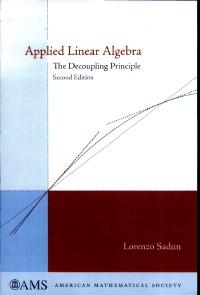
Applied linear algebra : the decoupling principle / 2nd ed.
副标题:无
作 者:Lorenzo Sadun.
分类号:
ISBN:9780821844410
微信扫一扫,移动浏览光盘
简介
"Linear algebra permeates mathematics, as well as physics and engineering. In this text for junior and senior undergraduates, Sadun treats diagonalization as a central tool in solving complicated problems in these subjects by reducing coupled linear evolution problems to a sequence of simpler decoupled problems. This is the Decoupling Principle." "Sadun includes some topics relating to infinite-dimensional spaces. He does not present a generaltheory, but enough so as to apply the decoupling principleto the wave equation, leading to Fourier series and the Fourier transform." "The second edition contains a series of Explorations. Most are numerical labs in which the reader is asked to use standard computer software to look deeper into the subject. Some explorations are theoretical,for instance, relating linear algebra to quantum mechanics. There is also an appendix reviewing basic matrix operations and another with solutions to a third ofthe exercises."--BOOK JACKET.
目录
Chapter 1. The Decoupling Principle 1
Exploration: Beats 8
Chapter 2. Vector Spaces and Bases 9
?.1. Vector Spaces 9
?.2. Linear Independence, Basis, and Dimension 14
?.3. Properties and Uses of a Basis 21
Exploration: Polynomials 24
?.4. Change of Basis 25
?.5. Building New Vector Spaces from Old Ones 29
Exploration: Projections 1 35
Chapter 3. Linear Transformations and Operators 37
?.1. Definitions and Examples 37
Exploration: Computer Graphics 43
?.2. The Matrix of a Linear Transformation 44
?.3. The Effect of a Change of Basis 48
?.4. Infinite Dimensional Vector Spaces 51
?.5. Kernels, Ranges, and Quotient Maps 53
Chapter 4. An Introduction to Eigenvalues 57
?.1. Definitions and Examples 57
?.2. Bases of Eigenvectors 59
?.3. Eigenvalues and the Characteristic Polynomial 61
?.4. The Need for Complex Eigenvalues 67
Exploration: Circles and Ellipses 71
?.5. When is an Operator Diagonalizable? 72
?.6. Traces, Determinants, and Tricks of the Trade 77
?.7. Simultaneous Diagonalization of Two Operators 82
?.8. Exponentials of Complex Numbers and Matrices 86
?.9. Power Vectors and Jordan Canonical Form 90
Chapter 5. Some Crucial Applications 97
?.1. Discrete-Time Evolution: x(n) = Ax(n - 1) 97
Exploration: Fibonacci Numbers and Tilings 103
?.2. First-Order Continuous-Time Evolution: dx/dt = Ax 104
?.3. Second-order Continuous-Time Evolution: d2x/dt2 = Ax 108
?.4. Reducing Second-Order Problems to First-Order 116
Exploration: Difference Equations 119
?.5. Long-Time Behavior and Stability 120
?.6. Markov Chains and Probability Matrices 126
Exploration: Random Walks 135
?.7. Linear Analysis near Fixed Points of Nonlinear Problems 136
Exploration: Nonlinear ODEs 143
Chapter 6. Inner Products 145
?.1. Real Inner Products: Definitions and Examples 145
?.2. Complex Inner Products 149
?.3. Bras, Kets, and Duality 152
?.4. Expansion in Orthonormal Bases: Finding Coefficients 158
?.5. Projections and the Gram-Schmidt Process 161
?.6. Orthogonal Complements and Projections onto Subspaces 167
?.7. Least Squares Solutions 170
Exploration: Curve Fitting 176
?.8. The Spaces ? and L2 177
?.9. Fourier Series on an Interval 182
Exploration: Fourier Series 188
Chapter 7. Adjoints, Hermitian Operators, and Unitary Operators 189
?.1. Adjoints and Transposes 190
?.2. Hermitian Operators 194
?.3. Quadratic Forms and Real Symmetric Matrices 200
?.4. Rotations, Orthogonal Operators, and Unitary Operators 207
Exploration: Normal Matrices 215
?.5. How the Four Classes are Related 216
Exploration: Representations of su2 220
Chapter 8. The Wave Equation 223
?.1. Waves on the Line 224
?.2. Waves on the Half-Line: Dirichlet and Neumann Boundary
Conditions 227
?.3. The Vibrating String 232
Exploration: Discretizing the Wave Equation 235
?.4. Standing Waves and Fourier Series 237
?.5. Periodic Boundary Conditions 242
?.6. Equivalence of Traveling Waves and Standing Waves 250
?.7. The Different Types of Fourier Series 254
Chapter 9. Continuous Spectra and the Dirac Delta Function 259
?.1. The Spectrum of a Linear Operator 260
?.2. The Dirac 3 Function 264
?.3. Distributions 269
?.4. Generalized Eigenfunction Expansions: The Spectral
Theorem 272
Chapter 10. Fourier Transforms 281
?0.1. Existence of Fourier Transforms 281
?0.2. Basic Properties of Fourier Transforms 286
?0.3. Convolutions and Differential Equations 292
Exploration: The Central Limit Theorem 294
?0.4. Partial Differential Equations 295
?0.5. Bandwidth and Heisenberg's Uncertainty Principle 301
?0.6. Fourier Transforms on the Half-Line 306
Chapter 11. Green's Functions 311
?1.1. Delta Functions and the Superposition Principle 311
?1.2. Inverting Operators 314
?1.3. The Method of Images 319
?1.4. Initial Value Problems 325
?1.5. Laplace's Equation on R2 330
Appendix A. Matrix Operations 337
A.1. Matrix Multiplication 337
A.2. Row reduction 338
A.3. Rank 340
A.4. Solving Ax = 0. 341
A.5. The column space 342
A.6. Summary 343
Appendix B. Solutions to Selected Exercises 345
Applied linear algebra : the decoupling principle / 2nd ed.
- 名称
- 类型
- 大小
光盘服务联系方式: 020-38250260 客服QQ:4006604884
云图客服:
用户发送的提问,这种方式就需要有位在线客服来回答用户的问题,这种 就属于对话式的,问题是这种提问是否需要用户登录才能提问
Video Player
×
Audio Player
×
pdf Player
×
