

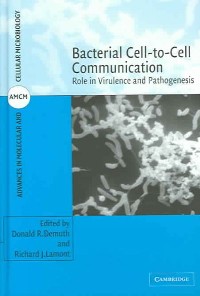
Bacterial cell-to-cell communication : role in virulence and pathogenesis /
副标题:无
作 者:edited by Donald R. Demuth and Richard J. Lamont.
分类号:
ISBN:9780521846387
微信扫一扫,移动浏览光盘
简介
Summary:
Publisher Summary 1
Descibes latest developments in bacterial communication and the role of these mechanisms in disease.
Publisher Summary 2
Many bacterial diseases are caused by organisms growing together as communities or biofilms. These microorganisms have the capacity to coordinately regulate specific sets of genes by sensing and communicating amongst themselves utilizing a variety of signals. This book examines the mechanisms of quorum sensing and cell-to-cell communication in bacteria and the roles that these processes play in regulating virulence, bacterial interactions with host tissues, and microbial development. Recent studies suggest that microbial cell-to-cell communication plays an important role in the pathogenesis of a variety of disease processes.
目录
Cover 1
Half-title 3
Series-title 5
Title 7
Copyright 8
Contents 9
Contributors 11
Preface 15
CHAPTER 1 Quorum sensing and regulation of Pseudomonas aeruginosa infections 19
Introduction 19
P.aeruginosa quorum sensing systems 20
Extending the P.aeruginosa QS realm 23
Influence of QS on P.aeruginosa virulence in plant and animal models 27
QS plays an active role in vivo 30
QS as a therapeutic target 31
References 33
CHAPTER 2 The Pseudomonas aeruginosa quinolone signal 41
Introduction 41
Discovery of PQS 41
Relationship of PQS to the P.aeruginosa quorum sensing circuitry 42
The genetics of PQS synthesis 43
The regulation of PQS synthesis 47
The timing of PQS production 49
PQS and P.aeruginosa virulence 51
The potential of PQS as a drug target 52
Other PQS-like molecules synthesized by P.aeruginosa 53
Concluding remarks 53
Acknowledgements 53
References 53
CHAPTER 3 Quorum-sensing-mediated regulation of plant\u2013bacteria interactions and Agrobacterium tumefaciens virulence 57
Introduction 57
The Ti plasmids of A.tumefaciens and the discovery of AHLs as conjugal pheromones 58
Identification of a Ti-plasmid-encoded AHL synthase and AHL receptor 61
Regulation of traR expression 62
Post-transcriptional regulation of TraR activity 64
The role of OOHL in TraR maturation 67
Structure and function studies of TraR 68
TraR as an activator of transcription 71
Perspectives and future studies 73
Acknowledgements 75
References 76
CHAPTER 4 Jamming bacterial communications: new strategies to combat bacterial infections and the development of biofilms 83
Introduction 83
Why QS inhibitors? 84
Pseudomonas aeruginosa and QS 86
The involvement of QS in P.aeruginosa biofilm development 87
Natural blockers: a eukaryotic defense strategy against biofilms and biofouling 89
Synthetic analogs 91
Screens for QS inhibitors 94
Novel QSI screens 96
Novel natural QSIs 97
Transcriptomics: the ultimate tool for analyzing drug specificity 99
Biofilm models: what QSI drugs do to a biofilm 102
Pulmonary dose\u2013response models 104
Treatment model 106
Antibiotics and QSI drugs: alone or together? 107
Acknowledgement 108
References 108
CHAPTER 5 Quorum-sensing-mediated regulation of biofilm growth and virulence of Vibrio cholerae 119
Introduction 119
Vibrio cholerae as a human pathogen and its infectious cycle 120
Quorum sensing regulation in V.cholerae 122
Quorum sensing negatively regulates virulence gene expression 124
Quorum sensing inhibits biofilm formation 125
Perspectives and future studies 129
Acknowledgements 130
References 131
CHAPTER 6 LuxS in cellular metabolism and cell-to-cell signaling 135
Introduction 135
Homoserine lactone quorum sensing systems 136
Oligopeptide quorum sensing pathways 136
Identification of LuxS 137
Metabolic pathway of AI-2 production 139
The structures of AI-2 141
The controversy of AI-2 and cell-to-cell signaling 144
AI-2 as a classical quorum sensing signal 146
AI-2 as a quorum sensing signal in bacteria other than Vibrio spp. 147
Bacteria with ambiguous roles for AI-2 150
AI-2 as an interspecies quorum sensing signal 152
Cell-to-cell signaling and AI-2 in dental plaque 153
The CF community 155
AI-2 as a reporter of metabolic status 156
Conclusions 159
References 160
CHAPTER 7 LuxS-dependent regulation of Escherichia coli virulence 169
Introduction 169
Enterohemorrhagic E.coli (EHEC) 169
LuxS and cell-to-cell signaling in bacteria 170
Cell-to-cell signaling in EHEC 173
Bacterial\u2013host cell-to-cell signaling 175
The EHEC quorum-sensing signaling cascade 177
Quorum sensing in EPEC 184
Concluding remarks 185
References 186
CHAPTER 8 Quorum sensing and cell-to-cell communication in the dental biofilm 193
Introduction 193
Contact-dependent signaling in oral bacteria 194
Quorum-sensing-dependent communication among oral bacteria 198
Quorum sensing by autoinducer 2 in oral bacteria 200
Is AI-2 a quorum sensing signal in oral bacteria? 201
Physiologic role of LuxS-dependent signaling: regulation of iron acquisition 202
LuxS-dependent regulation of virulence and biofilm development 203
AI-2 signal transduction in A.actinomycetemcomitans and P. gingivalis 205
The A.actinomycetemcomitans AI-2 receptor 206
The A.actinomycetemcomitans AI-2 sensor kinase 208
AI-2 signal transduction in P.gingivalis 210
Crosstalk and implications for AI-2 signal specificity 210
Acknowledgements 212
References 212
CHAPTER 9 Quorum-sensing-dependent regulation of staphylococcal virulence and biofilm development 217
Introduction 217
The Agr quorum sensing system 218
Agr-regulated genes 221
Quorum sensing in other staphylococci 225
Staphylococcus epidermidis 225
Staphylococcus lugdunensis 226
Staphylococcus saprophyticus 227
Agr specificity groups 227
Agr regulation of virulence in the context of other regulators and the environment in vivo 229
SrrAB 230
The sae locus 230
ArlRS 231
The σB factor 231
ClpX and ClpP 231
The SarA family 232
Regulation by Agr in vivo 232
Agr and staphylococcal biofilms 234
Initial attachment 235
Maturation 235
Detachment 236
Agr variants and their role in staphylococcal pathogenesis 238
Inhibition of staphylococcal quorum sensing as a therapeutic tool 242
RIP/RAP 242
Conclusion 244
Acknowledgements 244
References 244
CHAPTER 10 Cell-density-dependent regulation of streptococcal competence 251
Introduction 251
A brief history 251
Cell-density-dependent competence development 253
Genetic competence regulation in S.pneumoniae 254
The ComCDE competence regulon in S.pneumoniae 254
The competence-stimulating peptide (CSP) 255
The ComD, CSP receptor 258
The ComE response regulator 259
ComX: the link to late competence genes 260
Competence-induced cell lysis 262
Competence shutoff 263
The CiaRH and VicRK two-component signal transduction systems (TCSTS) 264
The Blp quorum-sensing system 265
Genetic competence in oral streptococci 266
Transformation in Streptococcus gordonii 268
Genetics of competence development 268
Regulation of competence 269
Transformation in Streptococcus mutans 272
Genetic regulation of competence development 272
Study of competence in model biofilms 273
Other CSP-regulated phenotypes 276
Conclusions and future perspectives 277
References 278
CHAPTER 11 Signaling by a cell-surface-associated signal during fruiting-body morphogenesis in Myxococcus xanthus 287
Introduction 287
Multicellularity as a survival strategy 288
Gliding motility in M.xanthus 291
Intercellular signaling during fruiting-body morphogenesis 294
The C-signal induces three responses that are separated in time and space 295
The molecular nature of the C-signal 296
Synthesis of the C-signal 297
C-signal transmission relies on a contact-dependent mechanism 298
The C-signal transduction pathway 299
How does a single signal induce three responses separated in time and space? 303
Multiple signal transduction pathways control morphogenesis 305
The C-signal-dependent motility response 306
C-signal-induced aggregation: a model 307
Signal integration during fruiting-body morphogenesis 310
Concluding remarks 311
Acknowledgements 311
References 311
Index 319
Half-title 3
Series-title 5
Title 7
Copyright 8
Contents 9
Contributors 11
Preface 15
CHAPTER 1 Quorum sensing and regulation of Pseudomonas aeruginosa infections 19
Introduction 19
P.aeruginosa quorum sensing systems 20
Extending the P.aeruginosa QS realm 23
Influence of QS on P.aeruginosa virulence in plant and animal models 27
QS plays an active role in vivo 30
QS as a therapeutic target 31
References 33
CHAPTER 2 The Pseudomonas aeruginosa quinolone signal 41
Introduction 41
Discovery of PQS 41
Relationship of PQS to the P.aeruginosa quorum sensing circuitry 42
The genetics of PQS synthesis 43
The regulation of PQS synthesis 47
The timing of PQS production 49
PQS and P.aeruginosa virulence 51
The potential of PQS as a drug target 52
Other PQS-like molecules synthesized by P.aeruginosa 53
Concluding remarks 53
Acknowledgements 53
References 53
CHAPTER 3 Quorum-sensing-mediated regulation of plant\u2013bacteria interactions and Agrobacterium tumefaciens virulence 57
Introduction 57
The Ti plasmids of A.tumefaciens and the discovery of AHLs as conjugal pheromones 58
Identification of a Ti-plasmid-encoded AHL synthase and AHL receptor 61
Regulation of traR expression 62
Post-transcriptional regulation of TraR activity 64
The role of OOHL in TraR maturation 67
Structure and function studies of TraR 68
TraR as an activator of transcription 71
Perspectives and future studies 73
Acknowledgements 75
References 76
CHAPTER 4 Jamming bacterial communications: new strategies to combat bacterial infections and the development of biofilms 83
Introduction 83
Why QS inhibitors? 84
Pseudomonas aeruginosa and QS 86
The involvement of QS in P.aeruginosa biofilm development 87
Natural blockers: a eukaryotic defense strategy against biofilms and biofouling 89
Synthetic analogs 91
Screens for QS inhibitors 94
Novel QSI screens 96
Novel natural QSIs 97
Transcriptomics: the ultimate tool for analyzing drug specificity 99
Biofilm models: what QSI drugs do to a biofilm 102
Pulmonary dose\u2013response models 104
Treatment model 106
Antibiotics and QSI drugs: alone or together? 107
Acknowledgement 108
References 108
CHAPTER 5 Quorum-sensing-mediated regulation of biofilm growth and virulence of Vibrio cholerae 119
Introduction 119
Vibrio cholerae as a human pathogen and its infectious cycle 120
Quorum sensing regulation in V.cholerae 122
Quorum sensing negatively regulates virulence gene expression 124
Quorum sensing inhibits biofilm formation 125
Perspectives and future studies 129
Acknowledgements 130
References 131
CHAPTER 6 LuxS in cellular metabolism and cell-to-cell signaling 135
Introduction 135
Homoserine lactone quorum sensing systems 136
Oligopeptide quorum sensing pathways 136
Identification of LuxS 137
Metabolic pathway of AI-2 production 139
The structures of AI-2 141
The controversy of AI-2 and cell-to-cell signaling 144
AI-2 as a classical quorum sensing signal 146
AI-2 as a quorum sensing signal in bacteria other than Vibrio spp. 147
Bacteria with ambiguous roles for AI-2 150
AI-2 as an interspecies quorum sensing signal 152
Cell-to-cell signaling and AI-2 in dental plaque 153
The CF community 155
AI-2 as a reporter of metabolic status 156
Conclusions 159
References 160
CHAPTER 7 LuxS-dependent regulation of Escherichia coli virulence 169
Introduction 169
Enterohemorrhagic E.coli (EHEC) 169
LuxS and cell-to-cell signaling in bacteria 170
Cell-to-cell signaling in EHEC 173
Bacterial\u2013host cell-to-cell signaling 175
The EHEC quorum-sensing signaling cascade 177
Quorum sensing in EPEC 184
Concluding remarks 185
References 186
CHAPTER 8 Quorum sensing and cell-to-cell communication in the dental biofilm 193
Introduction 193
Contact-dependent signaling in oral bacteria 194
Quorum-sensing-dependent communication among oral bacteria 198
Quorum sensing by autoinducer 2 in oral bacteria 200
Is AI-2 a quorum sensing signal in oral bacteria? 201
Physiologic role of LuxS-dependent signaling: regulation of iron acquisition 202
LuxS-dependent regulation of virulence and biofilm development 203
AI-2 signal transduction in A.actinomycetemcomitans and P. gingivalis 205
The A.actinomycetemcomitans AI-2 receptor 206
The A.actinomycetemcomitans AI-2 sensor kinase 208
AI-2 signal transduction in P.gingivalis 210
Crosstalk and implications for AI-2 signal specificity 210
Acknowledgements 212
References 212
CHAPTER 9 Quorum-sensing-dependent regulation of staphylococcal virulence and biofilm development 217
Introduction 217
The Agr quorum sensing system 218
Agr-regulated genes 221
Quorum sensing in other staphylococci 225
Staphylococcus epidermidis 225
Staphylococcus lugdunensis 226
Staphylococcus saprophyticus 227
Agr specificity groups 227
Agr regulation of virulence in the context of other regulators and the environment in vivo 229
SrrAB 230
The sae locus 230
ArlRS 231
The σB factor 231
ClpX and ClpP 231
The SarA family 232
Regulation by Agr in vivo 232
Agr and staphylococcal biofilms 234
Initial attachment 235
Maturation 235
Detachment 236
Agr variants and their role in staphylococcal pathogenesis 238
Inhibition of staphylococcal quorum sensing as a therapeutic tool 242
RIP/RAP 242
Conclusion 244
Acknowledgements 244
References 244
CHAPTER 10 Cell-density-dependent regulation of streptococcal competence 251
Introduction 251
A brief history 251
Cell-density-dependent competence development 253
Genetic competence regulation in S.pneumoniae 254
The ComCDE competence regulon in S.pneumoniae 254
The competence-stimulating peptide (CSP) 255
The ComD, CSP receptor 258
The ComE response regulator 259
ComX: the link to late competence genes 260
Competence-induced cell lysis 262
Competence shutoff 263
The CiaRH and VicRK two-component signal transduction systems (TCSTS) 264
The Blp quorum-sensing system 265
Genetic competence in oral streptococci 266
Transformation in Streptococcus gordonii 268
Genetics of competence development 268
Regulation of competence 269
Transformation in Streptococcus mutans 272
Genetic regulation of competence development 272
Study of competence in model biofilms 273
Other CSP-regulated phenotypes 276
Conclusions and future perspectives 277
References 278
CHAPTER 11 Signaling by a cell-surface-associated signal during fruiting-body morphogenesis in Myxococcus xanthus 287
Introduction 287
Multicellularity as a survival strategy 288
Gliding motility in M.xanthus 291
Intercellular signaling during fruiting-body morphogenesis 294
The C-signal induces three responses that are separated in time and space 295
The molecular nature of the C-signal 296
Synthesis of the C-signal 297
C-signal transmission relies on a contact-dependent mechanism 298
The C-signal transduction pathway 299
How does a single signal induce three responses separated in time and space? 303
Multiple signal transduction pathways control morphogenesis 305
The C-signal-dependent motility response 306
C-signal-induced aggregation: a model 307
Signal integration during fruiting-body morphogenesis 310
Concluding remarks 311
Acknowledgements 311
References 311
Index 319
Bacterial cell-to-cell communication : role in virulence and pathogenesis /
- 名称
- 类型
- 大小
光盘服务联系方式: 020-38250260 客服QQ:4006604884
云图客服:
用户发送的提问,这种方式就需要有位在线客服来回答用户的问题,这种 就属于对话式的,问题是这种提问是否需要用户登录才能提问
Video Player
×
Audio Player
×
pdf Player
×
