

简介
Summary:
Publisher Summary 1
Originally developed for mechanical and aeronautical engineering, structural optimization is not so easily applied to civil and architectural engineering, as structures in these fields are not mass products, but more often unique structures planned in accordance with specific design requirements. The shape and geometry of such structures are determined by a designer or an architect in view of nonstructural performance that includes aesthetics. Until now, books in this area gave little help to engineers working in cooperation with designers, as they covered conceptual material with little consideration of civil engineering applications, or they required a solid background in applied mathematics and continuum mechanics, an area not usually studied by practicing engineers and students in civil engineering.
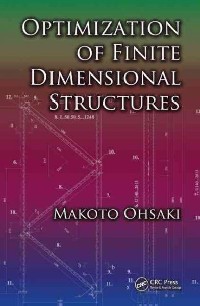
Optimization of Finite Dimensional Structures introduces methodologies and applications that are closely related to design problems encountered in structural optimization, to serve as a bridge between the communities of structural optimization in mechanical engineering and the researchers and engineers in civil engineering. This unparalleled, self-contained work
-Provides readers with the basics of optimization of frame structures, such as trusses, building frames, and long-span structures, with descriptions of various applications to real-world problems
-Summarizes the historical development of methodologies and theorems on optimization of frame structures
-Introduces many recently developed highly efficient optimization techniques presented with illustrative examples
-Describes traditional problems with constraints on limit loads, member stresses, compliance, and eigenvalues of vibration, all in detail
-Offers a unique look at optimization results for spatial trusses and latticed domes
Mathematical preliminaries and methodologies are summarized in the book's appendix, so that readers can attend to the details when needed without having to wade through tedious mathematics in the explanatory main chapters. Instead, small examples that can be solved by hand or by using a simple program are presented in these chapters, making the book readily accessible and highly useful for both classroom use and professional self-study.
Publisher Summary 2
Providing a bridge between the communities of structural optimization in mechanical engineering and the researchers and engineers in civil engineering, Ohsaki (Hiroshima U., Japan) introduces methodologies and real-world applications related to optimizing frame structures such as trusses, building frames, and long-span structures. He covers various formulations of structural optimization, design sensitivity analysis, optimizing the topology and configuration of trusses, optimizing building frames, and optimizing spatial trusses and frames. Mathematical details are provided in appendices. Annotation 漏2010 Book News, Inc., Portland, OR (booknews.com)
目录
Table Of Contents:
Preface v
1 Various Formulations of Structural Optimization 1(58)
1.1 Overview of structural optimization 1(2)
1.2 History of structural optimization 3(2)
1.3 Structural optimization problem 5(6)
1.3.1 Continuous problem 5(5)
1.3.2 Discrete problem 10(1)
1.4 Plastic design 11(3)
1.5 Stress constraints 14(3)
1.6 Fully-stressed design 17(8)
1.6.1 Stress-ratio approach 17(3)
1.6.2 Single loading condition 20(3)
1.6.3 Multiple loading conditions 23(2)
1.7 Optimality criteria approach 25(4)
1.8 Compliance constraint 29(14)
1.8.1 Problem formulation and sensitivity analysis 29(2)
1.8.2 Optimality conditions 31(3)
1.8.3 Reformulation of the optimization problem 34(5)
1.8.4 Convexity of compliance 39(3)
1.8.5 Other topics on compliance optimization 42(1)
1.9 Frequency constraints 43(5)
1.10 Configuration optimization of trusses 48(2)
1.11 Multiobjective structural optimization 50(2)
1.11.1 Basic concepts 50(1)
1.11.2 Problem formulation 51(1)
1.12 Heuristic approach 52(3)
1.13 Simultaneous analysis and design 55(4)
2 Design Sensitivity Analysis 59(26)
2.1 Overview of design sensitivity analysis 59(3)
2.2 Static responses 62(7)
2.2.1 Direct differentiation method 62(4)
2.2.2 Adjoint variable method 66(3)
2.3 Eigenvalues of free vibration 69(7)
2.3.1 Simple eigenvalue 69(4)
2.3.2 Multiple eigenvalues 73(3)
2.4 Linear buckling load 76(2)
2.5 Transient responses 78(3)
2.5.1 Direct differentiation method 78(1)
2.5.2 Adjoint variable method 79(2)
2.6 Nonlinear responses 81(2)
2.7 Shape sensitivity analysis of trusses 83(2)
3 Topology Optimization of Trusses 85(74)
3.1 Introduction 85(2)
3.2 Michell truss 87(1)
3.3 Topology optimization problem 88(2)
3.4 Optimization methods 90(3)
3.5 Stress constraints 93(20)
3.5.1 Introduction 93(1)
3.5.2 Governing equations 94(1)
3.5.3 Discontinuity in stress constraint 95(3)
3.5.4 Discontinuity due to member buckling 98(3)
3.5.5 Mathematical programming approach 101(5)
3.5.6 Problem with stress and local constraints 106(7)
3.6 Mixed integer programming for topology optimization with discrete variables 113(9)
3.6.1 Introduction 113(1)
3.6.2 Compliance minimization problem 114(1)
3.6.3 Stress constraints 115(4)
3.6.4 Numerical examples 119(3)
3.7 Genetic algorithm for truss topology optimization 122(6)
3.7.1 Introduction 122(1)
3.7.2 Optimization considering nodal cost 123(1)
3.7.3 Topological bit and fitness function 123(3)
3.7.4 Numerical examples 126(2)
3.8 Random search method using exact reanalysis 128(8)
3.8.1 Introduction 128(1)
3.8.2 Exact reanalysis 128(5)
3.8.3 Random search for topology optimization of trusses 133(3)
3.9 Multiple eigenvalue constraints 136(13)
3.9.1 Introduction 136(2)
3.9.2 Multiple eigenvalues in optimal topology 138(2)
3.9.3 Semidefinite programming for topology optimization 140(2)
3.9.4 Linear buckling constraint 142(2)
3.9.5 Numerical examples 144(5)
3.10 Application of data mining 149(10)
3.10.1 Frequent item set of decent solutions 149(4)
3.10.2 Topology mining of ground structures 153(6)
4 Configuration Optimization of Trusses 159(26)
4.1 Introduction 159(1)
4.2 General formulation and methodologies of configuration optimization 160(6)
4.3 Optimization of a regular grid truss 166(8)
4.3.1 Problem formulation 166(6)
4.3.2 Numerical examples 172(2)
4.4 Generation of a link mechanism 174(11)
4.4.1 Introduction 174(1)
4.4.2 Mechanical model of a link mechanism 174(4)
4.4.3 Problem formulation 178(3)
4.4.4 Numerical examples 181(4)
5 Optimization of Building Frames 185(74)
5.1 Overview of optimization of building frames 185(13)
5.1.1 Introduction 185(1)
5.1.2 Problem formulation 186(6)
5.1.3 Continuum approach 192(1)
5.1.4 Semi-rigid connections and braces 192(5)
5.1.5 Formulation of cost function 197(1)
5.2 Local and global searches of approximate optimal designs 198(16)
5.2.1 Introduction 198(2)
5.2.2 Optimization problem and optimality conditions 200(2)
5.2.3 Local search of approximate optimal solutions 202(4)
5.2.4 Global search of approximate optimal solutions 206(2)
5.2.5 Numerical example of a regular plane frame 208(6)
5.3 Parametric optimization of frames 214(20)
5.3.1 Introduction 214(2)
5.3.2 Two-level decomposition of frames 216(4)
5.3.3 General concept of decomposition to subsystems 220(2)
5.3.4 Parametric multidisciplinary optimization problem 222(2)
5.3.5 Optimization of plane frames 224(4)
5.3.6 Optimization of a three-dimensional frame 228(6)
5.4 Local search for multiobjective optimization of frames 234(16)
5.4.1 Introduction 234(1)
5.4.2 Heuristic approaches to combinatorial multiobjective programming 235(5)
5.4.3 Local search for multiobjective structural optimization 240(2)
5.4.4 Properties of Pareto optimal solutions 242(1)
5.4.5 Numerical examples 243(7)
5.5 Multiobjective seismic design of building frames 250(9)
5.5.1 Introduction 250(2)
5.5.2 Formulation of the multiobjective programming problem 252(1)
5.5.3 Optimization method 253(1)
5.5.4 Numerical examples 254(5)
6 Optimization of Spatial Trusses and Frames 259(56)
6.1 Introduction 259(2)
6.2 Seismic optimization of spatial trusses 261(5)
6.2.1 Introduction 261(1)
6.2.2 Design sensitivity analysis 262(1)
6.2.3 Optimization against seismic excitations 263(3)
6.3 Heuristic approaches to optimization of a spatial frame 266(5)
6.4 Shape optimization considering the designer's preference 271(9)
6.4.1 Introduction 271(2)
6.4.2 Description of an arch-type frame using a Bezier curve 273(2)
6.4.3 Shape optimization incorporating the designer's preference 275(2)
6.4.4 Sensitivity analysis with respect to control points 277(1)
6.4.5 Numerical examples 278(2)
6.5 Shape optimization of a single-layer latticed shell 280(8)
6.5.1 Introduction 280(1)
6.5.2 Description of a latticed shell and formulation of the optimization problem 281(3)
6.5.3 Numerical examples 284(4)
6.6 Configuration optimization of an arch-type truss with local geometrical constraints 288(7)
6.6.1 Direct assignments of geometrical constraints 288(3)
6.6.2 Optimization using a genetic algorithm 291(3)
6.6.3 Numerical examples 294(1)
6.7 Seismic design for spatially varying ground motions 295(10)
6.7.1 Introduction 295(1)
6.7.2 Response to spatially varying ground motions 295(4)
6.7.3 Problem formulation and design sensitivity analysis 299(2)
6.7.4 Postoptimal analysis 301(1)
6.7.5 Numerical examples 302(3)
6.8 Substructure approach to seismic optimization 305(10)
6.8.1 Introduction 305(1)
6.8.2 Frequency domain analysis for a secondary structure 306(3)
6.8.3 Optimization problem 309(1)
6.8.4 Numerical examples 310(5)
Appendix 315(52)
A.1 Mathematical preliminaries 315(4)
A.1.1 Positive definite matrix and convex functions 315(1)
A.1.2 Rayleigh's principle 316(2)
A.1.3 Singular value decomposition 318(1)
A.1.4 Directional derivative and subgradient 319(1)
A.2 Optimization methods 319(21)
A.2.1 Classification of optimization problems 319(2)
A.2.2 Nonlinear programming 321(13)
A.2.3 Dual problem 334(2)
A.2.4 Semidefinite programming 336(2)
A.2.5 Combinatorial problem 338(2)
A.3 Heuristics 340(5)
A.3.1 Introduction 340(1)
A.3.2 Single-point-search heuristics 341(4)
A.4 Multiobjective programming 345(5)
A.4.1 Definition of multiobjective programming 345(2)
A.4.2 Constraint approach 347(1)
A.4.3 Linear weighted sum approach 348(1)
A.4.4 Goal programming 349(1)
A.5 Parametric structural optimization problem 350(3)
A.6 Parametric curves and surfaces 353(6)
A.6.1 B茅zier curve 353(3)
A.6.2 B茅zier surface 356(1)
A.6.3 Adjoint curve 357(2)
A.7 Response spectrum approach 359(5)
A.7.1 SRSS method 359(2)
A.7.2 CQC method 361(1)
A.7.3 Design response spectrum 362(1)
A.7.4 Sensitivity analysis of mean maximum response 363(1)
A.8 List of available standard sections of beams and columns 364(3)
References 367(40)
Index 407(10)
Author Index 417
Preface v
1 Various Formulations of Structural Optimization 1(58)
1.1 Overview of structural optimization 1(2)
1.2 History of structural optimization 3(2)
1.3 Structural optimization problem 5(6)
1.3.1 Continuous problem 5(5)
1.3.2 Discrete problem 10(1)
1.4 Plastic design 11(3)
1.5 Stress constraints 14(3)
1.6 Fully-stressed design 17(8)
1.6.1 Stress-ratio approach 17(3)
1.6.2 Single loading condition 20(3)
1.6.3 Multiple loading conditions 23(2)
1.7 Optimality criteria approach 25(4)
1.8 Compliance constraint 29(14)
1.8.1 Problem formulation and sensitivity analysis 29(2)
1.8.2 Optimality conditions 31(3)
1.8.3 Reformulation of the optimization problem 34(5)
1.8.4 Convexity of compliance 39(3)
1.8.5 Other topics on compliance optimization 42(1)
1.9 Frequency constraints 43(5)
1.10 Configuration optimization of trusses 48(2)
1.11 Multiobjective structural optimization 50(2)
1.11.1 Basic concepts 50(1)
1.11.2 Problem formulation 51(1)
1.12 Heuristic approach 52(3)
1.13 Simultaneous analysis and design 55(4)
2 Design Sensitivity Analysis 59(26)
2.1 Overview of design sensitivity analysis 59(3)
2.2 Static responses 62(7)
2.2.1 Direct differentiation method 62(4)
2.2.2 Adjoint variable method 66(3)
2.3 Eigenvalues of free vibration 69(7)
2.3.1 Simple eigenvalue 69(4)
2.3.2 Multiple eigenvalues 73(3)
2.4 Linear buckling load 76(2)
2.5 Transient responses 78(3)
2.5.1 Direct differentiation method 78(1)
2.5.2 Adjoint variable method 79(2)
2.6 Nonlinear responses 81(2)
2.7 Shape sensitivity analysis of trusses 83(2)
3 Topology Optimization of Trusses 85(74)
3.1 Introduction 85(2)
3.2 Michell truss 87(1)
3.3 Topology optimization problem 88(2)
3.4 Optimization methods 90(3)
3.5 Stress constraints 93(20)
3.5.1 Introduction 93(1)
3.5.2 Governing equations 94(1)
3.5.3 Discontinuity in stress constraint 95(3)
3.5.4 Discontinuity due to member buckling 98(3)
3.5.5 Mathematical programming approach 101(5)
3.5.6 Problem with stress and local constraints 106(7)
3.6 Mixed integer programming for topology optimization with discrete variables 113(9)
3.6.1 Introduction 113(1)
3.6.2 Compliance minimization problem 114(1)
3.6.3 Stress constraints 115(4)
3.6.4 Numerical examples 119(3)
3.7 Genetic algorithm for truss topology optimization 122(6)
3.7.1 Introduction 122(1)
3.7.2 Optimization considering nodal cost 123(1)
3.7.3 Topological bit and fitness function 123(3)
3.7.4 Numerical examples 126(2)
3.8 Random search method using exact reanalysis 128(8)
3.8.1 Introduction 128(1)
3.8.2 Exact reanalysis 128(5)
3.8.3 Random search for topology optimization of trusses 133(3)
3.9 Multiple eigenvalue constraints 136(13)
3.9.1 Introduction 136(2)
3.9.2 Multiple eigenvalues in optimal topology 138(2)
3.9.3 Semidefinite programming for topology optimization 140(2)
3.9.4 Linear buckling constraint 142(2)
3.9.5 Numerical examples 144(5)
3.10 Application of data mining 149(10)
3.10.1 Frequent item set of decent solutions 149(4)
3.10.2 Topology mining of ground structures 153(6)
4 Configuration Optimization of Trusses 159(26)
4.1 Introduction 159(1)
4.2 General formulation and methodologies of configuration optimization 160(6)
4.3 Optimization of a regular grid truss 166(8)
4.3.1 Problem formulation 166(6)
4.3.2 Numerical examples 172(2)
4.4 Generation of a link mechanism 174(11)
4.4.1 Introduction 174(1)
4.4.2 Mechanical model of a link mechanism 174(4)
4.4.3 Problem formulation 178(3)
4.4.4 Numerical examples 181(4)
5 Optimization of Building Frames 185(74)
5.1 Overview of optimization of building frames 185(13)
5.1.1 Introduction 185(1)
5.1.2 Problem formulation 186(6)
5.1.3 Continuum approach 192(1)
5.1.4 Semi-rigid connections and braces 192(5)
5.1.5 Formulation of cost function 197(1)
5.2 Local and global searches of approximate optimal designs 198(16)
5.2.1 Introduction 198(2)
5.2.2 Optimization problem and optimality conditions 200(2)
5.2.3 Local search of approximate optimal solutions 202(4)
5.2.4 Global search of approximate optimal solutions 206(2)
5.2.5 Numerical example of a regular plane frame 208(6)
5.3 Parametric optimization of frames 214(20)
5.3.1 Introduction 214(2)
5.3.2 Two-level decomposition of frames 216(4)
5.3.3 General concept of decomposition to subsystems 220(2)
5.3.4 Parametric multidisciplinary optimization problem 222(2)
5.3.5 Optimization of plane frames 224(4)
5.3.6 Optimization of a three-dimensional frame 228(6)
5.4 Local search for multiobjective optimization of frames 234(16)
5.4.1 Introduction 234(1)
5.4.2 Heuristic approaches to combinatorial multiobjective programming 235(5)
5.4.3 Local search for multiobjective structural optimization 240(2)
5.4.4 Properties of Pareto optimal solutions 242(1)
5.4.5 Numerical examples 243(7)
5.5 Multiobjective seismic design of building frames 250(9)
5.5.1 Introduction 250(2)
5.5.2 Formulation of the multiobjective programming problem 252(1)
5.5.3 Optimization method 253(1)
5.5.4 Numerical examples 254(5)
6 Optimization of Spatial Trusses and Frames 259(56)
6.1 Introduction 259(2)
6.2 Seismic optimization of spatial trusses 261(5)
6.2.1 Introduction 261(1)
6.2.2 Design sensitivity analysis 262(1)
6.2.3 Optimization against seismic excitations 263(3)
6.3 Heuristic approaches to optimization of a spatial frame 266(5)
6.4 Shape optimization considering the designer's preference 271(9)
6.4.1 Introduction 271(2)
6.4.2 Description of an arch-type frame using a Bezier curve 273(2)
6.4.3 Shape optimization incorporating the designer's preference 275(2)
6.4.4 Sensitivity analysis with respect to control points 277(1)
6.4.5 Numerical examples 278(2)
6.5 Shape optimization of a single-layer latticed shell 280(8)
6.5.1 Introduction 280(1)
6.5.2 Description of a latticed shell and formulation of the optimization problem 281(3)
6.5.3 Numerical examples 284(4)
6.6 Configuration optimization of an arch-type truss with local geometrical constraints 288(7)
6.6.1 Direct assignments of geometrical constraints 288(3)
6.6.2 Optimization using a genetic algorithm 291(3)
6.6.3 Numerical examples 294(1)
6.7 Seismic design for spatially varying ground motions 295(10)
6.7.1 Introduction 295(1)
6.7.2 Response to spatially varying ground motions 295(4)
6.7.3 Problem formulation and design sensitivity analysis 299(2)
6.7.4 Postoptimal analysis 301(1)
6.7.5 Numerical examples 302(3)
6.8 Substructure approach to seismic optimization 305(10)
6.8.1 Introduction 305(1)
6.8.2 Frequency domain analysis for a secondary structure 306(3)
6.8.3 Optimization problem 309(1)
6.8.4 Numerical examples 310(5)
Appendix 315(52)
A.1 Mathematical preliminaries 315(4)
A.1.1 Positive definite matrix and convex functions 315(1)
A.1.2 Rayleigh's principle 316(2)
A.1.3 Singular value decomposition 318(1)
A.1.4 Directional derivative and subgradient 319(1)
A.2 Optimization methods 319(21)
A.2.1 Classification of optimization problems 319(2)
A.2.2 Nonlinear programming 321(13)
A.2.3 Dual problem 334(2)
A.2.4 Semidefinite programming 336(2)
A.2.5 Combinatorial problem 338(2)
A.3 Heuristics 340(5)
A.3.1 Introduction 340(1)
A.3.2 Single-point-search heuristics 341(4)
A.4 Multiobjective programming 345(5)
A.4.1 Definition of multiobjective programming 345(2)
A.4.2 Constraint approach 347(1)
A.4.3 Linear weighted sum approach 348(1)
A.4.4 Goal programming 349(1)
A.5 Parametric structural optimization problem 350(3)
A.6 Parametric curves and surfaces 353(6)
A.6.1 B茅zier curve 353(3)
A.6.2 B茅zier surface 356(1)
A.6.3 Adjoint curve 357(2)
A.7 Response spectrum approach 359(5)
A.7.1 SRSS method 359(2)
A.7.2 CQC method 361(1)
A.7.3 Design response spectrum 362(1)
A.7.4 Sensitivity analysis of mean maximum response 363(1)
A.8 List of available standard sections of beams and columns 364(3)
References 367(40)
Index 407(10)
Author Index 417
- 名称
- 类型
- 大小
光盘服务联系方式: 020-38250260 客服QQ:4006604884
云图客服:
用户发送的提问,这种方式就需要有位在线客服来回答用户的问题,这种 就属于对话式的,问题是这种提问是否需要用户登录才能提问
Video Player
×
Audio Player
×
pdf Player
×
