

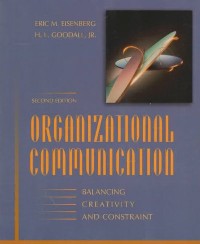
简介
Respected scholars Eric Eisenberg, H.L. Goodall Jr., and Angela Trethewey combine decades of teaching and scholarly experience to offer students a concise and readable introduction to organizational communication theories and their practical applications. Using the metaphor of creativity (getting what you want) and constraint (following established rules) this popular textbook offers students more opportunities than ever before to practice what they learn through a variety of features within the textbook itself and on its companion Web site.
目录
Table Of Contents:
Preface xvii
Chapter 1 The Changing World of Work 1(18)
QUESTIONS FOR DISCUSSION 1(2)
NEW DEVELOPMENTS IN THE WORLD OF WORK 3(9)
Globalization 4(1)
Questionable Labor Practices 5(1)
Multicultural Management 6(1)
Communication Technology 7(1)
Increased Competitive Pressure 8(1)
Focus on Product Quality and Customer Service 8(1)
Turbulent Organizational Environments 9(1)
Continuous Learning 10(1)
The Changing Relationship Between Organizations and Employees 11(1)
Shifting Power Bases 11(1)
FOCUS ON ETHICS 1.1: Organizational Structure and Employee Well-Being 12(5)
New Values and Priorities 14(1)
The Meaning of Work 14(1)
Worker Identity 15(2)
Who Can Afford to Prioritize? 17(1)
WHY STUDY ORGANIZATIONAL COMMUNICATION? 17(1)
SUMMARY 17(2)
Chapter 2 Situating Organizational Communication 19(33)
QUESTIONS FOR DISCUSSION 19(1)
APPROACHES TO ORGANIZATIONAL COMMUNICATION 20(5)
Communication as Information Transfer 20(2)
Communication as Transactional Process 22(1)
Communication as Strategic Control 23(2)
FOCUS ON ETHICS 2.1: Organizational Ambiguity in Action 25(5)
Communication as Balancing Creativity and Constraint 26(4)
INTERPRETING COMMUNICATION THROUGH SELF, OTHER, AND CONTEXT 30(8)
Symbolic Interaction 32(1)
The Elements of Communication Relationships: Self, Others, and Context 32(1)
Self 32(1)
Others 33(1)
Context 34(2)
Multiple Contexts and the Situated Individual 36(2)
ORGANIZATIONS AS DIALOGUES 38(6)
Definitions of Dialogue 39(1)
Dialogue as Equitable Transaction 39(2)
Dialogue as Empathic Conversation 41(1)
Dialogue as Real Meeting 42(2)
SUMMARY 44(4)
CASE STUDY: The Many Robert Smiths 48(4)
Chapter 3 Founding Perspectives on Organizations and Communication 52(42)
QUESTIONS FOR DISCUSSION 52(1)
WHY FOCUS ON THEORY? 53(1)
ORGANIZATIONAL COMMUNICATION THEORIES AS HISTORICAL NARRATIVES: THE THREE P'S 54(2)
Partiality 54(1)
Partisanship 54(1)
Problematic 55(1)
THE CLASSICAL MANAGEMENT APPROACH 56(14)
Historical and Cultural Background 56(1)
From Empire to Hierarchy 57(3)
From Resistance to Domination 60(4)
Scientific Management 64(2)
Fayol's Classical Management 66(1)
Bureaucracy 67(1)
Implications for Organizational Communication 68(2)
FOCUS ON ETHICS 3.1: The Influence of the Bureaucratic Organization on Home and Family Life 70(2)
THE HUMAN RELATIONS APPROACH 72(10)
Historical and Cultural Background 72(2)
What Is Human Relations? 74(1)
The Hawthorne Studies 74(1)
Reflections on Human Relations 75(2)
Beyond Human Relations 77(1)
Leadership Style 78(2)
Simon's Decision-Making Model 80(1)
The Institutional School 81(1)
THE HUMAN RESOURCES APPROACH 82(4)
Maslow's Hierarchy of Needs 82(1)
McGregor's Theory Y Management 83(2)
Likert's Principle of Supportive Relationships 85(1)
FOCUS ON ETHICS 3.2: The Politics of Middle Management 86
SUMMARY 85
CASE STUDY: Riverside State Hospital 90(4)
Chapter 4 The Systems Perspective on Organizations and Communication 94(29)
QUESTIONS FOR DISCUSSION 94(1)
THE SYSTEMS APPROACH 95(1)
HISTORICAL AND CULTURAL BACKGROUND 96(6)
The Information Revolution 96(4)
Biology and General Systems Theory 100(2)
From Biology to Organizational Communication 102(1)
WHAT IS A SYSTEM? 102(6)
Environment and Open Systems 103(1)
Interdependence 103(4)
Goals 107(1)
FOCUS ON ETHICS 4.1: The Addictive Organizational System 108(4)
Processes and Feedback 110(1)
Openness, Order, and Contingency 111(1)
THE APPEAL OF SYSTEMS THEORY FOR ORGANIZATIONAL COMMUNICATION 112(7)
Wheatley's New Science of Leadership 113(1)
Senge's Learning Organization 114(1)
Weick's Sense-Making Model 115(2)
Retrospective Sense-Making 117(1)
Loose Coupling 118(1)
Partial Inclusion 118(1)
SUMMARY 119(2)
CASE STUDY: Stargazer 121(2)
Chapter 5 Cultural Studies of Organizations and Communication 123(26)
QUESTIONS FOR DISCUSSION 123(1)
THE CULTURAL APPROACH 124(3)
Cultures as Symbolic Constructions 125(2)
HISTORICAL AND CULTURAL BACKGROUND 127(9)
Factors Contributing to the Rise of Organizational Culture 127(1)
Social Trends 127(2)
Methodology 129(4)
Practicality 133(3)
FOCUS ON ETHICS 5.1: The Politics of Interpreting Culture 136(1)
FIVE VIEWS OF ORGANIZATIONAL CULTURE 137(9)
Comparative Management 137(1)
Corporate Culture 138(1)
Organizational Cognition 139(1)
Organizational Symbolism 140(1)
Critical and Postmodern Views 141(2)
Integration 143(1)
Differentiation 144(1)
Fragmentation 145(1)
A COMMUNICATION PERSPECTIVE ON ORGANIZATIONAL CULTURE 146(1)
SUMMARY 146(2)
CASE STUDY: The Culture of Meetings 148(1)
Chapter 6 Critical Approaches to Organizations and Communication 149(22)
QUESTIONS FOR DISCUSSION 149(1)
CRITICAL THEORY 150(3)
Historical and Cultural Background 150(1)
The Rise of Critical Theory in the United States 151(1)
The Centrality of Power 152(1)
POWER AND IDEOLOGY 153(4)
The Hidden Power of Cultures: Native Assumptions 154(1)
The Hidden Power of Ideology: Manufactured Consent 155(1)
The Hidden Power of Communication: Myths, Metaphors, and Stories 156(1)
FOCUS ON ETHICS 6.1: Metaphors Can Suspend Critical Thinking 157(2)
The Hidden Power of Organizational Communication: Politics 158(1)
The Hidden Power of Society: Hegemony 159(1)
CRITICAL THEORIES OF POWER 159(6)
Feminist Theory 159(3)
Work-Hate Narratives 162(3)
PRO-PEOPLE OR PRO-PROFITS? 165(3)
CRITICAL THEORY AND ORGANIZATIONAL COMMUNICATION RESEARCH 168(1)
SUMMARY 168(2)
CASE STUDY: The Brilliant Engineer 170(1)
Chapter 7 Postmodern Perspectives on Organizational Communication 171(22)
QUESTIONS FOR DISCUSSION 171(1)
WHAT IS POSTMODERN THEORY? 172(1)
A TOUR OF A POSTMODERN ORGANIZATION 173(5)
From Signs to Practices 174(1)
Democracy in the Workplace 175(1)
Facilitating Multicultural Communication 175(2)
Corporate Image 177(1)
Teams and Global Networks 177(1)
THE POSTMODERN TURN: WHERE DID IT COME FROM? 178(5)
Postmodernity versus Postmodernism 178(1)
A Historical Break 178(1)
New Political and Aesthetic Movements 179(2)
New Cultural Understandings and Practices 181(2)
OBJECTIONS TO POSTMODERN THEORY 183(3)
Postmodern Deconstruction 184(1)
An Example: The Nordstrom Employee Handbook 184(2)
FOCUS ON ETHICS 7.1: The Dilemma of Postmodern Ethics 186(2)
A Definitional Debate? 187(1)
IMPLICATIONS OF THE POSTMODERN APPROACH FOR CREATIVITY AND CONSTRAINT 188(2)
Postmodern Dialogue 188(1)
Narratives: The Sites of the Postmodern Consciousness 189(1)
The Postmodern View of Work as Interpretation 189(1)
SUMMARY 190(2)
CASE STUDY: Designing a Postmodern University 192(1)
Chapter 8 The Experience of Work 193(38)
QUESTIONS FOR DISCUSSION 193(2)
THE EXPERIENCE OF WORK WITHIN ORGANIZATIONS 195(9)
Assimilation: Entering the Organizational Dialogue 196(1)
Anticipatory Socialization 196(1)
Organizational Assimilation 197(2)
Organizational Turning Points or Exits 199(1)
Indicators of Cooperation 199(1)
Job Satisfaction 200(1)
Job Involvement 201(1)
Organizational Identification 202(1)
Organizational Commitment 202(1)
Employee Empowerment 203(1)
FOCUS ON ETHICS 8.1: "Support Us or Else" 204(18)
Worker Productivity 205(2)
Indicators of Resistance 207(1)
Stress and Burnout 207(1)
Environmental Stressors 208(1)
National Culture 208(1)
Intercultural Difficulties 208(2)
Physical Characteristics of the Workplace 210(1)
Organizational Stressors 210(1)
Social Support 211(1)
Participation in Decision Making 211(1)
Diversity 212(2)
Expression of Emotion 214(1)
Job Stressors 215(1)
Workload 215(1)
Role Uncertainty 216(1)
Job Design 216(2)
Individual Stressors 218(1)
Personality Traits 219(1)
Personal Life 219(1)
Communication Style 220(1)
New Directions for Work Organization 220(2)
THE EXPERIENCE OF WORK OUTSIDE OF ORGANIZATIONS 222(6)
Outsourcers: The New Economy 224(1)
Self-Reliance: Developing a New Skill Set 225(2)
Redefining Work Identity at Midlife 227(1)
SUMMARY 228(1)
CASE STUDY I: The Secret Fisherman 228(2)
CASE STUDY II: Developing a Skill Set 230(1)
Chapter 9 Relational Contexts for Organizational Communication 231(40)
QUESTIONS FOR DISCUSSION 231(1)
THE ROLE OF WORK RELATIONSHIPS UNDER THE NEW SOCIAL CONTRACT 232(4)
COMMUNICATING WITH SUPERIORS 236(5)
Semantic Information Distance 236(1)
Upward Distortion 237(1)
Managing the Boss 238(2)
Mystery and Transgression 240(1)
FOCUS ON ETHICS 9.1: Managing the Superior-Subordinate Relationship 241(1)
COMMUNICATING WITH SUBORDINATES 242(8)
Openness 242(1)
Supportiveness 243(1)
Motivation 244(1)
Goal-setting Theory 245(1)
Expectancy Theory 246(1)
Equity Theory 247(1)
Compliance-Gaining 248(1)
Empowerment 248(2)
COMMUNICATING WITH PEERS 250(4)
Within-Group Communication 251(1)
Cross-Functional Communication 252(1)
Managing the White Space 253(1)
Cultivating Internal Customers and Suppliers 253(1)
Unstructured Communication 254(1)
COMMUNICATING WITH CUSTOMERS AND SUPPLIERS 254(3)
The Customer Service Revolution 254(3)
Suppliers as Organizational Partners 257(1)
INTERCULTURAL COMMUNICATION 257(3)
Nonverbal Dimensions 259(1)
Negotiating a Middle Ground 260(1)
NEW DIRECTIONS IN LEADERSHIP 260(4)
Learning Leadership Skills 262(1)
Leadership and Organizational Effectiveness 262(2)
INTIMACY IN WORK RELATIONSHIPS 264(3)
Romantic Relationships at Work 265(1)
Sexual Harassment in the Workplace 266(1)
CREATIVITY AND CONSTRAINT IN WORK RELATIONSHIPS 267(2)
SUMMARY 269
CASE STUDY: The Total Empowerment Program 268
Chapter 10 Communicating in Teams and Networks 271(34)
QUESTIONS FOR DISCUSSION 271(1)
TEAMS 272(6)
What Is a Team-Based Organization? 272(1)
Managing the Transition to Teams 273(1)
Types of Teams 274(1)
Project Teams 274(1)
Work Teams 275(2)
Quality Improvement Teams 277(1)
FOCUS ON ETHICS 10.1: The Dilemmas of Midlevel Management in Fostering Empowerment 278(15)
Communicative Dimensions of Teamwork 279(1)
Roles 279(1)
Norms 280(1)
Decision Making 280(4)
Conflict and Consensus 284(2)
Cultural Diversity 286(2)
Team Learning 288(4)
A Retreat from Teams? 292(1)
NETWORKS 293(9)
Types of Networks 293(1)
Small-Group Communication Networks 293(2)
Emergent Communication Networks 295(1)
Communication Networks 296(1)
Patterns of Interaction 296(1)
Communication Roles 297(1)
Content Areas of Communication 298(1)
Interorganizational Communication Networks 299(2)
The Networked Society 301(1)
CREATIVITY AND CONSTRAINT IN GROUP RELATIONSHIPS 302(1)
SUMMARY 302(1)
CASE STUDY: The Networked Community 303(2)
Chapter 11 Managing the Total Organization: Strategy, Image, and Communication Technology 305(26)
QUESTIONS FOR DISCUSSION 305(1)
POSITIONING THE ORGANIZATION THROUGH STRATEGY AND IMAGE 306(13)
Competitive Strategy 306(1)
Types of Business Strategies 307(3)
Strategy and the Business Life Cycle 310(1)
Image 311(1)
Reputation 311(1)
Public Relations 312(1)
Identity versus Image 313(1)
Corporate Crises 314(1)
Strategic Alignment 315(1)
The Original 7-S Model of Strategic Alignment 315(4)
The New 7-S Model of Strategic Alignment 319(1)
COMMUNICATION TECHNOLOGY 319(7)
Types of Communication Technology 320(1)
Effects of Communication Technology on the Workplace 321(2)
Synchronicity and Media Richness 323(1)
Secrecy and Privacy Issues 324(1)
Mediated Interpersonal Communication 324(2)
FOCUS ON ETHICS 11.1: Surfing Sickness 326(1)
SUMMARY 326(2)
CASE STUDY: A Tale of Two Strategies 328(3)
Chapter 12 The Future of Organizational Communication 331(16)
QUESTIONS FOR DISCUSSION 331(1)
THE LEARNING ORGANIZATION 332(6)
Learning Basic Skills 332(1)
Learning New Technologies 333(2)
Biotechnology 335(1)
Virtual Reality 335(1)
Learning New Ways of Organizing 336(1)
Participative Action Research 337(1)
Ecofeminism 338(1)
THE MORAL DIMENSIONS OF ORGANIZATIONAL COMMUNICATION 338(1)
Communication Ethics 338(1)
FOCUS ON ETHICS 12.1: Who's Responsible? 339(2)
Ecological Responsibility 340(1)
SCENARIO PLANNING: A GUIDE TO THE FUTURE OF ORGANIZATIONAL COMMUNICATION 341(3)
CREATIVITY AND CONSTRAINT: A NEW INTERPRETATION 344(2)
SUMMARY 346(1)
References 347(30)
Subject Index 377(12)
Author Index 389
Preface xvii
Chapter 1 The Changing World of Work 1(18)
QUESTIONS FOR DISCUSSION 1(2)
NEW DEVELOPMENTS IN THE WORLD OF WORK 3(9)
Globalization 4(1)
Questionable Labor Practices 5(1)
Multicultural Management 6(1)
Communication Technology 7(1)
Increased Competitive Pressure 8(1)
Focus on Product Quality and Customer Service 8(1)
Turbulent Organizational Environments 9(1)
Continuous Learning 10(1)
The Changing Relationship Between Organizations and Employees 11(1)
Shifting Power Bases 11(1)
FOCUS ON ETHICS 1.1: Organizational Structure and Employee Well-Being 12(5)
New Values and Priorities 14(1)
The Meaning of Work 14(1)
Worker Identity 15(2)
Who Can Afford to Prioritize? 17(1)
WHY STUDY ORGANIZATIONAL COMMUNICATION? 17(1)
SUMMARY 17(2)
Chapter 2 Situating Organizational Communication 19(33)
QUESTIONS FOR DISCUSSION 19(1)
APPROACHES TO ORGANIZATIONAL COMMUNICATION 20(5)
Communication as Information Transfer 20(2)
Communication as Transactional Process 22(1)
Communication as Strategic Control 23(2)
FOCUS ON ETHICS 2.1: Organizational Ambiguity in Action 25(5)
Communication as Balancing Creativity and Constraint 26(4)
INTERPRETING COMMUNICATION THROUGH SELF, OTHER, AND CONTEXT 30(8)
Symbolic Interaction 32(1)
The Elements of Communication Relationships: Self, Others, and Context 32(1)
Self 32(1)
Others 33(1)
Context 34(2)
Multiple Contexts and the Situated Individual 36(2)
ORGANIZATIONS AS DIALOGUES 38(6)
Definitions of Dialogue 39(1)
Dialogue as Equitable Transaction 39(2)
Dialogue as Empathic Conversation 41(1)
Dialogue as Real Meeting 42(2)
SUMMARY 44(4)
CASE STUDY: The Many Robert Smiths 48(4)
Chapter 3 Founding Perspectives on Organizations and Communication 52(42)
QUESTIONS FOR DISCUSSION 52(1)
WHY FOCUS ON THEORY? 53(1)
ORGANIZATIONAL COMMUNICATION THEORIES AS HISTORICAL NARRATIVES: THE THREE P'S 54(2)
Partiality 54(1)
Partisanship 54(1)
Problematic 55(1)
THE CLASSICAL MANAGEMENT APPROACH 56(14)
Historical and Cultural Background 56(1)
From Empire to Hierarchy 57(3)
From Resistance to Domination 60(4)
Scientific Management 64(2)
Fayol's Classical Management 66(1)
Bureaucracy 67(1)
Implications for Organizational Communication 68(2)
FOCUS ON ETHICS 3.1: The Influence of the Bureaucratic Organization on Home and Family Life 70(2)
THE HUMAN RELATIONS APPROACH 72(10)
Historical and Cultural Background 72(2)
What Is Human Relations? 74(1)
The Hawthorne Studies 74(1)
Reflections on Human Relations 75(2)
Beyond Human Relations 77(1)
Leadership Style 78(2)
Simon's Decision-Making Model 80(1)
The Institutional School 81(1)
THE HUMAN RESOURCES APPROACH 82(4)
Maslow's Hierarchy of Needs 82(1)
McGregor's Theory Y Management 83(2)
Likert's Principle of Supportive Relationships 85(1)
FOCUS ON ETHICS 3.2: The Politics of Middle Management 86
SUMMARY 85
CASE STUDY: Riverside State Hospital 90(4)
Chapter 4 The Systems Perspective on Organizations and Communication 94(29)
QUESTIONS FOR DISCUSSION 94(1)
THE SYSTEMS APPROACH 95(1)
HISTORICAL AND CULTURAL BACKGROUND 96(6)
The Information Revolution 96(4)
Biology and General Systems Theory 100(2)
From Biology to Organizational Communication 102(1)
WHAT IS A SYSTEM? 102(6)
Environment and Open Systems 103(1)
Interdependence 103(4)
Goals 107(1)
FOCUS ON ETHICS 4.1: The Addictive Organizational System 108(4)
Processes and Feedback 110(1)
Openness, Order, and Contingency 111(1)
THE APPEAL OF SYSTEMS THEORY FOR ORGANIZATIONAL COMMUNICATION 112(7)
Wheatley's New Science of Leadership 113(1)
Senge's Learning Organization 114(1)
Weick's Sense-Making Model 115(2)
Retrospective Sense-Making 117(1)
Loose Coupling 118(1)
Partial Inclusion 118(1)
SUMMARY 119(2)
CASE STUDY: Stargazer 121(2)
Chapter 5 Cultural Studies of Organizations and Communication 123(26)
QUESTIONS FOR DISCUSSION 123(1)
THE CULTURAL APPROACH 124(3)
Cultures as Symbolic Constructions 125(2)
HISTORICAL AND CULTURAL BACKGROUND 127(9)
Factors Contributing to the Rise of Organizational Culture 127(1)
Social Trends 127(2)
Methodology 129(4)
Practicality 133(3)
FOCUS ON ETHICS 5.1: The Politics of Interpreting Culture 136(1)
FIVE VIEWS OF ORGANIZATIONAL CULTURE 137(9)
Comparative Management 137(1)
Corporate Culture 138(1)
Organizational Cognition 139(1)
Organizational Symbolism 140(1)
Critical and Postmodern Views 141(2)
Integration 143(1)
Differentiation 144(1)
Fragmentation 145(1)
A COMMUNICATION PERSPECTIVE ON ORGANIZATIONAL CULTURE 146(1)
SUMMARY 146(2)
CASE STUDY: The Culture of Meetings 148(1)
Chapter 6 Critical Approaches to Organizations and Communication 149(22)
QUESTIONS FOR DISCUSSION 149(1)
CRITICAL THEORY 150(3)
Historical and Cultural Background 150(1)
The Rise of Critical Theory in the United States 151(1)
The Centrality of Power 152(1)
POWER AND IDEOLOGY 153(4)
The Hidden Power of Cultures: Native Assumptions 154(1)
The Hidden Power of Ideology: Manufactured Consent 155(1)
The Hidden Power of Communication: Myths, Metaphors, and Stories 156(1)
FOCUS ON ETHICS 6.1: Metaphors Can Suspend Critical Thinking 157(2)
The Hidden Power of Organizational Communication: Politics 158(1)
The Hidden Power of Society: Hegemony 159(1)
CRITICAL THEORIES OF POWER 159(6)
Feminist Theory 159(3)
Work-Hate Narratives 162(3)
PRO-PEOPLE OR PRO-PROFITS? 165(3)
CRITICAL THEORY AND ORGANIZATIONAL COMMUNICATION RESEARCH 168(1)
SUMMARY 168(2)
CASE STUDY: The Brilliant Engineer 170(1)
Chapter 7 Postmodern Perspectives on Organizational Communication 171(22)
QUESTIONS FOR DISCUSSION 171(1)
WHAT IS POSTMODERN THEORY? 172(1)
A TOUR OF A POSTMODERN ORGANIZATION 173(5)
From Signs to Practices 174(1)
Democracy in the Workplace 175(1)
Facilitating Multicultural Communication 175(2)
Corporate Image 177(1)
Teams and Global Networks 177(1)
THE POSTMODERN TURN: WHERE DID IT COME FROM? 178(5)
Postmodernity versus Postmodernism 178(1)
A Historical Break 178(1)
New Political and Aesthetic Movements 179(2)
New Cultural Understandings and Practices 181(2)
OBJECTIONS TO POSTMODERN THEORY 183(3)
Postmodern Deconstruction 184(1)
An Example: The Nordstrom Employee Handbook 184(2)
FOCUS ON ETHICS 7.1: The Dilemma of Postmodern Ethics 186(2)
A Definitional Debate? 187(1)
IMPLICATIONS OF THE POSTMODERN APPROACH FOR CREATIVITY AND CONSTRAINT 188(2)
Postmodern Dialogue 188(1)
Narratives: The Sites of the Postmodern Consciousness 189(1)
The Postmodern View of Work as Interpretation 189(1)
SUMMARY 190(2)
CASE STUDY: Designing a Postmodern University 192(1)
Chapter 8 The Experience of Work 193(38)
QUESTIONS FOR DISCUSSION 193(2)
THE EXPERIENCE OF WORK WITHIN ORGANIZATIONS 195(9)
Assimilation: Entering the Organizational Dialogue 196(1)
Anticipatory Socialization 196(1)
Organizational Assimilation 197(2)
Organizational Turning Points or Exits 199(1)
Indicators of Cooperation 199(1)
Job Satisfaction 200(1)
Job Involvement 201(1)
Organizational Identification 202(1)
Organizational Commitment 202(1)
Employee Empowerment 203(1)
FOCUS ON ETHICS 8.1: "Support Us or Else" 204(18)
Worker Productivity 205(2)
Indicators of Resistance 207(1)
Stress and Burnout 207(1)
Environmental Stressors 208(1)
National Culture 208(1)
Intercultural Difficulties 208(2)
Physical Characteristics of the Workplace 210(1)
Organizational Stressors 210(1)
Social Support 211(1)
Participation in Decision Making 211(1)
Diversity 212(2)
Expression of Emotion 214(1)
Job Stressors 215(1)
Workload 215(1)
Role Uncertainty 216(1)
Job Design 216(2)
Individual Stressors 218(1)
Personality Traits 219(1)
Personal Life 219(1)
Communication Style 220(1)
New Directions for Work Organization 220(2)
THE EXPERIENCE OF WORK OUTSIDE OF ORGANIZATIONS 222(6)
Outsourcers: The New Economy 224(1)
Self-Reliance: Developing a New Skill Set 225(2)
Redefining Work Identity at Midlife 227(1)
SUMMARY 228(1)
CASE STUDY I: The Secret Fisherman 228(2)
CASE STUDY II: Developing a Skill Set 230(1)
Chapter 9 Relational Contexts for Organizational Communication 231(40)
QUESTIONS FOR DISCUSSION 231(1)
THE ROLE OF WORK RELATIONSHIPS UNDER THE NEW SOCIAL CONTRACT 232(4)
COMMUNICATING WITH SUPERIORS 236(5)
Semantic Information Distance 236(1)
Upward Distortion 237(1)
Managing the Boss 238(2)
Mystery and Transgression 240(1)
FOCUS ON ETHICS 9.1: Managing the Superior-Subordinate Relationship 241(1)
COMMUNICATING WITH SUBORDINATES 242(8)
Openness 242(1)
Supportiveness 243(1)
Motivation 244(1)
Goal-setting Theory 245(1)
Expectancy Theory 246(1)
Equity Theory 247(1)
Compliance-Gaining 248(1)
Empowerment 248(2)
COMMUNICATING WITH PEERS 250(4)
Within-Group Communication 251(1)
Cross-Functional Communication 252(1)
Managing the White Space 253(1)
Cultivating Internal Customers and Suppliers 253(1)
Unstructured Communication 254(1)
COMMUNICATING WITH CUSTOMERS AND SUPPLIERS 254(3)
The Customer Service Revolution 254(3)
Suppliers as Organizational Partners 257(1)
INTERCULTURAL COMMUNICATION 257(3)
Nonverbal Dimensions 259(1)
Negotiating a Middle Ground 260(1)
NEW DIRECTIONS IN LEADERSHIP 260(4)
Learning Leadership Skills 262(1)
Leadership and Organizational Effectiveness 262(2)
INTIMACY IN WORK RELATIONSHIPS 264(3)
Romantic Relationships at Work 265(1)
Sexual Harassment in the Workplace 266(1)
CREATIVITY AND CONSTRAINT IN WORK RELATIONSHIPS 267(2)
SUMMARY 269
CASE STUDY: The Total Empowerment Program 268
Chapter 10 Communicating in Teams and Networks 271(34)
QUESTIONS FOR DISCUSSION 271(1)
TEAMS 272(6)
What Is a Team-Based Organization? 272(1)
Managing the Transition to Teams 273(1)
Types of Teams 274(1)
Project Teams 274(1)
Work Teams 275(2)
Quality Improvement Teams 277(1)
FOCUS ON ETHICS 10.1: The Dilemmas of Midlevel Management in Fostering Empowerment 278(15)
Communicative Dimensions of Teamwork 279(1)
Roles 279(1)
Norms 280(1)
Decision Making 280(4)
Conflict and Consensus 284(2)
Cultural Diversity 286(2)
Team Learning 288(4)
A Retreat from Teams? 292(1)
NETWORKS 293(9)
Types of Networks 293(1)
Small-Group Communication Networks 293(2)
Emergent Communication Networks 295(1)
Communication Networks 296(1)
Patterns of Interaction 296(1)
Communication Roles 297(1)
Content Areas of Communication 298(1)
Interorganizational Communication Networks 299(2)
The Networked Society 301(1)
CREATIVITY AND CONSTRAINT IN GROUP RELATIONSHIPS 302(1)
SUMMARY 302(1)
CASE STUDY: The Networked Community 303(2)
Chapter 11 Managing the Total Organization: Strategy, Image, and Communication Technology 305(26)
QUESTIONS FOR DISCUSSION 305(1)
POSITIONING THE ORGANIZATION THROUGH STRATEGY AND IMAGE 306(13)
Competitive Strategy 306(1)
Types of Business Strategies 307(3)
Strategy and the Business Life Cycle 310(1)
Image 311(1)
Reputation 311(1)
Public Relations 312(1)
Identity versus Image 313(1)
Corporate Crises 314(1)
Strategic Alignment 315(1)
The Original 7-S Model of Strategic Alignment 315(4)
The New 7-S Model of Strategic Alignment 319(1)
COMMUNICATION TECHNOLOGY 319(7)
Types of Communication Technology 320(1)
Effects of Communication Technology on the Workplace 321(2)
Synchronicity and Media Richness 323(1)
Secrecy and Privacy Issues 324(1)
Mediated Interpersonal Communication 324(2)
FOCUS ON ETHICS 11.1: Surfing Sickness 326(1)
SUMMARY 326(2)
CASE STUDY: A Tale of Two Strategies 328(3)
Chapter 12 The Future of Organizational Communication 331(16)
QUESTIONS FOR DISCUSSION 331(1)
THE LEARNING ORGANIZATION 332(6)
Learning Basic Skills 332(1)
Learning New Technologies 333(2)
Biotechnology 335(1)
Virtual Reality 335(1)
Learning New Ways of Organizing 336(1)
Participative Action Research 337(1)
Ecofeminism 338(1)
THE MORAL DIMENSIONS OF ORGANIZATIONAL COMMUNICATION 338(1)
Communication Ethics 338(1)
FOCUS ON ETHICS 12.1: Who's Responsible? 339(2)
Ecological Responsibility 340(1)
SCENARIO PLANNING: A GUIDE TO THE FUTURE OF ORGANIZATIONAL COMMUNICATION 341(3)
CREATIVITY AND CONSTRAINT: A NEW INTERPRETATION 344(2)
SUMMARY 346(1)
References 347(30)
Subject Index 377(12)
Author Index 389
- 名称
- 类型
- 大小
光盘服务联系方式: 020-38250260 客服QQ:4006604884
云图客服:
用户发送的提问,这种方式就需要有位在线客服来回答用户的问题,这种 就属于对话式的,问题是这种提问是否需要用户登录才能提问
Video Player
×
Audio Player
×
pdf Player
×
