

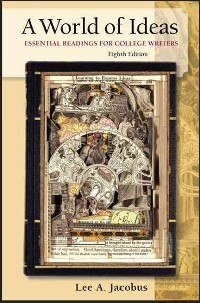
A world of ideas : essential readings for college writers / 8th ed.
副标题:无
作 者:[edited by] Lee A. Jacobus.
分类号:
ISBN:9780312385330
微信扫一扫,移动浏览光盘
简介
Summary:
Publisher Summary 1
The most successful reader of its kind, A World of Ideas introduces first-year writing students to the thinkers and writers whose ideas have shaped civilization: for example, Niccol貌 Machiavelli on government, Elizabeth Cady Stanton on justice, and Sigmund Freud on the mind. Because students perceive these writers as important, they take the writing course seriously: they learn to read more attentively, think more critically, and write more effectively. No other composition reader offers a comparable collection of important readings along with the supportive apparatus students need to understand, analyze, and respond to them.
目录
Table Of Contents:
Preface v
To the Student xiii
EVALUATING IDEAS: An Introduction to Critical Reading 1
PART ONE GOVERNMENT 13
VISUALIZING GOVERNMENT
EUGENE DELACROIX
Liberty Leading the People [IMAGE] 18
LAO-TZU
Thoughts from the Tao-te Ching 21
In recommending that a ruler practice judicious inactivity rather than wasteful busyness, the ancient Chinese philosopher minimizes the power of the state over the individual.
NICCOL脪 MACHIAVELLI
The Qualities of the Prince 37
In this excerpt from the most notorious political treatise of all time, Machiavelli, a veteran of intrigue in Florence's Medici court, recommends unscrupulous tactics for the ruler who wishes to secure power for himself and stability in his domain.
JEAN-JACQUES ROUSSEAU
The Origin of Civil Society 55
The French philosopher Rousseau speculates that members of a society forfeit individual freedoms for the greater good of all and stresses a revolutionary view鈥攅quality before the law.
THOMAS JEFFERSON
The Declaration of Independence 77
In this primary document of modern democratic government, Jefferson justifies the right of the American colonies to dissolve their bonds with a tyrannical monarchy and to construct a free nation of independent souls in its stead.
JOS脡 ORTEGA Y GASSET
The Greatest Danger, the State 87
One of Ortega's greatest fears is that European democracies in the 1930's had in them the seeds of tyranny. Like other political philosophers, Ortega fears the disorder that results when qualified leaders fail their responsibility and unqualified mobs produce a tyranny of the majority.
CARL BECKER
Ideal Democracy 101
In an essay written in 1932, at democracy's lowest hour in the West, Becker reminds us that "Democracy is in some sense an economic luxury," but that we must nonetheless recognize its value and persist in its defense.
HANNAH ARENDT
Total Domination 121
Arendt, a historian and political theorist, argues that terror is necessary for the state to achieve total domination over the individual and that the concentration camp represents the most intense form of terror a state can exert in modern society.
PART TWO JUSTICE 135
VISUALIZING JUSTICE
LUCA GIORDANO
Justice [IMAGE] 140
MARCUS TULLIUS CICERO
The Defense of Injustice 143
Cicero, the great Roman orator and legendary champion of justice, plays devil's advocate as he powerfully argues that in some circumstances justice is inexpedient and problematic for a state to provide.
FREDERICK DOUGLASS
From Narrative of the Life of Frederick Douglass, an American Slave 157
One of the most eloquent orators of the nineteenth century, Frederick Douglass, reveals how an indomitable spirit reacted to a system of law that sanctioned slavery, treated people as chattel, and denied justice for them and their offspring into perpetuity.
HENRY DAVID THOREAU
Civil Disobedience 173
A man who lived by his ideals of justice, Thoreau explains how and why it is not only reasonable but also sometimes essential to disobey unjust laws imposed by the state.
ELIZABETH CADY STANTON
Declaration of Sentiments and Resolutions 201
Stanton draws on her experience as a feminist and on Thomas Jefferson's model to show that, one hundred years after the Declaration of Independence, half of America still waited to be freed from tyranny.
MARTIN LUTHER KING JR.
Letter from Birmingham Jail 211
King, a minister and civil rights leader, advocates nonviolent action as a means of changing the unconscionable practices of racial segregation and of achieving justice for all.
JOHN RAWLS
A Theory of Justice 233
The most distinguished contemporary thinker on the subject of justice, Rawls argues that the essence of justice is fairness and that decisions of governments or institutions should be guided by their effect on the least powerful members of the society or group concerned.
PART THREE THE INDIVIDUAL 245
VISUALIZING THE INDIVIDUAL
CASPAR DAVID FRIEDRICH
Wanderer Above the Sea of Fog [IMAGE] 250
RALPH WALDO EMERSON
Self-Reliance 255
Emerson elaborates on one of the great American themes of independence and self-reliance. He rails against peer-pressure and conformity.
In this essay he says, "A foolish consistency is the hobgoblin of little minds" and in the process condemns conformity and insists you must trust yourself.
EMILE DURKHEIM
Individualism and the Intellectuals 271
The father of modern sociology, Durkheim argues against privileging the institutions of society over the rights of the individual.
His was a time of great intellectual ferment and his argument helped the cause of intellectuals who took a stand against a government that behaved badly.
W.E.B. DU BOIS
Of Our Spiritual Strivings 287
One of the great early African American intellectuals, Du Bois describes his own journey toward becoming an individual in a society that had no ready-made place for him.
He asks in his first words, "How does it feel to be a problem?"
Then he goes on to offer an answer.
RUTH BENEDICT The Individual and the Pattern of Culture 301
A distinguished anthropologist, Benedict explores the position of the individual in several cultures, including the Northwest Kwakiutl Indians, the Plains Indians, the Zuni, and others.
She describes what happens when society is intolerant of individual behavior and the price some must pay for their distinctiveness.
ERICH FROMM
The Individual in the Chains of Illusion 325
In the shadow of the atomic age, which threatened annihilation as he wrote, Fromm hopes for the appearance of the One Man who, like Buddha, will be totally individual and help us move onward toward enlightenment.
As he says of hierarchical organizations, "the great danger, as with all institutions, is that the individual has the illusion of being an individual."
PART FOUR WEALTH AND POVERTY 339
VISUALIZING WEALTH AND POVERTY
HENRY O. TANNER
The Thankful Poor [IMAGE] 344
ADAM SMITH
Of the Natural Progress of Opulence 347
This excerpt from the classic work on modern capitalism The Wealth of Nations explores the economic relationship between rural areas and cities in an attempt to understand the "natural" steps to wealth.
KARL MARX
The Communist Manifesto 359
Marx, the most thorough critic of laissez-faire capitalism, traces the dehumanizing progress of the nineteenth-century bourgeois economic structure and heralds its downfall at the hands of a united international proletariat.
ANDREW CARNEGIE
The Gospel of Wealth 387
The great American industrialist and steel magnate argues that it is not only desirable, but natural that some people in a free society should be enormously wealthy and that most should not.
He also insists that great personal wealth is held in trust for the public and must be given away during one's own lifetime to support worthy causes.
JOHN KENNETH GALBRAITH
The Position of Poverty 405
Improving the plight of society's poorest members is a central responsibility of today's wealthy nations, says Galbraith, the most widely read economist of the past four decades.
ROBERT B. REICH
Why the Rich Are Getting Richer and the Poor, Poorer 419
The former secretary of labor talks about the different categories of workers in the United States and the inevitable changes occurring as the U.S. economy is altered by globalization.
PART FIVE MIND 439
VISUALIZING THE MIND
SALVADOR DALI
The Persistence of Memory [IMAGE] 443
PLATO
The Allegory of the Cave 447
Plato, the founder of Western philosophy, talks about the nature of perception and the limits of the human mind, emphasizing the difficulties everyone encounters in discovering the truth about appearances.
REN脡 DESCARTES
Fourth Meditation: Of Truth and Error 461
Descartes, one of the great French philosophers, meditates on the nature of God and how he may learn to distinguish truth from error.
He conducts his inquiry entirely through his reason, with no reference to the physical world of the senses, which, he feels, might introduce error.
SIGMUND FREUD
The Oedipus Complex 475
After Freud posited the existence and functioning of the unconscious mind, one of his most important鈥攁nd controversial鈥攖heories was the assertion that infants went through a stage in which they unconsciously wished to possess their opposite-sex parent all for themselves.
CARL JUNG
The Personal and the Collective Unconscious 487
Jung proposes that as a cultural group we have a collective unconscious鈥攁n unconscious awareness and wishes that transcend the individual and represent the needs of the group to which we belong.
HOWARD GARDNER
A Rounded Version: The Theory of Multiple Intelligences 503
Gardner, a contemporary psychologist, has a novel view of the mind that proposes seven distinct forms of human intelligence: linguistic, logical-mathematical, spatial, musical, bodily-kinesthetic, interpersonal, and intrapersonal.
STEVEN PINKER
Thinking Machines 525
The basic question Pinker asks is, what is intelligence?
Then he proceeds to examine the machines that have acted intelligently by following rules that produce reliable information.
He then outlines his computational theory of intelligence and links it to "thinking machines."
V.S. RAMACHANDRAN
Neuroscience鈥擳he New Philosophy 553
In his quest for insights into the nature of consciousness, Ramachandran examines some of the most unusual disorders of the mind, including syndromes that make one think family members are "imitations" of themselves.
He asks, what is the sense of self, and how does language contribute to producing it?
PART SIX NATURE 571
VISUALIZING NATURE
ASHER B. DURAND,
Kindred Spirits [IMAGE] 576
FRANCIS BACON
The Four Idols 579
A prominent figure in philosophy and politics during the reign of England's Elizabeth I, Bacon describes the obstacles that hinder human beings' efforts to understand the world around them and the mysteries of nature.
CHARLES DARWIN
Natural Selection 597
The scrupulous habits of observation that culminated in the landmark theory of evolution are everywhere evident in Darwin's analysis of the ways species adapt to their natural environments.
RACHEL CARSON
The Sunless Sea 615
For ages, the deepest parts of the sea were thought to be lifeless.
But Carson reviews research into the depths conducted by underwater explorers and describes creatures of astonishing complexity that live in a world of almost unimaginable darkness.
STEPHEN JAY GOULD
Nonmoral Nature 635
Gould, a scientist of diverse experience, warns against assuming that the natural world mirrors our own ideas of good and evil.
MICHIO KAKU
The Mystery of Dark Matter 651
To understand why galaxies do not fly apart, physicists postulate the existence of a form of matter that makes up 90 percent of the universe but that cannot be seen or touched: dark matter.
Eminent physicist Kaku explains the history of the theory of dark matter and reveals the difficulties modern physicists face in describing how the universe works.
FRANCIS FUKUYAMA
Genetic Engineering 667
The possibility of engineering our genes to produce taller, smarter, better-looking children has been an ideal for some, and now it seems it could become a reality for many.
The questions involved in such engineering are such that we may be correct in being fearful of the future.
PART SEVEN ETHICS AND MORALITY 683
VISUALIZING ETHICS AND MORALITY
JOSEPH WRIGHT OF DERBY
An Experiment on a Bird in the Air Pump [IMAGE] 687
ARISTOTLE
The Aim of Man 691
Aristotle describes the search for the highest good, which he defines as happiness.
In the process of defining the good, he relates it to the idea of virtuous behavior, living an ethical and moral life.
For him, the concept of morality is communal, not just individual.
FRIEDRICH NIETZSCHE
Morality as Anti-Nature 713
Nietzsche, one of modernism's most influential thinkers, argues that rules of morality and ethics set down by religions force individuals to adhere to principles that deny their human nature.
IRIS MURDOCH
Morality and Religion 729
Murdoch, one of the twentieth century's most distinguished authors, questions whether there can be morality without religion and whether if evil is conquered the concept of morality would remain.
ALDO LEOPOLD
The Land Ethic 745
In an effort to extend the concept of ethics beyond human interrelationships, Leopold suggests that when we harm the land we are committing an ethical violation.
The land is not just soil, but all that is supported on it, the entire biota, all of which may be harmed if we do not behave ethically toward it. Leopold was an early conservationist with an ethical and moral purpose.
PETER SINGER AND JIM MASON
The Ethics of Eating Meat 767
Singer and Mason, a philosopher and a journalist, discuss factory farming, in which livestock are herded into tiny spaces and suffer pain until they are slaughtered.
Their purpose is to awaken us to the ethical issues involved in mistreating animals raised for the express purpose of being served on our tables.
They ask us to decide whether it is ethical to eat meat at all.
PART EIGHT GENDER AND CULTURE 791
VISUALIZING GENDER AND CULTURE
MARY STEVENSON CASSATT
In The Loge [IMAGE] 796
MARY WOLLSTONECRAFT
Of the Pernicious Effects Which Arise from the Unnatural Distinctions Established in Society 799
In this excerpt from one of the first great works of feminism, Wollstonecraft argues that the laws, property rights, and class distinctions of her day are mechanisms of control that deny women their liberty and demean their lives.
JOHN STUART MILL
The Subjection of Women 815
Mill, one of the most distinguished philosophers of his time, the Victorian age, cries out against a social system that denies education and opportunity to women.
He clarifies the subjection of women in marriage and argues against wasting the talent of half of society, talent that he says is in great demand in the modern industrial age.
VIRGINIA WOOLF
Shakespeare's Sister 837
In this excerpt from A Room of One's Own, her book-length essay on the role of women in history and society, Woolf imaginatively reconstructs the environment of Shakespeare's hypothetical sister and demonstrates how little opportunity she would have had in the sixteenth century.
MARGARET MEAD
Sex and Temperament 855
The anthropologist Margaret Mead attacks the idea that there is a biological basis for what we may think of as a masculine or a feminine temperament.
She illustrates her argument with examples from a number of societies whose views about masculinity and femininity are quite at odds with any that we might recognize in our own experience.
CLAUDE L脡VI-STRAUSS
Men, Women, and Chiefs 873
Because he wanted to study society at its most basic level, Levi-Strauss spent almost two years among Brazilian Indians who had little or no contact with Europeans.
He describes their political system and the responsibilities of the chief.
He also describes the gender-specific activities that prevailed in the Nambikwara hunter-gatherer society.
GERMAINE GREER
Masculinity 889
One of the most celebrated of modern feminists, Greer begins by establishing that masculinity is a social, not a biological, construct.
She then offers a careful analysis of the specific qualities of masculinity that, while obviously controversial, can be easily verified or denied by reference to the day-to-day experience of the reader.
WRITING ABOUT IDEAS: An Introduction to Rhetoric 903
INDEX OF RHETORICAL TERMS 929
Preface v
To the Student xiii
EVALUATING IDEAS: An Introduction to Critical Reading 1
PART ONE GOVERNMENT 13
VISUALIZING GOVERNMENT
EUGENE DELACROIX
Liberty Leading the People [IMAGE] 18
LAO-TZU
Thoughts from the Tao-te Ching 21
In recommending that a ruler practice judicious inactivity rather than wasteful busyness, the ancient Chinese philosopher minimizes the power of the state over the individual.
NICCOL脪 MACHIAVELLI
The Qualities of the Prince 37
In this excerpt from the most notorious political treatise of all time, Machiavelli, a veteran of intrigue in Florence's Medici court, recommends unscrupulous tactics for the ruler who wishes to secure power for himself and stability in his domain.
JEAN-JACQUES ROUSSEAU
The Origin of Civil Society 55
The French philosopher Rousseau speculates that members of a society forfeit individual freedoms for the greater good of all and stresses a revolutionary view鈥攅quality before the law.
THOMAS JEFFERSON
The Declaration of Independence 77
In this primary document of modern democratic government, Jefferson justifies the right of the American colonies to dissolve their bonds with a tyrannical monarchy and to construct a free nation of independent souls in its stead.
JOS脡 ORTEGA Y GASSET
The Greatest Danger, the State 87
One of Ortega's greatest fears is that European democracies in the 1930's had in them the seeds of tyranny. Like other political philosophers, Ortega fears the disorder that results when qualified leaders fail their responsibility and unqualified mobs produce a tyranny of the majority.
CARL BECKER
Ideal Democracy 101
In an essay written in 1932, at democracy's lowest hour in the West, Becker reminds us that "Democracy is in some sense an economic luxury," but that we must nonetheless recognize its value and persist in its defense.
HANNAH ARENDT
Total Domination 121
Arendt, a historian and political theorist, argues that terror is necessary for the state to achieve total domination over the individual and that the concentration camp represents the most intense form of terror a state can exert in modern society.
PART TWO JUSTICE 135
VISUALIZING JUSTICE
LUCA GIORDANO
Justice [IMAGE] 140
MARCUS TULLIUS CICERO
The Defense of Injustice 143
Cicero, the great Roman orator and legendary champion of justice, plays devil's advocate as he powerfully argues that in some circumstances justice is inexpedient and problematic for a state to provide.
FREDERICK DOUGLASS
From Narrative of the Life of Frederick Douglass, an American Slave 157
One of the most eloquent orators of the nineteenth century, Frederick Douglass, reveals how an indomitable spirit reacted to a system of law that sanctioned slavery, treated people as chattel, and denied justice for them and their offspring into perpetuity.
HENRY DAVID THOREAU
Civil Disobedience 173
A man who lived by his ideals of justice, Thoreau explains how and why it is not only reasonable but also sometimes essential to disobey unjust laws imposed by the state.
ELIZABETH CADY STANTON
Declaration of Sentiments and Resolutions 201
Stanton draws on her experience as a feminist and on Thomas Jefferson's model to show that, one hundred years after the Declaration of Independence, half of America still waited to be freed from tyranny.
MARTIN LUTHER KING JR.
Letter from Birmingham Jail 211
King, a minister and civil rights leader, advocates nonviolent action as a means of changing the unconscionable practices of racial segregation and of achieving justice for all.
JOHN RAWLS
A Theory of Justice 233
The most distinguished contemporary thinker on the subject of justice, Rawls argues that the essence of justice is fairness and that decisions of governments or institutions should be guided by their effect on the least powerful members of the society or group concerned.
PART THREE THE INDIVIDUAL 245
VISUALIZING THE INDIVIDUAL
CASPAR DAVID FRIEDRICH
Wanderer Above the Sea of Fog [IMAGE] 250
RALPH WALDO EMERSON
Self-Reliance 255
Emerson elaborates on one of the great American themes of independence and self-reliance. He rails against peer-pressure and conformity.
In this essay he says, "A foolish consistency is the hobgoblin of little minds" and in the process condemns conformity and insists you must trust yourself.
EMILE DURKHEIM
Individualism and the Intellectuals 271
The father of modern sociology, Durkheim argues against privileging the institutions of society over the rights of the individual.
His was a time of great intellectual ferment and his argument helped the cause of intellectuals who took a stand against a government that behaved badly.
W.E.B. DU BOIS
Of Our Spiritual Strivings 287
One of the great early African American intellectuals, Du Bois describes his own journey toward becoming an individual in a society that had no ready-made place for him.
He asks in his first words, "How does it feel to be a problem?"
Then he goes on to offer an answer.
RUTH BENEDICT The Individual and the Pattern of Culture 301
A distinguished anthropologist, Benedict explores the position of the individual in several cultures, including the Northwest Kwakiutl Indians, the Plains Indians, the Zuni, and others.
She describes what happens when society is intolerant of individual behavior and the price some must pay for their distinctiveness.
ERICH FROMM
The Individual in the Chains of Illusion 325
In the shadow of the atomic age, which threatened annihilation as he wrote, Fromm hopes for the appearance of the One Man who, like Buddha, will be totally individual and help us move onward toward enlightenment.
As he says of hierarchical organizations, "the great danger, as with all institutions, is that the individual has the illusion of being an individual."
PART FOUR WEALTH AND POVERTY 339
VISUALIZING WEALTH AND POVERTY
HENRY O. TANNER
The Thankful Poor [IMAGE] 344
ADAM SMITH
Of the Natural Progress of Opulence 347
This excerpt from the classic work on modern capitalism The Wealth of Nations explores the economic relationship between rural areas and cities in an attempt to understand the "natural" steps to wealth.
KARL MARX
The Communist Manifesto 359
Marx, the most thorough critic of laissez-faire capitalism, traces the dehumanizing progress of the nineteenth-century bourgeois economic structure and heralds its downfall at the hands of a united international proletariat.
ANDREW CARNEGIE
The Gospel of Wealth 387
The great American industrialist and steel magnate argues that it is not only desirable, but natural that some people in a free society should be enormously wealthy and that most should not.
He also insists that great personal wealth is held in trust for the public and must be given away during one's own lifetime to support worthy causes.
JOHN KENNETH GALBRAITH
The Position of Poverty 405
Improving the plight of society's poorest members is a central responsibility of today's wealthy nations, says Galbraith, the most widely read economist of the past four decades.
ROBERT B. REICH
Why the Rich Are Getting Richer and the Poor, Poorer 419
The former secretary of labor talks about the different categories of workers in the United States and the inevitable changes occurring as the U.S. economy is altered by globalization.
PART FIVE MIND 439
VISUALIZING THE MIND
SALVADOR DALI
The Persistence of Memory [IMAGE] 443
PLATO
The Allegory of the Cave 447
Plato, the founder of Western philosophy, talks about the nature of perception and the limits of the human mind, emphasizing the difficulties everyone encounters in discovering the truth about appearances.
REN脡 DESCARTES
Fourth Meditation: Of Truth and Error 461
Descartes, one of the great French philosophers, meditates on the nature of God and how he may learn to distinguish truth from error.
He conducts his inquiry entirely through his reason, with no reference to the physical world of the senses, which, he feels, might introduce error.
SIGMUND FREUD
The Oedipus Complex 475
After Freud posited the existence and functioning of the unconscious mind, one of his most important鈥攁nd controversial鈥攖heories was the assertion that infants went through a stage in which they unconsciously wished to possess their opposite-sex parent all for themselves.
CARL JUNG
The Personal and the Collective Unconscious 487
Jung proposes that as a cultural group we have a collective unconscious鈥攁n unconscious awareness and wishes that transcend the individual and represent the needs of the group to which we belong.
HOWARD GARDNER
A Rounded Version: The Theory of Multiple Intelligences 503
Gardner, a contemporary psychologist, has a novel view of the mind that proposes seven distinct forms of human intelligence: linguistic, logical-mathematical, spatial, musical, bodily-kinesthetic, interpersonal, and intrapersonal.
STEVEN PINKER
Thinking Machines 525
The basic question Pinker asks is, what is intelligence?
Then he proceeds to examine the machines that have acted intelligently by following rules that produce reliable information.
He then outlines his computational theory of intelligence and links it to "thinking machines."
V.S. RAMACHANDRAN
Neuroscience鈥擳he New Philosophy 553
In his quest for insights into the nature of consciousness, Ramachandran examines some of the most unusual disorders of the mind, including syndromes that make one think family members are "imitations" of themselves.
He asks, what is the sense of self, and how does language contribute to producing it?
PART SIX NATURE 571
VISUALIZING NATURE
ASHER B. DURAND,
Kindred Spirits [IMAGE] 576
FRANCIS BACON
The Four Idols 579
A prominent figure in philosophy and politics during the reign of England's Elizabeth I, Bacon describes the obstacles that hinder human beings' efforts to understand the world around them and the mysteries of nature.
CHARLES DARWIN
Natural Selection 597
The scrupulous habits of observation that culminated in the landmark theory of evolution are everywhere evident in Darwin's analysis of the ways species adapt to their natural environments.
RACHEL CARSON
The Sunless Sea 615
For ages, the deepest parts of the sea were thought to be lifeless.
But Carson reviews research into the depths conducted by underwater explorers and describes creatures of astonishing complexity that live in a world of almost unimaginable darkness.
STEPHEN JAY GOULD
Nonmoral Nature 635
Gould, a scientist of diverse experience, warns against assuming that the natural world mirrors our own ideas of good and evil.
MICHIO KAKU
The Mystery of Dark Matter 651
To understand why galaxies do not fly apart, physicists postulate the existence of a form of matter that makes up 90 percent of the universe but that cannot be seen or touched: dark matter.
Eminent physicist Kaku explains the history of the theory of dark matter and reveals the difficulties modern physicists face in describing how the universe works.
FRANCIS FUKUYAMA
Genetic Engineering 667
The possibility of engineering our genes to produce taller, smarter, better-looking children has been an ideal for some, and now it seems it could become a reality for many.
The questions involved in such engineering are such that we may be correct in being fearful of the future.
PART SEVEN ETHICS AND MORALITY 683
VISUALIZING ETHICS AND MORALITY
JOSEPH WRIGHT OF DERBY
An Experiment on a Bird in the Air Pump [IMAGE] 687
ARISTOTLE
The Aim of Man 691
Aristotle describes the search for the highest good, which he defines as happiness.
In the process of defining the good, he relates it to the idea of virtuous behavior, living an ethical and moral life.
For him, the concept of morality is communal, not just individual.
FRIEDRICH NIETZSCHE
Morality as Anti-Nature 713
Nietzsche, one of modernism's most influential thinkers, argues that rules of morality and ethics set down by religions force individuals to adhere to principles that deny their human nature.
IRIS MURDOCH
Morality and Religion 729
Murdoch, one of the twentieth century's most distinguished authors, questions whether there can be morality without religion and whether if evil is conquered the concept of morality would remain.
ALDO LEOPOLD
The Land Ethic 745
In an effort to extend the concept of ethics beyond human interrelationships, Leopold suggests that when we harm the land we are committing an ethical violation.
The land is not just soil, but all that is supported on it, the entire biota, all of which may be harmed if we do not behave ethically toward it. Leopold was an early conservationist with an ethical and moral purpose.
PETER SINGER AND JIM MASON
The Ethics of Eating Meat 767
Singer and Mason, a philosopher and a journalist, discuss factory farming, in which livestock are herded into tiny spaces and suffer pain until they are slaughtered.
Their purpose is to awaken us to the ethical issues involved in mistreating animals raised for the express purpose of being served on our tables.
They ask us to decide whether it is ethical to eat meat at all.
PART EIGHT GENDER AND CULTURE 791
VISUALIZING GENDER AND CULTURE
MARY STEVENSON CASSATT
In The Loge [IMAGE] 796
MARY WOLLSTONECRAFT
Of the Pernicious Effects Which Arise from the Unnatural Distinctions Established in Society 799
In this excerpt from one of the first great works of feminism, Wollstonecraft argues that the laws, property rights, and class distinctions of her day are mechanisms of control that deny women their liberty and demean their lives.
JOHN STUART MILL
The Subjection of Women 815
Mill, one of the most distinguished philosophers of his time, the Victorian age, cries out against a social system that denies education and opportunity to women.
He clarifies the subjection of women in marriage and argues against wasting the talent of half of society, talent that he says is in great demand in the modern industrial age.
VIRGINIA WOOLF
Shakespeare's Sister 837
In this excerpt from A Room of One's Own, her book-length essay on the role of women in history and society, Woolf imaginatively reconstructs the environment of Shakespeare's hypothetical sister and demonstrates how little opportunity she would have had in the sixteenth century.
MARGARET MEAD
Sex and Temperament 855
The anthropologist Margaret Mead attacks the idea that there is a biological basis for what we may think of as a masculine or a feminine temperament.
She illustrates her argument with examples from a number of societies whose views about masculinity and femininity are quite at odds with any that we might recognize in our own experience.
CLAUDE L脡VI-STRAUSS
Men, Women, and Chiefs 873
Because he wanted to study society at its most basic level, Levi-Strauss spent almost two years among Brazilian Indians who had little or no contact with Europeans.
He describes their political system and the responsibilities of the chief.
He also describes the gender-specific activities that prevailed in the Nambikwara hunter-gatherer society.
GERMAINE GREER
Masculinity 889
One of the most celebrated of modern feminists, Greer begins by establishing that masculinity is a social, not a biological, construct.
She then offers a careful analysis of the specific qualities of masculinity that, while obviously controversial, can be easily verified or denied by reference to the day-to-day experience of the reader.
WRITING ABOUT IDEAS: An Introduction to Rhetoric 903
INDEX OF RHETORICAL TERMS 929
A world of ideas : essential readings for college writers / 8th ed.
- 名称
- 类型
- 大小
光盘服务联系方式: 020-38250260 客服QQ:4006604884
云图客服:
用户发送的提问,这种方式就需要有位在线客服来回答用户的问题,这种 就属于对话式的,问题是这种提问是否需要用户登录才能提问
Video Player
×
Audio Player
×
pdf Player
×
