

简介
Summary:
Publisher Summary 1
To help clarify the multiple versions of kinship and its history that the villagers of the Fuzhou region manipulate as easily as chopsticks, Szonyi (history, U. of Toronto) examines the history of patrilineal kinship organization there from the early Ming to the 20th century. He concludes that kinship encompassed negotiations between different conceptions of what it was and should be, and could and should do. Annotation c. Book News, Inc., Portland, OR (booknews.com)
Publisher Summary 2
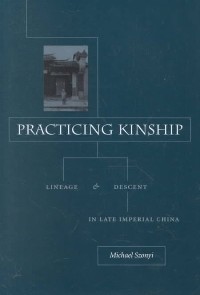
Presenting a new approach to the history of Chinese kinship, this book attempts to bridge the gap between anthropological and historical scholarship on the Chinese lineage by considering its development in terms of individual and collective strategies. Based on a wide range of newly available sources such as lineage genealogies and stone inscriptions, as well as oral history and extensive observation of contemporary ritual practice in the field, this work explores the historical development of kinship in villages of the Fuzhou region of southeastern Fujian province.
In the late imperial period (1368-1911), the people of Fuzhou compiled lengthy genealogies, constructed splendid ancestral halls, and performed elaborate collective rituals of ancestral sacrifice, testimony to the importance they attached to organized patrilineal kinship. In their writings on the lineage, members of late imperial elites presented such local behavior as the straightforward expression of universal and eternal principles. In this book, the author shows that kinship in the Fuzhou region was a form of strategic practice that was always flexible and negotiable. In using the concepts and institutions of kinship, individuals and groups redefined them to serve their own purposes, which included dealing with ethnic differentiation, competing for power and status, and formulating effective responses to state policies. Official efforts to promote a neo-Confucian agenda, to register land and population, and to control popular religion drove people to organize themselves on kinship principles and to institutionalize their kinship relationships. Local efforts to turn compliance with official policies, or at least claims of compliance, to local advantage meant that policymakers were continually frustrated.
Because kinship was constituted in a complex of representations, it was never stable or fixed, but fluid and multiple. In offering this new perspective on this history of Chinese lineage practices, the author also provides new insights into the nature of cultural integration and state control in traditional Chinese society.
Publisher Summary 3
Presenting a new approach to the history of Chinese kinship, this book attempts to bridge the gap between anthropological and historical scholarship on the Chinese lineage. It explores the historical development of kinship in the villages of the Fuzhou region of southeastern Fujian province.
目录
List of Illustrations p. xi
Kinship Ideas and Institutions in Fuzhou History p. 1
Genealogical Tracing and Ethnic Labeling p. 26
Organizing Kin: The Lijia and the Lineage p. 56
The Ancestral Hall p. 90
Rituals of the Ancestral Hall: New Year's Day and the Lantern Festival p. 138
The Local Cult: Lijia, Lineage, and Temple p. 169
Conclusion: Flexible Strategies of Kinship Practice p. 197
Religious Inscriptions from the Fuzhou Region p. 209
Character List p. 217
Notes p. 225
Bibliography p. 287
Index p. 307
Kinship Ideas and Institutions in Fuzhou History p. 1
Genealogical Tracing and Ethnic Labeling p. 26
Organizing Kin: The Lijia and the Lineage p. 56
The Ancestral Hall p. 90
Rituals of the Ancestral Hall: New Year's Day and the Lantern Festival p. 138
The Local Cult: Lijia, Lineage, and Temple p. 169
Conclusion: Flexible Strategies of Kinship Practice p. 197
Religious Inscriptions from the Fuzhou Region p. 209
Character List p. 217
Notes p. 225
Bibliography p. 287
Index p. 307
- 名称
- 类型
- 大小
光盘服务联系方式: 020-38250260 客服QQ:4006604884
云图客服:
用户发送的提问,这种方式就需要有位在线客服来回答用户的问题,这种 就属于对话式的,问题是这种提问是否需要用户登录才能提问
Video Player
×
Audio Player
×
pdf Player
×
